WALK TO BE THE KNOWER | LLM OCR 中英对照版
Page 1
WALK TO BE THE KNOWER
走向觉知者之道
Life of the Buddha
佛陀的一生
What did the Buddha teach
佛陀教导了什么
Hand book of Vipassana Meditation
内观禅修手册
At Wat Tam Wua Forest Monastery
于坦武阿森林寺(Wat Tam Wua)
Page 2
WALK TO BE THE KNOWER
行走,成为觉知者
LIFE OF THE BUDDHA
佛陀的一生
What did the Buddha teach .
佛陀教导了什么?
Hand book of Vipassana Meditation.
内观禅修手册。
At Wat Tam Wua Forest Monastery.
于谭哇森林寺(Wat Tam Wua)。
Page 3
Contents
目录
forward
前言
PART 1. Life of the Buddha 1
第一部分:佛陀的一生 1
1.1) His Promise to Take Birth in the Human Realm 1
1.1)誓愿投生人间 1
1.2.) Queen Maya's Dream 2
1.2)摩耶夫人(Māyā)的梦 2
1.3) Birth of the Buddha 4
1.3)佛陀诞生 4
1.4) A Youth Dedicated to the Mastery of Learning and Athletics 7
1.4)致力精通学业与武艺的青年时期 7
1.5) The Skillful Conduct of Worldly Affairs 8
1.5)善巧处理世间事务 8
1.6) The Renunciation of Worldly Life 9
1.6)出离世俗生活 9
1.7) The Four Encounters 10
1.7)四门游观 10
1.8) The Six Years of Austerities 13
1.8)六年苦行 13
1.9) The Defeat of Mara 17
1.9)降伏魔罗(Māra) 17
1.10) The Enlightenment of the World 18
1.10)觉悟照耀世间 18
1.11) The descent from Trayatrimsa Heaven 21
1.11)从忉利天(三十三天,Trāyastriṃśa)下降 21
1.12) The Passage into Parinirvana 22
1.12)入般涅槃 22
Page 4
PART 2: What did the Buddha teach. 2.1) The Triple Gems 26 2.2) The four noble truths 29 2.3) Noble Eight fold Paths 31 2.4) Three areas of training 34 2.4.1 ) Training in Morality 36 2.4.2 ) Training in Mentality ( concentration) 37 2.4.3 )Training in Wisdom 39 2.5) Maha Satipa ṭhāna Sutta 49 2.5.1) Mindfulness of the body ( Kāyānupassanā) 59 2.5.2) Mindfulness of feelings ( Vedanānupassanā ) 59 2.5.3 ) Mindfulness of the Mind ( Cittānupassanā ) 62 2.5.4 ) Mindfulness of theMental-Quality ( Dhammānupassanā ) 63
第二部分:佛陀教导了什么 2.1)三宝 29 2.2)四圣谛 31 2.3)八正道 34 2.4)三学 36 2.4.1)戒学 37 2.4.2)定学(禅定/专注) 39 2.4.3)慧学 49 2.5)《大念处经》 59 2.5.1)身随观 59 2.5.2)受随观 62 2.5.3)心随观 63 2.5.4)法随观 64
PART THREE : practice meditation 3.1) Tools for Practicing Dhamma 64 3.2) Samatha and Vipassana Meditation 66
第三部分:禅修实践 3.1)修习正法(Dhamma)的工具 64 3.2)止禅与观禅(Samatha 与 Vipassanā) 66
Page 5
3.2.1) The differentiation between Samatha and Vipassana 69
3.2.1)奢摩他与内观的分别 69
3.3 ) Foundation of Mindfulness 72
3.3)正念的基础 72
3.4) The purpose of Samatha and Vipassana 76
3.4)奢摩他与内观的目的 76
3.5) Two kinds of Samadhi 78
3.5)两种三摩地 78
3.6) Practicing Mindfulness in Daily life 84
3.6)在日常生活中修习正念 84
3.7) Feel your entire body 90
3.7)觉知全身 90
3.7.1) How to feel your entire body 91
3.7.1)如何觉知全身 91
3.7.2. Feel your body through holistic observation 92
3.7.2.通过整体观照来觉知身体 92
3.8) Walking Meditation: the best mindfulness practice 93
3.8)行禅:最佳的正念修习 93
3.9 ) How to awareness of the mind 100
3.9)如何觉知心 100
3.10 ) Process of Practicing Vipassana 105
3.10)内观修习流程 105
3.10.1 ) STEP 1 ) Practice Samatha Concentration 106
3.10.1)步骤 1)修习奢摩他(Samatha)定力 106
3.10.2 ) STEP 2 ) Practice Vipassana "The knower" 109
3.10.2)STEP 2)修习内观“知者” 109
3.10.3 ) STEP 3 ) Practice " Stable mind " 114
3.10.3)STEP 3)修习“安住心” 114
3.10.4 ) STEP 4 ) Practice separation of matter and mind 123
3.10.4)步骤 4)修习色(rūpa)与心(nāma)的分离 123
3.10.5 ) STEP 5 ) See the three characteristics of the Khandha 124
3.10.5)STEP 5)观见五蕴的三相 124
3.11 ) Disenchantment and discernment of the truth of unsubstantial nature the truth of unsubstantial nature 128
3.11)对无实体本性之真理生起厌离与辨知 无实体本性之真理 128
3.12 ) Neutrality to conditioned states 129
3.12)对有为法保持中舍 129
Page 6
3.13 ) Mindfulness of mind may alternate between concentration and insight meditation 129
3.13)心念正念可能在止禅(专注禅修)与观禅(内观禅修)之间交替进行 129
3.14 ) To advance from common objects of consciousness to refined state of void 133
3.14)从一般的心识所缘推进至更为微细的空境界 133
3.15 ) To let go of the void mind and reach the ultimate reality 135
3.15)舍离住于空的心,而证达究竟实相 135
3.16 ) To attain the first stage of Enlightenment, the Stream-Entry 136
3.16)证得觉悟的第一阶段——入流(Stream-Entry,预流) 136
3.17 ) Attainment of the Eye of Truth 139
3.17)证得法眼 139
3.18 ) Realization of Nibbāna 140
3.18)证得涅槃 140
3.19 ) Successive Steps of Vipassana Knowledge 143
3.19)内观智(毗婆舍那智,Vipassanā Ñāṇa)的次第步骤 143
3.20) Conclusion for practicing Vipassana Meditation 146
3.20)修习内观禅修的结语 146
3.21 ) Glossary 149
3.21)术语表 149
PART FOUR : ABOUT WAT PA TAM WUA FOREST MONASTERY 151
第四部分:关于瓦帕谭瓦(Wat Pa Tam Wua)森林寺院 151
REFERENCE WORKS IN THAI 158
泰文参考文献 158
REFERENCE WORKS IN ENGLISH 158
英文参考文献 158
------------------------------
------------------------------
Page 7
Forward
前言
The term " the knower" is the very common in the Thai forest monks tradition as well as the term " Bud-dho " which means " The knower, the awakening and the blossom one." And it's the result from the second type of Samadhi ( Characteristic-examination) which is stable and essential for seeing the truth ,or seeing the three characteristic of the existence of the body and mind.
“the knower(知者)”这一术语在泰国森林僧传统中极为常见;同样常见的还有“Bud-dho(佛陀)”,意为“知者、觉醒者与绽放者”。而这源自第二类三摩地(samādhi,特相/特征观照:Characteristic-examination)的成果;此类三摩地稳固且至关重要,能用来见到真理,或如实观见身心存在的三相(three characteristics)。
" Walk to be the knower" is the way to practice meditation with the right concentration to wake our mind up out of the world of thought and fabrication.
“Walk to be the knower(行走成为知者)”是一种禅修方法:以正确的定力(concentration)使我们的心从思维与造作的世界中醒觉出来。
This book is based on the teaching of Luang pu Dulya Atulo which was a famous disciple of Luang pu Mun Purihatto . His Teaching was emphasized in awareness the mind. Every things happen in the mind first and then turn to actions.
本书依据龙普(Luang pu)Dulya Atulo 的教导编写;他是龙普(Luang pu)Mun Purihatto 的著名弟子。其教法着重于对心的觉知:一切首先在心中发生,随后才转为行为。
"The knower" is the quality of our mind that separate the mind from all of defilements, and finally it will free itself from the five khandhas or matter and mind. After we return everything to the nature ,we will receive the greatest gift available to any being. Nirvana is complete liberation, weightless, and released
“The knower(知者)”是我们心的一种品质:它使心与一切烦恼(defilements)分离,最终令其从五蕴(khandhas)——亦即色与名(matter and mind)——中解脱。当我们将一切归还于自然之时,便会获得任何众生所能得到的最殊胜礼物。涅槃(Nirvana)是圆满的解脱:无重(weightless)、彻底释然(released)。
Page 8
from any desire, with no more attachment, no more struggle, and never again delude. The mind is untouchable: nothing can ever come in, take over the mind and make it suffer ever again.
远离一切欲望,不再执取,不再挣扎,亦不复受迷惑。此心不可触及:再没有任何事物能够侵入、控制此心,使其再次受苦。
Many foreigners came to Wat Pa Tam Wua to practice meditation and don't know the second kind of Samadhi( the knower). And some are know nothing about Buddhism ,either. So this book is appropriate to both the new beginning and anyone who practicing in the advance level.
许多外国人来到 Wat Pa Tam Wua 修习禅修,却不了解第二种三摩地(Samadhi,“知者” the knower)。也有一些人对佛教同样一无所知。因此,本书既适合初学者,也适合修行已臻较高阶段的人阅读。
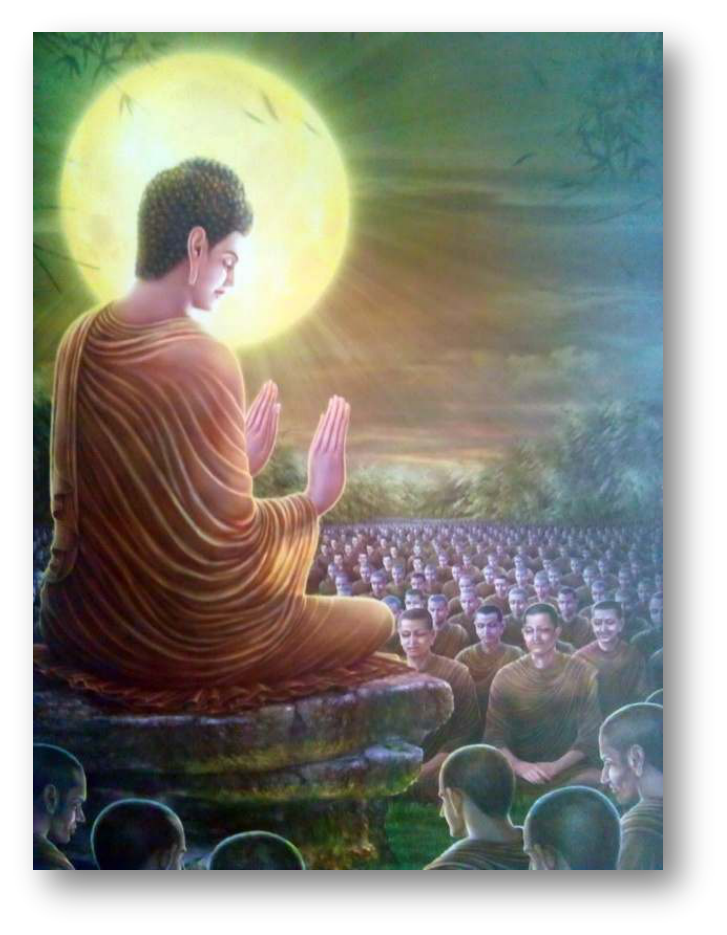
This book have four parts, the first part is about the life of the Buddha which all of the pictures are from the paintings from Ajahn Krissana Suriyakarn in the book "Prathom Somphotikhata", the second parts is about the Dhamma and the third part is about the practice Vipassana meditation and the last is about Wat Tam Wua Forest monastery. The purpose of this book is only be the guide line for the foreigners to gain more understanding about the practicing Vipassana Meditation and the Buddhism.
本书分为四部分:第一部分讲述佛陀的一生,书中所有插图均取自阿姜·克里萨纳·苏里亚坎(Ajahn Krissana Suriyakarn)在《巴通·颂波提卡塔》(Prathom Somphotikhata)一书中的绘画作品;第二部分阐述法(Dhamma);第三部分介绍内观禅修(Vipassanā)的修习;最后一部分介绍谭武阿(Wat Tam Wua)森林寺。本书的目的仅在于作为指南,帮助外国读者更深入理解内观禅修的实践与佛教。
Phra Anek Thanissarapoti
Phra Anek Thanissarapoti
Page 9
Page 10
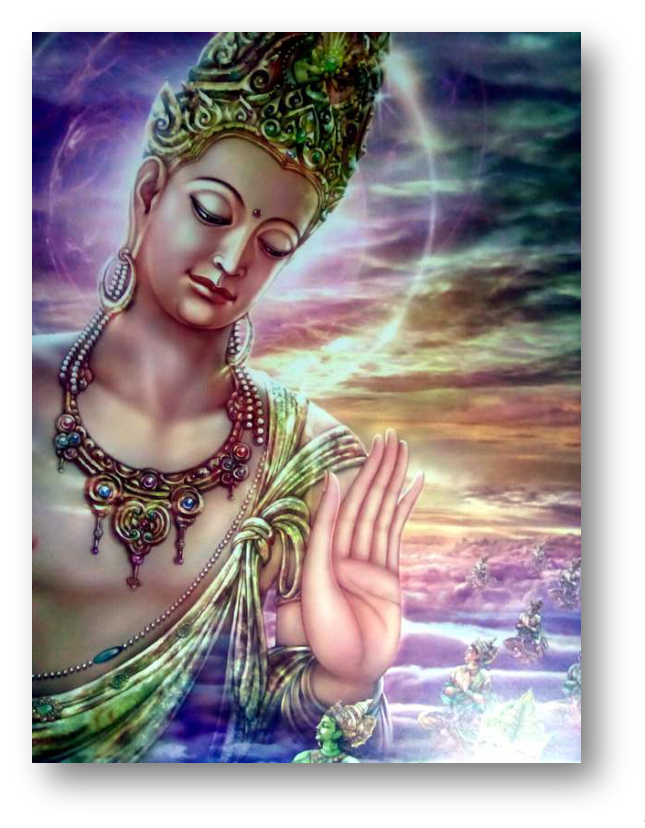
PART 1): Life of the Buddha
第一部分:佛陀生平
Gautama Buddha , the historical Buddha, lived between 563 and 483 BC in the area known as the Indo - Nepalese region. As a bodhisatta, he had passed through thousands of existences before coming to the earth for the ultimate transmigration.
乔达摩佛陀(Gautama Buddha),即历史上的佛陀,生活于公元前563年至公元前483年间,活动于所谓的印—尼泊尔地区。作为菩萨(bodhisatta),在为完成最后一次轮回投生而来到人间之前,他已历经数千世的生命存在。
1.1) His Promise to Take Birth in the Human Realm
1.1)许下投生人界之愿
Before the Buddha was born into this world as Shakyamuni, he was a bodhisattva in the Tushita heaven (home of the contented gods). His name there was Shvetaketu ("White Banner"). From here he witnessed the dark ages engulfing the human realm, leading to its spiritual impoverishment. Moved to
在佛陀以释迦牟尼(Shakyamuni)之身降生此世之前,他曾住于兜率天(Tushita heaven,知足天众之所)的菩萨(bodhisattva)。他在彼处名为 Shvetaketu(“White Banner”,意为“白幢”)。从兜率天中,他目睹黑暗时代笼罩人界,致使其精神生活日益贫乏。因而深受触动,
Page 11
compassion like a true bodhisattva, he vowed to manifest himself in the sentient world and relieve people from their sufferings.
他怀着如真正菩萨(bodhisattva)般的悲心,发愿示现于有情世间,救拔众生离苦。
Indeed, in strictly canonical terms, a bodhisattva is defined as an individual who discovers the source of the Ultimate Truth better known as Nirvana, but postpones his own enlightenment until he has guided all his fellow beings to this same source of fulfillment. Thus, Buddha, looking down upon the sentient beings suffering in the throes of ignorance, felt a pang of compassion, and in accordance with his bodhisattva status, decided to descend to the earth and spread the word of Dharma. Visually, Buddha is depicted making this vow surrounded by other sacred beings, holding aloft a lotus flower in his right hand, symbolizing the purity of his intention
确实,若严格依经典语境而言,菩萨(bodhisattva)被界定为:已发现“究竟真理”之源——亦即更广为人知的涅槃(Nirvana)——却将自身的圆满觉悟延后,直至引导一切同类有情同归此圆满之源的人。因此,佛陀(Buddha)俯观众生在无明的煎迫中受苦,悲心顿起;并依其菩萨之位,决定降临人间,宣说佛法(Dharma)。在图像表现上,佛陀常被描绘为在诸圣众环绕中发此誓愿,右手高举莲花,以象征其发心之清净。
1.2.) Queen Maya's Dream
1.2.) 摩耶夫人之梦
The Lalitavistara (1st cent. AD) says that Buddha himself selected the time, place, and caste of his birth. He finally short listed King Shuddhodana and his wife, Queen Mayadevi, rulers of the Shakya (Lion) clan, as his future parents. This generous couple was well known throughout the land for their just and noble bearing. Scriptures assert that Buddha chose a king as his father since the royal caste was more respected that the priestly one. It indeed seems strange that
《Lalitavistara》(约公元1世纪)记载,佛陀(Buddha)亲自选择了其诞生的时间、地点与种姓。最终,他选定释迦族(Shakya,Lion)之主净饭王(King Shuddhodana)及其王后摩耶夫人(Queen Mayadevi)为未来双亲。这对仁厚的夫妇以公正与高贵的风范闻名全国。经文断言,佛陀之所以选择国王为父,是因为王族种姓较祭司种姓更受尊崇。这确实令人觉得奇怪:
Page 12
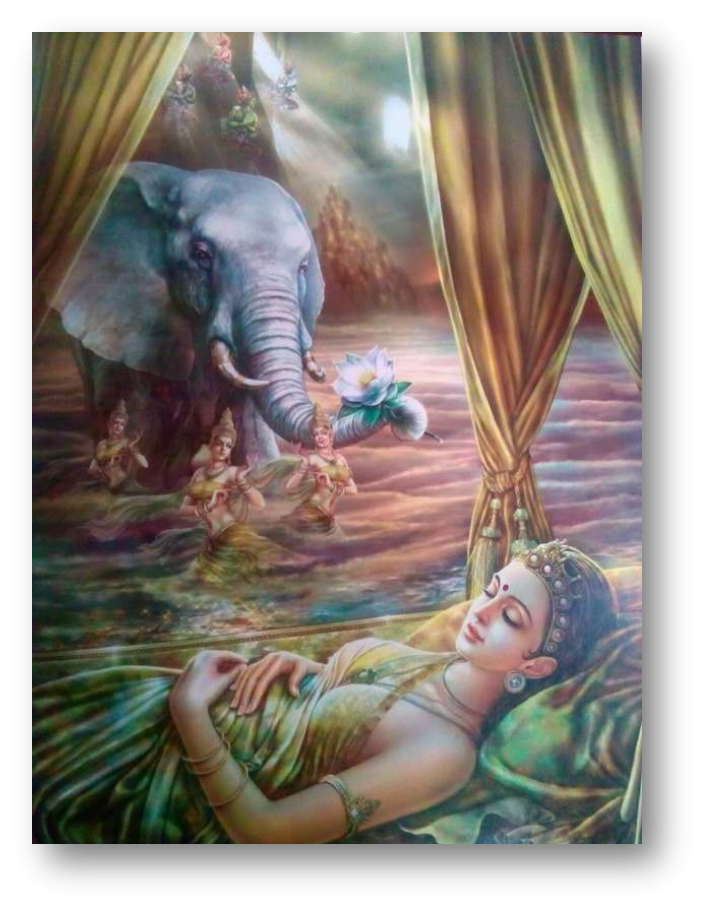
the Buddha, who never believed in the caste system, was so particular in the choice of a Brahmin or Kshatriya family for his own birth. In fact, it was precisely to show the futility of the notion of high-birth as an aid in spiritual salvation that this choice was made.
佛陀从不认同种姓制度,却在自身降生之处,特意示现为出自婆罗门(Brahmin)或刹帝利(Kshatriya)家族。事实上,正是为了彰显将“高贵出身”视为助益灵性解脱之凭借的观念终归徒然,才作此抉择。
The bodhisattva's descent from the Tushita heaven occurred as a dream to Mayadevi. In this dream, a white elephant approached and touched her right side with its trunk. Through this symbolic act, the bodhisattva entered the womb of Mayadevi and impregnated her.
菩萨自兜率天(Tuṣita)下生之事,以梦境示现于摩耶夫人(Māyādevī)。梦中,一头白象趋近,以象鼻触触其右胁。借由此一象征性之相,菩萨入摩耶夫人之胎,使其怀孕。
Page 13
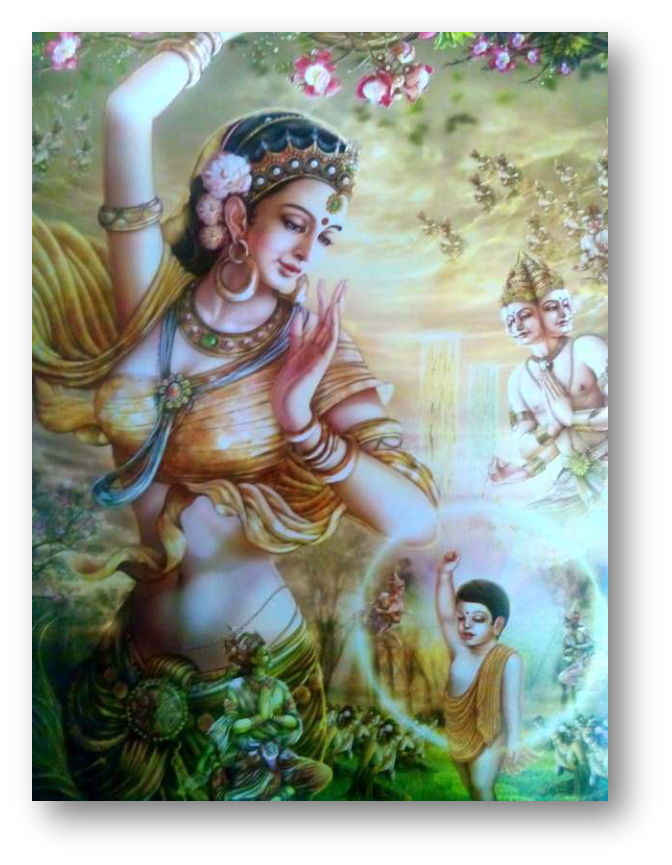
The choice of an elephant as a symbol of her impregnation is a well-thought out metaphor because elephants are known for their strength and intelligence, and also associated with gray-rain clouds and thus with fertility, since rainwater means that seeds will germinate and vegetables will be able to grow. The white color (of the elephant), adds to this an element of purity and immaculacy. The royal fortunetellers explained that the dream announced the queen's pregnancy, and that the newborn would possess exceptional traits.
以大象象征她的受孕,是一则经过深思熟虑的隐喻:大象以力量与智慧著称,也常与灰色的雨云联系在一起,因此被视为与生育相关——雨水降下,种子方能萌发,蔬菜亦得以生长。大象的白色更在此基础上增添了清净与无垢的意涵。王室的占卜师解释说,此梦宣告王后已怀孕,而新生儿将具备卓越非凡的特质。
1.3).Birth of the Buddha
1.3)佛陀诞生
Mayadevi had successfully carried the Buddha-to-Be for ten months without any complications or pain.
摩耶夫人(Māyādevī)怀胎十月,安稳地怀着“未来成佛者”(Buddha-to-Be),期间既无并发症,亦无痛苦。
Near the end of her pregnancy, she took a trip to her parental home to have the baby there with
在临近分娩之际,她启程前往娘家,打算在那里产子,并与
Page 14
her mother, an ancient custom that is still sometimes practiced. On the way however there was a pleasant grove, overflowing with a rich profusion of fruits and flowers. Desiring to rest among them, the queen instructed her party to put camp there. She stepped out of her palanquin and reached to grasp one of the branches of a flowering tree. No sooner had she done so than she felt the throes of giving birth. Standing thus, with her hand to the branch, she delivered, and the Buddha-to-Be emerged from his mother. He immediately walked, spoke, and was received by Brahma.
她(去探望)母亲——这是一项古老习俗,至今仍偶尔实行。途中却有一片令人愉悦的林苑,果实与花朵繁盛丰饶。王后想在林中稍作歇息,便吩咐随行众人于此扎营。她下了肩舆(palanquin),伸手去攀握一株开花树的枝条。她刚一触及,便觉临产阵痛骤起。她就这样站立着,手扶树枝分娩;于是菩萨(Buddha-to-Be,未来佛)从母体中诞生。他随即行走、开口说话,并为梵天(Brahma)所迎受。
Five days after his birth , the young prince received the name "Siddhartha" . When his parents took him to the temple, the statues of the Gods prostrated themselves before him, great were the rejoicings of the people over the birth of this illustrious prince. Also at this time a devout old man name Asita came down from the Himalayas to meet the new born prince. An ascetic of high spiritual attainments, Asita was particularly pleased to hear this happy news. Having been a tutor to the king, he visited the palace to see the royal baby. The King,who felt honored by his un expected visit, carried the child up to him in order to make the child pay him due reverence. To the surprise of all, the child's legs turned and rested on the matted locks of the ascetic.
他出生五天后,年轻的王子被取名为“悉达多”(Siddhartha)。父母带他前往寺庙时,诸神的塑像竟在他面前俯伏顶礼;民众为这位杰出王子的诞生而欢庆不已。亦在此时,一位虔诚的长者阿私陀(Asita)自喜马拉雅山下来,前来拜见新生王子。阿私陀为具高深精神成就的苦行者(ascetic),闻此喜讯尤为欣悦。因曾为国王之师,他遂入宫探望王室婴儿。国王以其意外来访为荣,抱起婴儿,欲令其向阿私陀致以应有的礼敬。出人意料的是,婴儿双腿忽然一转,竟安放在苦行者纠结成毡的发髻(matted locks)之上。
Page 15
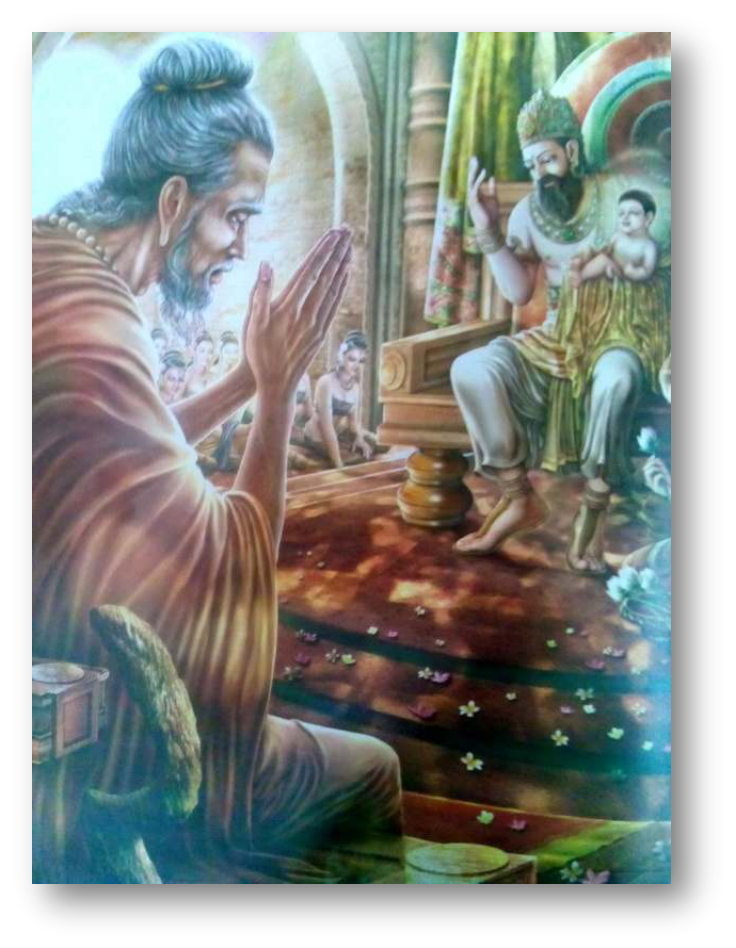
Instantly , the ascetic rose from the seat and recognizing in the young child the 80 signs that are pledges to a highly religious vocation, and foreseeing with his supernormal vision the child's future greatness, saluted him with clasped hands. The Royal father did likewise.
霎时,苦行者从座位起身,在那幼童身上认出象征将投身高度宗教使命的八十种相(80 signs);又以其超常的神通(supernormal vision)预见孩子未来的伟大,便合掌致敬。王父亦如是行礼。
The great ascetic smiled at first and then was sad. Questioned regarding his mingled feelings, he answered that he smiled because the prince would eventually become a Buddha , an Enlightened One, and he was sad because he would not be able to benefit from the superior wisdom of the Enlightened One owing to his prior death and rebirth in a Formless plane.
这位大苦行者起初含笑,继而转为悲伤。有人问及他这喜悲交集的缘由,他答道:之所以微笑,是因为王子终将成佛(Buddha),成为觉者(Enlightened One);之所以悲伤,则是因为自己将先行命终,并再生于无色界(Formless plane),因此无法受益于觉者的殊胜智慧。
Page 16
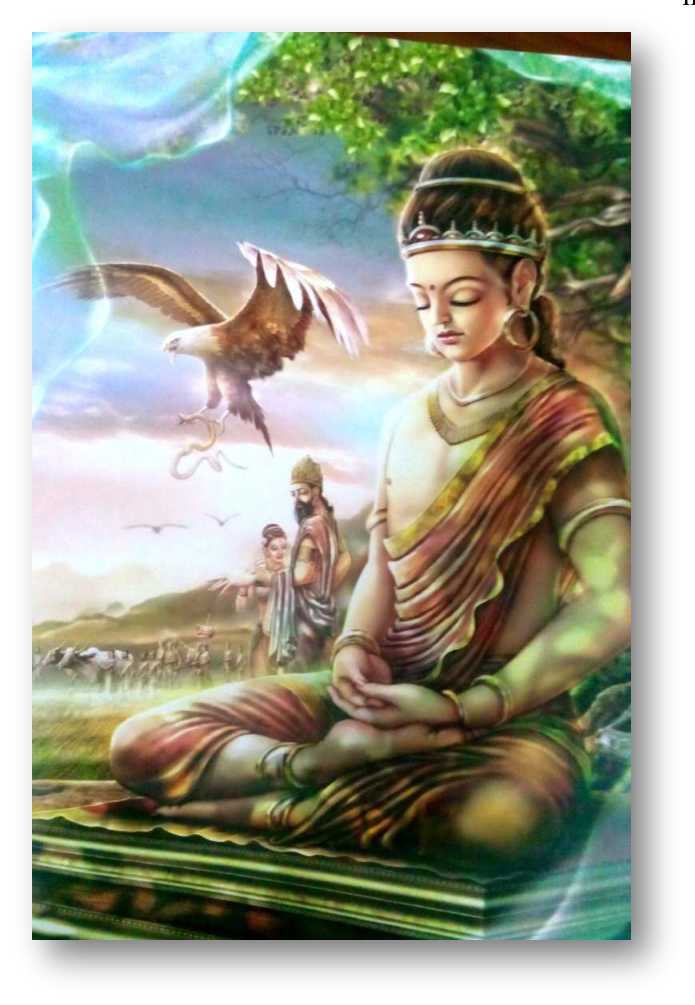
1.4) A Youth Dedicated to the Mastery of Learning and Athletics
1.4)致力于精通学业与体育的青年
Seven days after giving birth Mayadevi died, and her sister Mahaprajapati raised the prince. When the young prince was in his twelfth year, the king called the wise Brahmans in council. They revealed that Siddhartha devote himself to asceticism if he cast his eyes on aged, sickness , or death -and, if he were to meet a hermit.
摩耶夫人(Māyādevī)在分娩后第七天便去世,其妹摩诃波阇波提(Mahāpajāpatī)抚养了王子。王子十二岁那年,国王召集睿智的婆罗门(Brahmin)共议。他们说:若悉达多(Siddhartha)目睹衰老、疾病或死亡——并且若他遇见一位隐士(hermit)——他将会献身于苦行(asceticism)。
As the son of the king, Siddhartha was provided with the finest upbringing. His life had ample quantities of both opportunity and security. He received the finest education
作为国王之子,悉达多(Siddhartha)自幼享有最优渥的教养。他的生活兼具充足的机遇与安稳。他接受了最好的教育。
Page 17
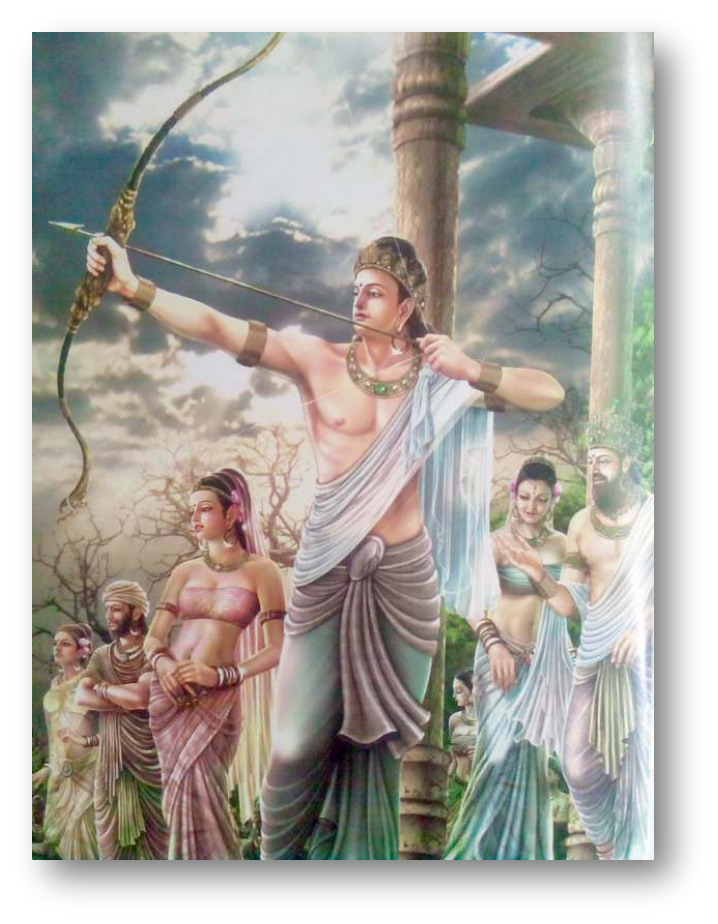
and mastered all lessons taught to him. In his younger years, he excelled in sports and other contests of skill. The vigorous training befitted the grooming of a future monarch. He was said to particularly excel on the horse and with the bow.
并且精通所受的一切教导。在他年少时,他在体育运动以及各类技艺竞赛中都表现出众。这种严格而有力的训练,正适合用来栽培一位未来的君主。据说他尤以骑术与弓箭之技最为擅长。
1.5) The Skillful Conduct of Worldly Affairs
1.5)世间事务的善巧行持
When he came of age and assumed royal duties, prince Siddhartha became a true man of the world and had a retinue of many queens and attendant ladies.. And then the King made a ceremony for wedding, The most beautiful princess in the land, Yasodhara , was found for his bride, and after Siddhartha proved
当他成年并承担王室职责时,悉达多王子成为一位深谙世务之人,身边随侍着许多王妃与侍女……随后,国王为婚礼举行仪式;在这片国土上最美丽的公主耶输陀罗(Yasodhara)被选为他的妻子,而在悉达多证明……之后
Page 18
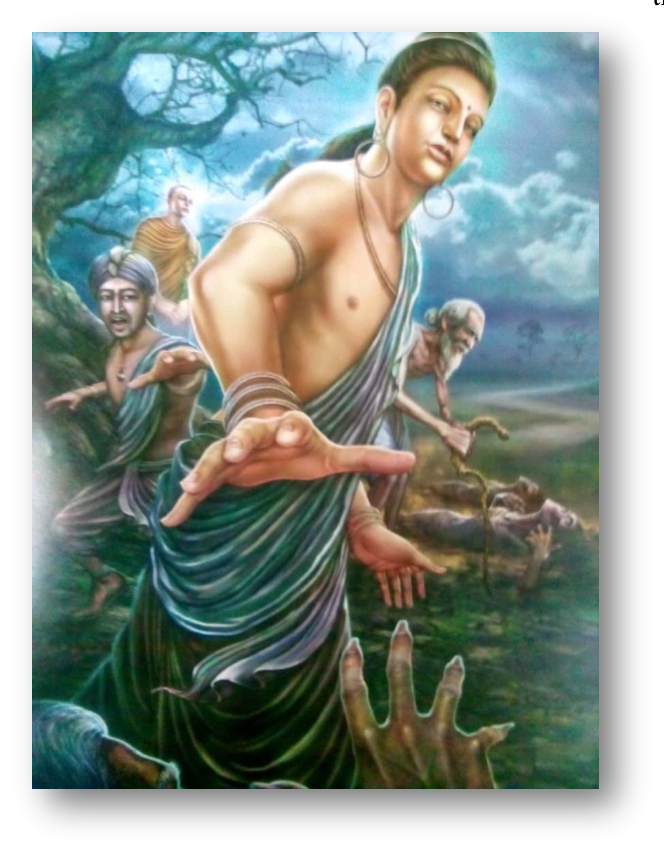
himself in many tournaments calling for strength and powers, when he was 16, the two were wed.
他曾参加许多考验力量与武艺的比武竞赛;在他16岁时,两人便成婚。
1.6) The Renunciation of Worldly Life
1.6)出离世俗生活
Grief-stricken at the idea of losing his son, the King doubled the guard around the walls and increased the pleasures and distractions within. And at this point, Yasodhara born him a son whom he called Rahula ( meaning " chain"), a name that indicated Gautama's sense of dissatisfaction with his life of luxury, while the birth of his son evoked in him much tenderness. His apparent sense of dissatisfaction turned to disillusion when he saw three things, an old man, a diseased man.
国王一想到可能失去儿子便悲痛不已,于是加倍城墙周围的守卫,并在宫中增添更多享乐与消遣。就在此时,耶输陀罗为他生下一子,他为其取名罗睺罗(Rahula / Rāhula,意为“锁链”(chain))。此名暗示乔达摩对奢华生活怀有不满足之感;然而,儿子的诞生又在他心中激起了深切的柔情。他那看似的不满足,在见到三件事时转为幻灭:一位老人、一位病人。
Page 19
1.7) The Four Encounters
1.7)四相(四次遭遇)
Having been warned by the court astrologers that his son may well give it all up and choose the path of meditation, Buddha's father tried his best to shield him from the harsh realities of life. This state of affairs continued until one day, by chance, while riding his chariot, Siddhartha encountered an old man walking along the road. Intrigued by his first encounter with old age, the prince addressed his charioteer: "Who is this man there with the white hair, feeble hand gripping a staff, eyes lost beneath his brows, limbs bent and hanging loose? Has something happened to alter him, or is that his natural state?"
宫廷占星师曾警告:其子很可能会舍弃一切,转而选择禅修之道;因此,佛陀之父竭力将他与人生的严酷现实隔绝开来。如此情形延续至某日,机缘巧合之下,悉达多(Siddhartha)乘车出行时,遇见一位沿路行走的老人。王子初见衰老之相,心生惊异,便问车夫:“那边那人是谁?白发苍然,手弱无力却扶杖而行,双目隐没于眉下,四肢屈曲,松垂不振。是遭逢了什么变故才成如此,还是这便是他的本然状态?”
"That is old age," said the charioteer, "the ravisher of beauty, the ruin of vigor, the cause of sorrow, destroyer of delights, the bane of memories and the enemy of the senses. In his childhood, that one too drank milk and learned to creep along the floor, came step by step to vigorous youth, and he has now, step by step, in the same way, gone on to old age."
车夫答道:“这便是老年——夺去美貌者,摧毁精力者,引生忧悲者,破坏欢乐者,损害记忆者,亦是诸根(感官)之敌。此人幼时也曾饮乳,学着在地上爬行;一步一步成长至强盛的青年,而今也同样一步一步,循此过程走到了老年。”
The charioteer thus revealed in his simplicity what was to have been hidden from the king's son, who exclaimed, "What! And will this evil come to me too?"
车夫以朴实之语,道出了原本要对王子隐瞒的事实;王子惊呼:“什么!这等苦厄也会临到我身上吗?”
"Without doubt, by the force of time," said the charioteer.
车夫答道:“毫无疑问。以时间之力(时力)所必至。”
Page 20
11
11
And thus the great soul one, whose mind was but a store of merits, was agitated when he heard of old age - like a bull who has heard close by the crash of a thunderbolt. He further encountered in such manner a sick man and a dead man, leading to great turbulence in his mind.
于是,那位大士——其心如功德宝藏——一听到“老”的消息,便深受震动,犹如公牛近旁听到霹雳轰然巨响一般。他又以同样的方式见到病者与死者,使其内心掀起强烈的波澜与动荡。
One day he came across an ascetic mendicant. "Who art thou?" he asked. To which the other answered, "Terrified by birth and death, desiring liberation, I became an ascetic. As a beggar, wandering without family and without hope, accepting any fare, I live now for nothing but the highest good." Convinced that herein lay the way to quell his mental agitation, Gautama resolved to follow this holy man's example.
一日,他遇到一位出家行脚的乞士(mendicant)。“你是谁?”他问。对方答道:“我畏惧生死,希求解脱,故而出家修行。作为乞者,我无家无望,云游无定,随缘受食;如今我活着,只为追求至上的善(the highest good)。”确信其中正是止息内心骚动之道,乔达摩(Gautama)遂决意仿效这位圣者。
Page 21
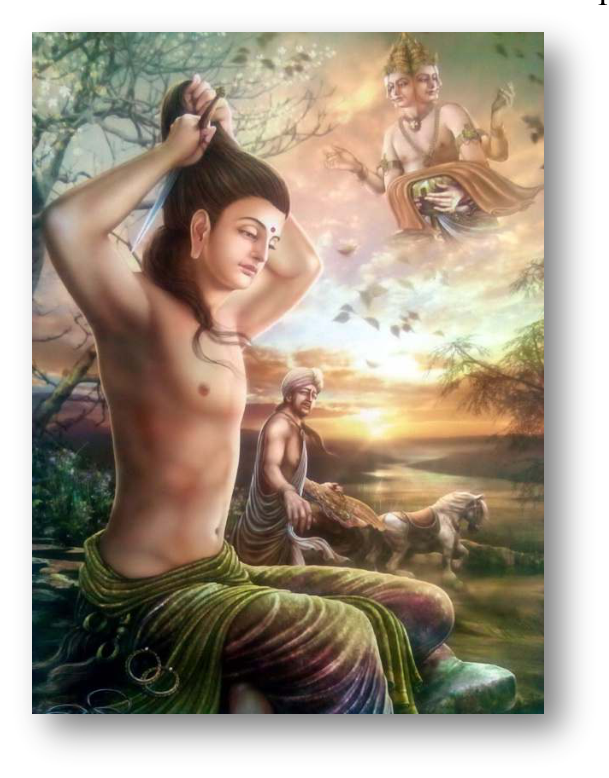
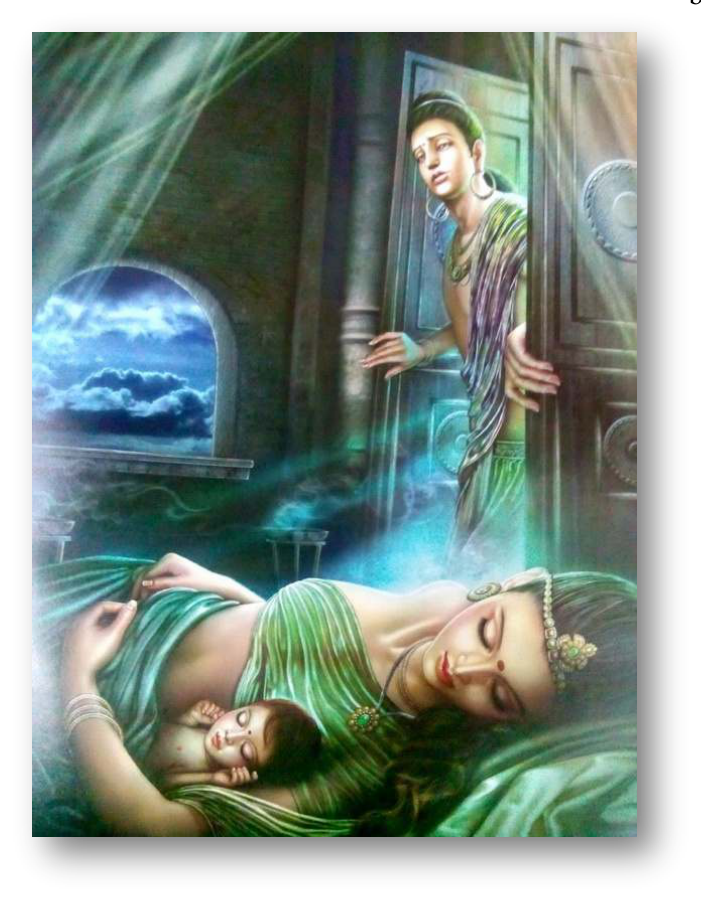
Gautama left the luxurious palace of his father in the middle of the night, leaving behind his sleeping wife and son. The first thing Gautama Buddha did after leaving his father's palace was to severe his long and beautiful hair with his princely blade. He thought, "These locks of mine are not suited to a monk; but there is no one to cut the hair of a future Buddha. Therefore I will cut them off myself with my sword." And grasping a scimitar with his right hand, he seized his top-knot with his left hand, and cut it off, together with his jeweled turban.
乔达摩(Gautama)在半夜离开了父亲奢华的王宫,把熟睡的妻子与儿子留在身后。离开父王宫殿后,乔达摩佛陀所做的第一件事,便是以王者所用之刃割断自己那一头修长而秀美的头发。他心想:“这些发绺不适合沙门;然而未来佛无人为其剪发,因此我要亲自以剑断之。”于是他右手执弯刀,左手握住顶髻,一并将其连同镶宝的头巾割下。
His hair thus became two finger- breadths in length, and curling to the right, lay close to his head. Taking hold of his top- knot and diadem, he threw them into the air, saying: "If I am to become a Buddha, let them stay in the sky; but if not, let them fall to the ground."
于是他的头发便成了两指宽的长度,向右卷曲,贴伏于头顶。他拿起自己的顶髻与冠冕,将它们抛向空中,说道:“若我当成佛,就让它们停留在空中;若不然,就让它们坠落于地。”
They rose into the air for a distance of one league before
它们腾空而起,上升至一由旬(yojana)的距离后才……
Page 22
Vasava (corresponding to the Indra), the chief of gods, perceiving them with his divine eyes, received them in an appropriate jeweled casket, and established them in heaven. "His hair he cut, so sweet with many pleasant scents, This Chief of men, and high impelled it towards the sky; And there god Vasava, the god with a thousand eyes, In golden casket caught it, bowing low his head."
天神之王瓦萨瓦(Vasava,对应因陀罗 Indra)以天眼见此,便以相称的宝匣恭敬承受,并安置于天界。“这位人中之雄自剪其发,芬馥甜美,具诸妙香;随即高掷向空。彼处千眼天神瓦萨瓦,以金匣承接,俯首致敬。”
1.8) The Six Years of Austerities
1.8)六年苦行
For many years, Gautama studied the doctrines until, having felt the need to learn more elsewhere , he traveled and fasted. His two teachers had showed him how to reach very deep states of meditation
多年间,乔达摩研习诸法教义;后来他觉察仍需往他处进一步参学,遂出行游方,并行持断食(fasting)。他的两位导师曾教导他,如何证入极为深深的禅定境界。
Page 23
( samadhi ) . This did not, however, lead to a sense of true knowledge or peace, and the practice of deep meditation was abandoned in favor of a life of extreme asceticism which he shared with five companions. But again, after five or six years of self-mortification,
(三摩地,samādhi)。然而,这并未带来真正的智慧或内心的安宁,于是他放弃了深度禅修,转而过一种极端苦行的生活,并与五位同伴共同修持。但即便如此,在经历了五六年的自我折磨之后,
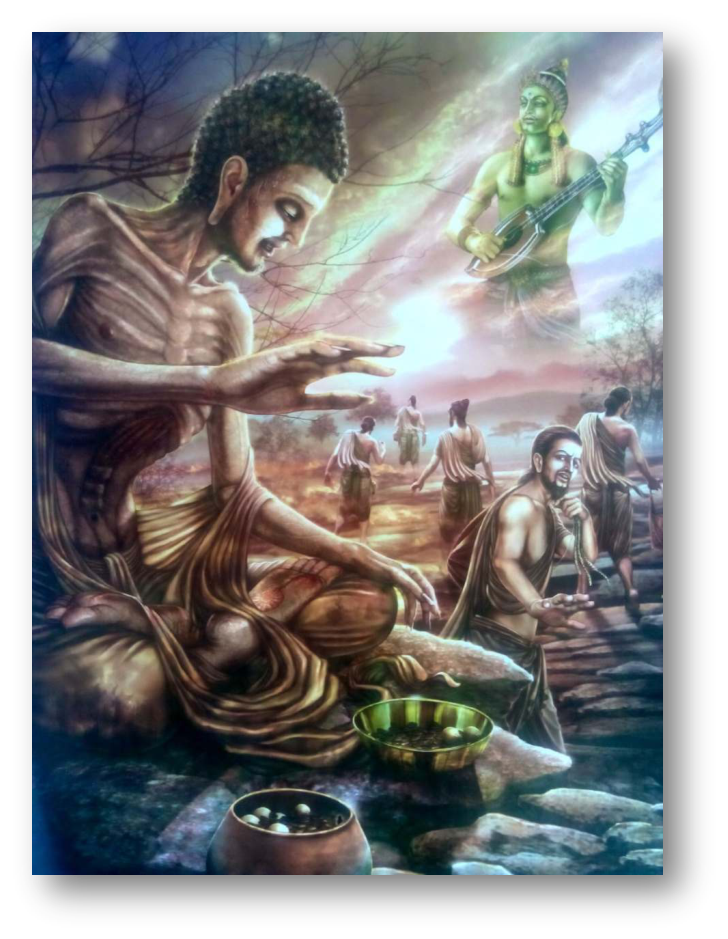
Wandering in his search for enlightenment, Buddha came to a pleasant hermitage by a lovely stream, where, for six years, he joined five mendicants in a way of discipline based on progressively severe fasting. He ate a single grain of rice for each of the first two years, drank a single drop of water for each of the second two years, and took nothing at all during the last two. Consequently, his bones stuck out like a row of spindles, and when he touched his stomach, he could almost feel his spine. His hair fell out and his skin became withered. His body had become terribly wasted - it was little more than loose flesh hanging on protruding bones. He had not cut his hair or beard in six months, and when he rubbed his head, handful of hair fell out .
在寻求觉悟的漂泊旅途中,佛陀来到一处宜人的隐修处,旁有一条秀丽的溪流。在那里,他与五位行乞者(mendicants)共同修行长达六年,奉行一种以逐步加重禁食为核心的严厉苦修。起初两年,他每天只食一粒米;接下来的两年,他每天仅饮一滴水;最后两年则完全不摄取任何食物。于是,他的骨骼如一排纺锤般凸出;当他触摸腹部时,几乎能感觉到自己的脊柱。他的头发脱落,皮肤枯槁。身体极度消瘦——几乎只剩松弛的皮肉挂在突出的骨架上。六个月里他不曾修剪头发或胡须,而当他揉搓头皮时,便一把一把地掉落头发。
But all this was in vain. However severe his austerities, perhaps even because of them, the body still clamored for attention, and he was still plagued by material craving. In fact, he seemed more conscious of himself than ever. Buddha had to face the fact that asceticism had failed to redeem him. All he had achieved after
但这一切终归徒然。无论苦行多么严酷——甚至或许正因为如此——身体仍不断呼求照料,他依旧为对物质的贪求所困扰。事实上,他似乎比以往任何时候都更强烈地觉察到“自我”。佛陀不得不正视一个事实:苦行并未使他获得救度与解脱。他在……之后所取得的一切
Page 24
this heroic assault upon his body was a prominent rib cage, and a dangerously weakened physique. Siddharta felt he had failed to achieve true insight and rejected such practices as dangerous and useless.
这种对身体的“英雄式折磨”使他的肋骨格外凸出,身躯也虚弱到危险的程度。悉达多(Siddharta)认为自己并未获得真正的洞见,遂将此类修行视为既危险又无益而加以摒弃。
Discovering that excessive fasts destroy strength, he learned that as he had transcended earthly life, so must he next transcend asceticism. Alone and weak, he sat beneath the sacred Bodhi tree of wisdom, and swore to die before arising without the wisdom he sought.
他发现过度禁食会摧毁体力,于是明白:既然自己已超越世俗生活,下一步也必须超越苦行(asceticism)。他孤身而虚弱,坐在神圣的菩提树(Bodhi tree)下,誓言若未证得所求的智慧,宁可死去也绝不起身。
Finally, it dawned upon him that physical austerity is one of the two extremes, and that the 'Middle Way' between these two extremes is the path to enlightenment.' He thus slowly rose, and went to bathe in the stream.
最终,他恍然领悟到:身体上的苦行(physical austerity)是两种极端之一,而介于两种极端之间的“中道”(Middle Way)才是通向觉悟的道路。于是他缓缓起身,前往溪流中沐浴。
Page 25
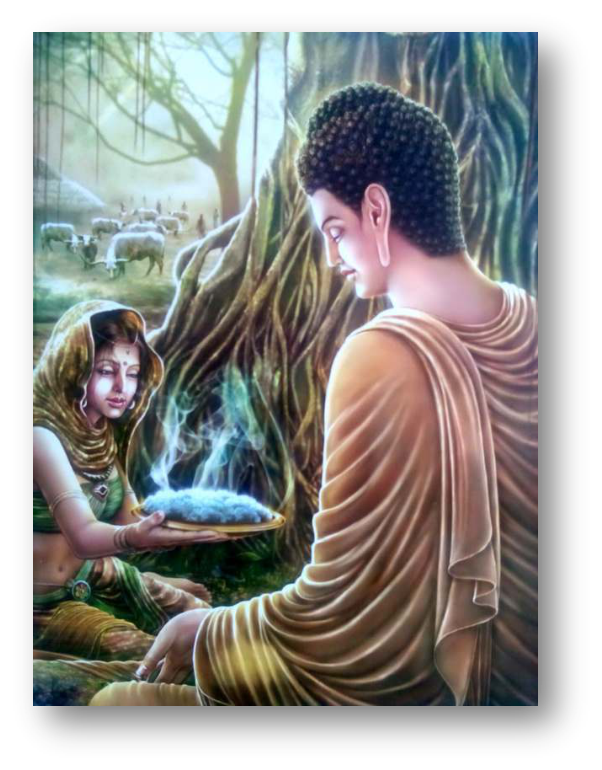
He crossed over to the far bank where he met a village girl named Sujata who offered him a bowl of rice pudding (kheer). It was the first food he had accepted in years and it instantly restored his body to lustrous good health.
他渡至对岸,在那里遇见一位名叫苏迦达(Sujata)的村女,她供养他一碗米乳(kheer,甜米粥/米布丁)。这是他多年中第一次接受食物,立刻令他的身体恢复为光泽润泽、健康充沛的状态。
Resolved to continued his quest, Siddhartha made his way to a deer park at Isipatana, near present day Benares. Here he sat beneath a tree meditation on death and rebirth. Thus nourished, and accompanied solely by his own resolve, Siddhartha strode majestically towards the bodhi tree, to make his last bid for liberation. Abandoning himself to meditation, he vowed not to move from that spot until he had attained full enlightenment. He return to himself to learn from his success and failures. He did not hesitate to let meditation nourish his mind and body, and the sense of peace and ease grew within him.He did not distance himself or try to escape his feelings and perceptions, but maintain mindfulness in order to observe them as they arose. He abandoned the desire to escape the world of phenomena .
决意继续他的求道之旅,悉达多(Siddhartha)前往今贝拿勒斯(Benares,今瓦拉纳西)附近的仙人堕处(Isipatana)鹿野苑。在那里,他坐在树下,观修死亡与再生。由此获得滋养,又唯以自身坚固的愿力为伴,悉达多庄严从容地迈向菩提树(bodhi tree),作最后一次求取解脱的努力。他全然投入禅修,誓言未证得究竟圆满的觉悟之前,决不离开此处。他回返自身,从自己的成功与失败中汲取教益。他毫不迟疑地让禅修滋养身心,内在的安宁与轻安(peace and ease)在他心中不断增长。他既不与自己的感受与知觉疏离,也不试图逃避它们,而是保持正念(mindfulness),以便在它们生起时如实观照。他亦放下了想要逃离现象界(world of phenomena)的欲望。
Page 26
1.9) The Defeat of Mara
1.9)魔罗(Māra)的败退
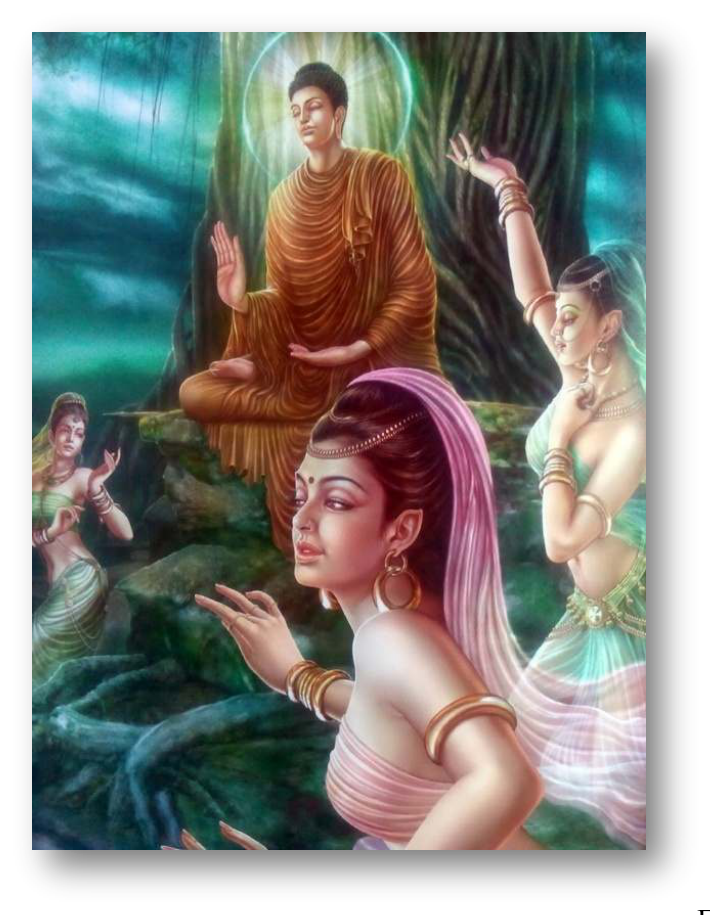
Hearing this solemn vow, Mara, the Buddhist manifestation of death and desire, felt threatened. Mara's power over sentient beings originated from their attachment to sensuous pleasures and the consequent fear of death which lead to intense suffering. Enlightenment would free Siddhartha from Mara's control and provide an opportunity for others to free themselves also by emulating him. Likewise, Mara first sent his three beautiful daughters named Desire (Future), Fulfillment (Present), and Regret (Past). The Buddha had already disengaged himself from these pinnings and
听闻这庄严的誓愿,魔罗(Māra)——佛教中死亡与欲望的化现——感到自身受到了威胁。魔罗对有情众生的支配力,源于他们对感官欲乐的贪著,以及由此而生的对死亡的恐惧;这种恐惧会导致强烈的苦恼。若得觉悟,悉达多将脱离魔罗的掌控,并为他人提供契机:众人可以效法其行,从而同样获得解脱。于是,魔罗先遣其三位美丽的女儿前来,名为 Desire(未来)、Fulfillment(现在)与 Regret(过去)。佛陀早已不再为这些系缚所牵引,并
Page 27
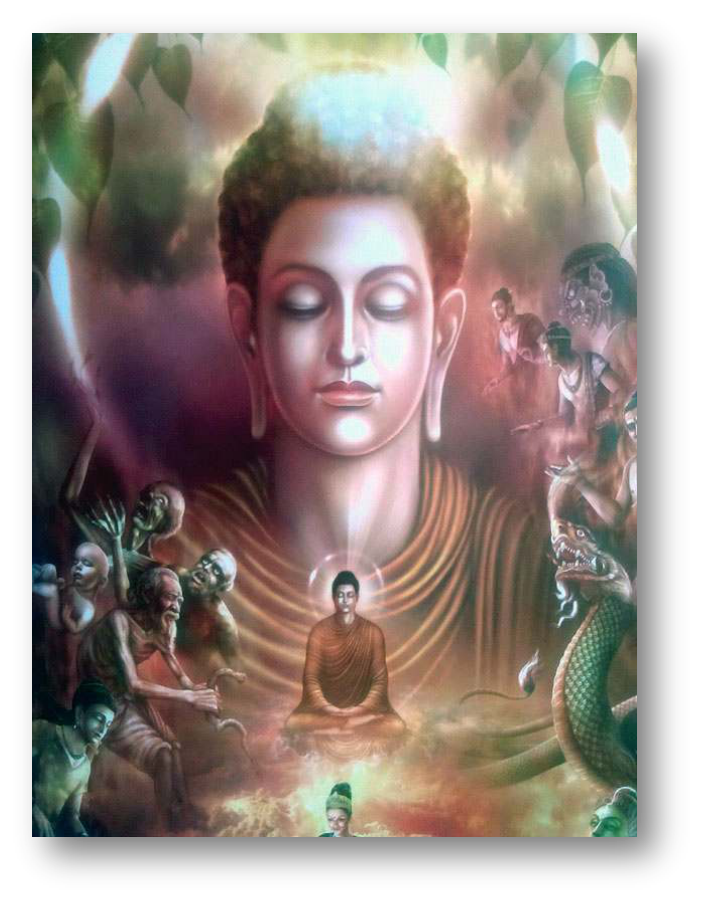
thus remained unmoved. This prompted Mara to intimidate the venerable one by installing fear in his heart. Towards this end he generated an army of wrathful and hideous creatures, the very personifications of death. But all through the tribulations, Buddha sat calm and unflinching, and Mara had no other recourse than to withdraw, and thus was cleared the final hurdle on the way to Buddha's enlightenment.
却仍岿然不动。这促使魔罗(Māra)企图在这位尊者心中植入恐惧以相威胁。为达此目的,他化现出一支由暴怒而丑恶的众生组成的军势,宛如死亡的具象化身。然而在一切考验与苦难之中,佛陀始终安坐,宁静而无所动摇;魔罗别无他途,只得退却。至此,通向佛陀成等正觉之路上的最后一道障碍亦被扫清。
1.10) The Enlightenment of the World
1.10)世界的觉悟
It was here that Siddharta attained a knowledge of the way things are, it was through this knowledge that he acquired the title Buddha ( meaning " awakening one"). This awakening was
正是在此处,悉达多(Siddharta)证得了对诸法实相的如实知见;也正是凭借此知见,他获得了“佛陀”(Buddha,意为“觉醒者”)这一称号。这种觉醒是
Page 28
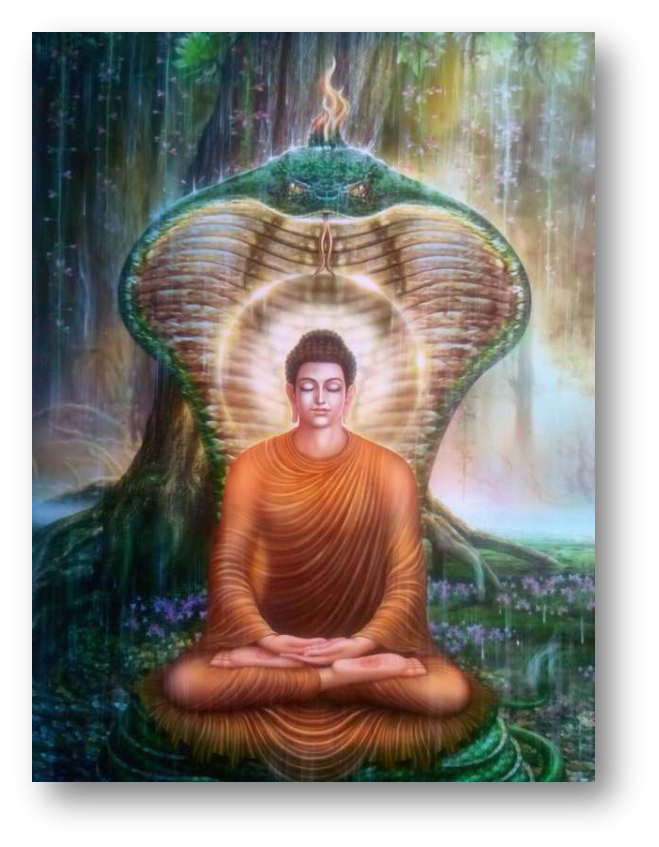
achieved during a night of meditation, which passed through various stages as the illumination that Gautama had sought slowly welled up in his heart. He knew the exact condition of all beings and the cause of their rebirths. He saw beings live, die and transmigrate. In meditation of human pain, he was enlightened about both its genesis and the means of destroying it.
这一切是在一夜禅修中证得的;那一夜历经不同层次,乔达摩(Gautama)所寻求的觉悟之光缓缓在他心中涌起。他了知一切众生的真实境况,以及促成其再生的因缘。他观见众生生起、死亡,并在轮回中迁流转生。在对人类苦痛的禅观中,他于苦的生起之因与灭苦之道,皆得明觉。
In this first stage he saw each of his previous existences, and then understood the chain of cause and effect. In the second he surveyed the death and the rebirth of all living beings and understood the law that governs the cycle of birth and death. In the third he identified the Four Noble Truths: the universality of suffering, the cause of suffering through selfish desire, the solution and the way to overcome suffering. This
在第一阶段,他观见自己过去的每一世存在,并由此了悟因果相续之链。第二阶段,他遍观一切众生的死亡与再生,理解支配生死流转的法则。第三阶段,他确证“四圣谛”(Four Noble Truths):苦之普遍;以自私贪欲为因而生苦;以及灭苦之解答与超越苦的道路。这
Page 29
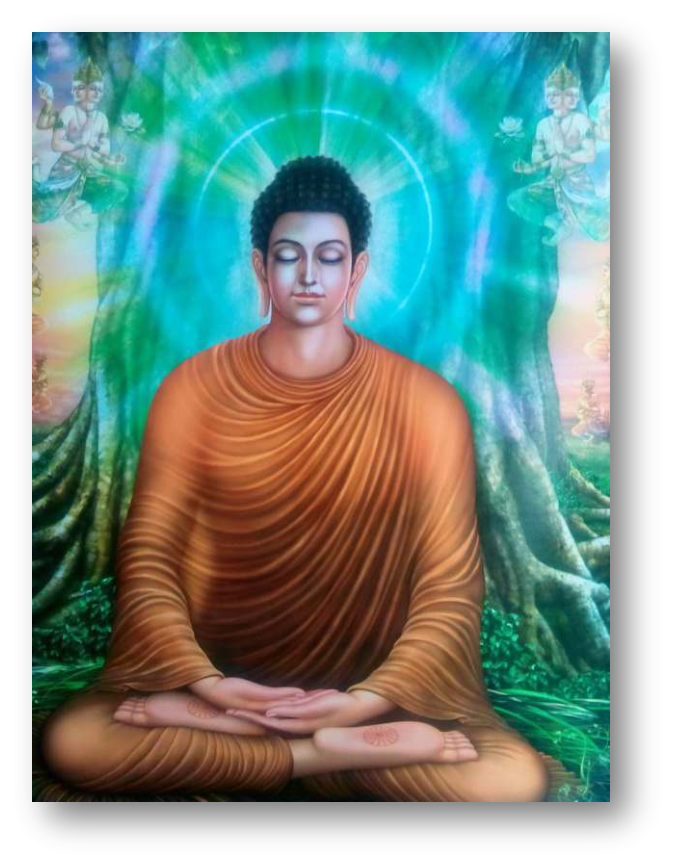
final point is called the Noble Eightfold Path , this being eight steps consisting of wisdom ( right views, right intention) ethics ( right speech , right action, right livelihood), mental discipline ( right effort, right mindfulness, right concentration) , which lead to liberation from the source of suffering.
最后一点称为“八正道”(Noble Eightfold Path),即由八个要素构成:智慧(正见、正思惟/正志)、戒德/伦理(正语、正业、正命)与心的修习(正精进、正念、正定)。依此修行,能引导人从苦之根源获得解脱。
When day came, Gautama had attained perfect illumination , and had become a Buddha. The rays emanating from his body shone to the boundaries of space. He stayed in meditation for seven more days, and then for four more weeks he stayed by the tree.
天亮时,乔达摩(Gautama)已证得圆满的觉悟(perfect illumination),成为佛陀(Buddha)。他身上放射的光明照彻至空间的边际。他又继续入定七天,随后又在那棵树旁停留了四周。
Having gained enlightenment, Gautama came to be called Shakyamuni, or the silent lion, indicating the explosive potential he carried within himself. He first went up to Sarnath near Varanasi where he
成道之后,乔达摩(Gautama)被称为释迦牟尼(Shakyamuni),又称“沉默之狮”(the silent lion),以示他内在所蕴含的巨大、足以爆发的潜能。他首先前往波罗奈(Varanasi)附近的鹿野苑(Sarnath),在那里他
Page 30
21
21
met the five disciples with whom he had previously traversed the path of asceticism. Though they had deserted him after their failed experiment, the unearthly glow from his body now attracted them. Hearing his discourse, they became his first followers.
他遇见了那五位弟子——先前曾与他共同走过苦行(asceticism)之路的人。尽管在那次试验失败后,他们曾离他而去;然而此刻,他身上超凡出尘的光辉又吸引了他们。聆听佛陀的开示(discourse)后,他们成为了他的最初弟子与追随者。
1.11) The Descent from the Trayatrimsa Heaven
1.11)从忉利天(Trāyastriṃśa,三十三天)降下
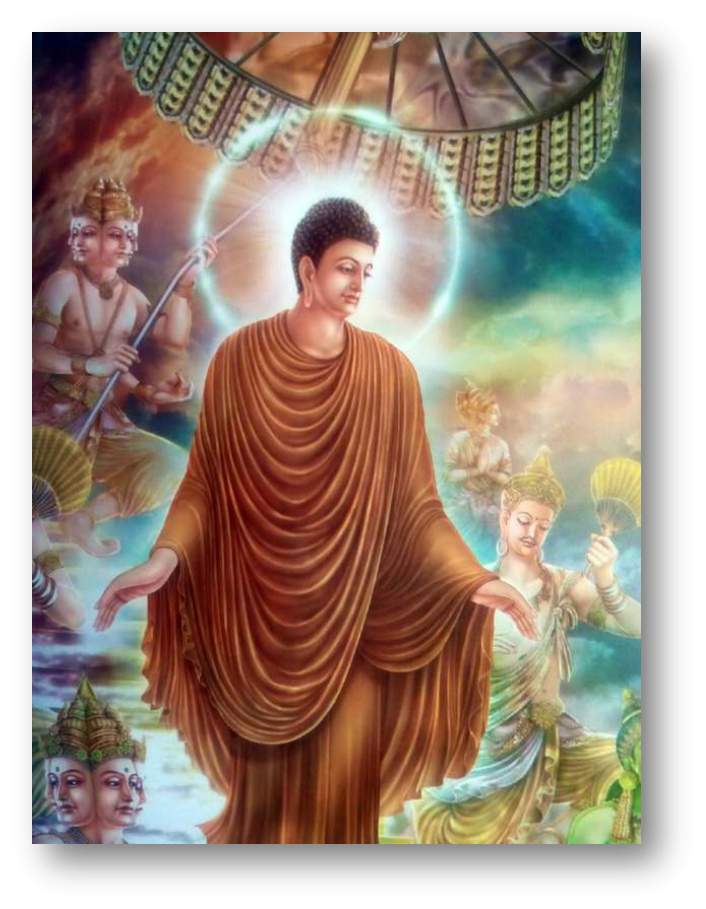
Queen Maya, after her death, was said to have been reborn in the Trayatrimsa heaven. Having attained enlightenment, Buddha decided to ascend to the Trayatrimsa heaven, literally the heaven of thirty-three
相传,摩耶夫人去世后转生于忉利天(Trāyastriṃśa,三十三天)。佛陀成道后,决定升至忉利天,其名义即“三十三天”。
Page 31
gods, to visit his mother. The name 'thirty-three' derives from the fact that it is the residence of the 33 gods of Hinduism, an ancient notion, having roots in Vedic thought. With three strides Buddha reached the heaven, where he preached before the divine congregation, including his mother, for several months.
……诸天,为探望其母。“三十三”这一名称源于此处为印度教三十三天神之居所;此一古老观念根植于吠陀思想。佛陀以三步即至天界,于诸天会众之前说法,母亲亦在其中,历时数月。
When the inhabitants of the earth fervently supplicated him to return, Buddha coasted downwards with the help of a ladder that had thirty-three rungs, handcrafted by the divine architect Vishwakarma. This descent is the most celebrated event of the entire episode and is often glorified in independent artworks.
当世间众生恳切祈请其返还时,佛陀借助一架三十三级阶梯徐徐下降;此梯由天界工巧神毗湿瓦羯磨(Vishwakarma)亲手制作。此次下降是整段事迹中最为著名、最受颂扬的情节,亦常被独立呈现于艺术作品之中。
1.12) The Passage into Parinirvana
1.12)趋入般涅槃
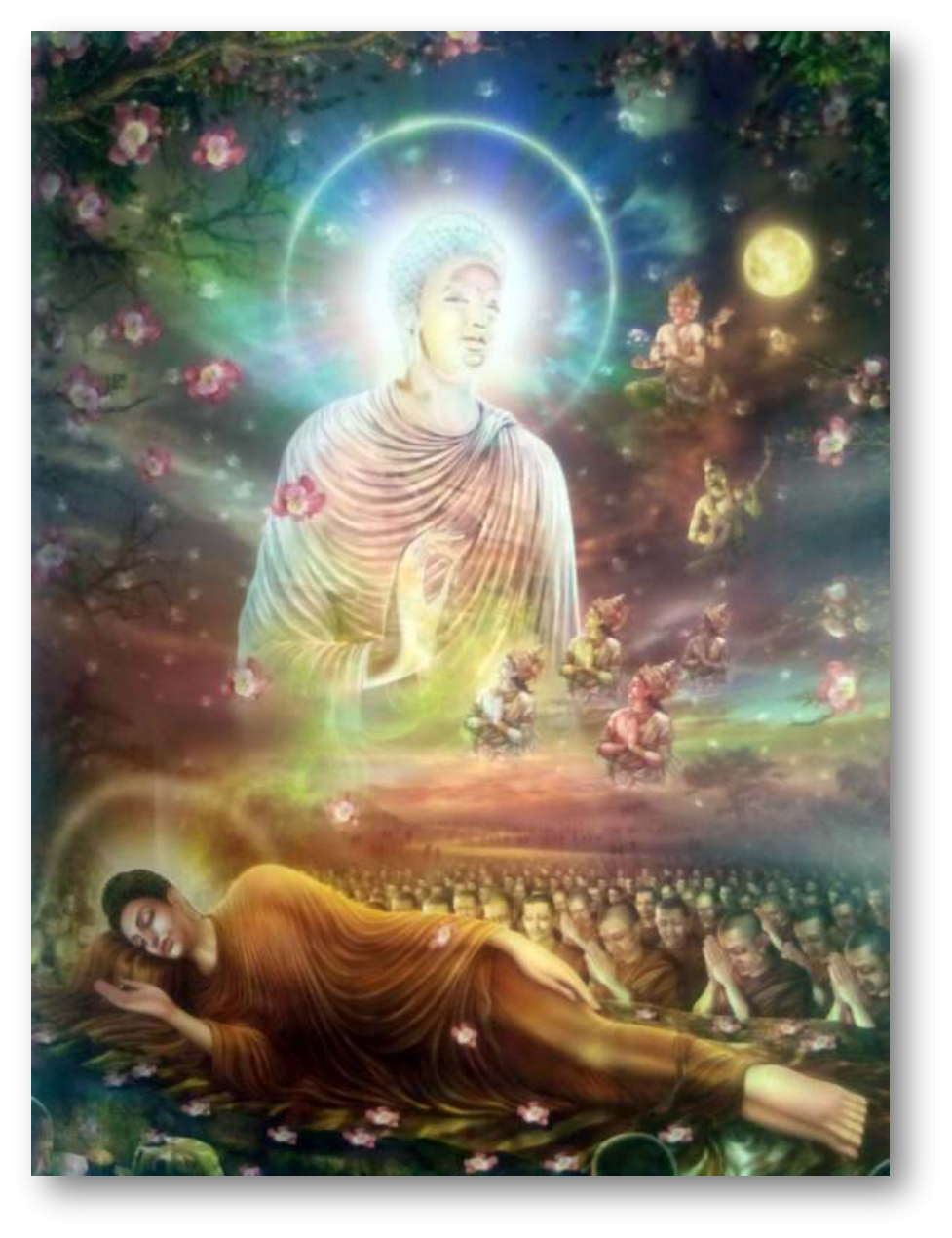
Traveling great distances to disseminate his teachings, Buddha finally reached the city of Kushinagara, where he asked his disciples to spread a couch for him in a grove. He lay there, reclining on his right side, facing west, with his head supported by his hand.
为广弘其教法而长途行化之后,佛陀终至拘尸那伽罗(Kushinagara)城,请弟子于一处林苑中为其敷设卧榻。佛陀卧于其上,右胁而卧,面向西方,以手支头。
Growing weaker, he said that," Do not say we have no master now. The doctrine I have preached will be your master when I have disappeared . Listen,
他渐趋衰弱,遂说道:“莫言我等如今已无导师。我所宣说之法(Dharma),在我灭度之后,将为汝等之师。谛听,”
Page 32
I beg you : ALL CREATIONS ARE IMPERMANENT; work diligently for your liberation," And after this he gave the last words
“我恳请你们:诸行无常;当勤修不放逸,以求解脱。”随后,他又宣说了最后的遗教。
" Beware Bhikkhus! I warn you thus " All concocted things disintegrate"
“比丘们,当警觉!我如此告诫你们:一切有为法(诸行)终归坏灭、解体。”
"You ought always to be carefully alert"
“你们应当恒常谨慎,保持警觉。”
" These are the finals words of Tathagata"
“此乃如来(Tathāgata)的最后遗教。”
Having pronounced these final words, Buddha went into the Jhana stages, or meditative absorptions. Going from level to level, one after the other ,
宣说这些最后的话后,佛陀进入禅那(jhāna)诸定次第,即禅定的诸层次(meditative absorptions)。他由一层入一层,次第而行,
Page 33
Then the Buddha entered the first jhana. Leaving that, he entered the second,the third, the fourth jhana , then he successively entered the sphere of Infinite space, the sphere of Infinite consciousness , the sphere of nothingness , the spher of neither -Perception-Nor-Non -Perception. Then he attained the Cessation of fellingband perception and then he did this process it again one time but stop at the fourth jhana . Then he came out of the meditative absorption for the last time and passed into nirvana , leaving nothing whatever behind that can cause rebirth again in this or any other world,and finally passed into Nirvana. After his death, Buddha's remains were cremated, as became the Buddhist tradition.
随后,佛陀入初禅那(jhana)。出此定后,又入第二禅那、第三禅那、第四禅那;继而依次入无边空处、无边识处、无所有处、非想非非想处。随后,他证得受想灭尽定(灭受想定);又将上述过程再行一次,但止于第四禅那。最后一次从禅定中出定后,他证入涅槃,不再留下任何能导致此世或他世再生的因缘,终于入般涅槃。佛陀圆寂后,其遗身被荼毗火化,此亦成为佛教传统。
The passing away, or the final Nirvana, of the Buddha occurred in 483 BC on a full moon in the month of May, known in the Indian calendar as Wesak. And its the same day that the Buddha born , became Enlightenment and Final Pariniravana. So we called this day Wesak Day which is recognized as the day of the buddha's birthday, enlightenment, and nirvana which miraculously occured on the same day.
佛陀的入灭(passing away),亦即最终涅槃(final Nirvana),据说发生于公元前483年5月的月圆之夜,在印度历中称为卫塞节(Wesak)。据称这一天也正是佛陀诞生、成等正觉(Enlightenment)以及最终般涅槃(final Pariniravana)之日。因此,人们称此日为卫塞节(Wesak Day),并公认为佛陀诞辰、成道与入涅槃之日——三事奇迹般同日发生。
Page 34
25
25
Page 35
PART 2: What did the buddha teach.
第二部分:佛陀教导了什么。
At present, Buddhism continues to gain an ever-widening acceptance in countries and societies far beyond its original home. Many people throughout the world , through their own careful choice, are adopting Buddhism 's peacefully , compassionate and reasonable ways as guiding principles in their lives. Buddhism is not a belief system. It's not about accepting certain tenets or believing a set of claims or principles. In fact , it's quite the opposite. It's about examining the world clearly and carefully about testing everything and every idea. Buddhism is about seeing. It's about knowing rather than believing or hoping or wishing .It's also about not being afraid to examine anything and everything .
当今,佛教在远远超出其最初发源地的国家与社会中,持续获得日益广泛的接纳。世界各地许多人出于审慎的自主选择,将佛教平和、慈悲且理性的方法作为人生的指导原则。佛教并非一种“信仰体系”。它不在于接受某些教条,或相信一套主张或原则。事实上,恰恰相反:它强调清晰而审慎地观察世界,检验一切以及每一个观念。佛教关乎“看见”(seeing)。它关乎“知”(knowing),而非“信”,亦非“希望”“祈愿”。它也关乎不畏惧去审视任何事物与一切事物。
Eighty years before the commencement of the Buddhist Era, a great man was born into the world. He was the son of king Suddhodana and Queen Siri MahaMaya of Sakka country which is now within the boundaries of Nepal.His name was "Siddhatha."
在佛历纪元开始之前八十年,一位伟人降生于世。他是释迦国(Sakka)国王Suddhodana与王后Siri MahaMaya之子;释迦国今位于尼泊尔境内。他名为“Siddhatha”。
Thirty five years later, Prince Siddhatha attained Supreme Enlightenment and thereafter became known as the " Enlightened One " or the "Lord buddha " as he is called in Thai . He proclaimed his Dhamma or Universal truth to the people,and there after ,the buddhist religion( the teaching of the Buddha) and the Buddhist community of disciples came
三十五年后,悉达多太子证得无上正等正觉,此后被称为“觉者”,或如泰语所称“佛陀世尊”。他向民众宣说其法(Dhamma),亦即普遍真理;其后,佛教(佛陀的教导)以及由弟子组成的佛教僧团随之兴起。
Page 36
into existence. The community was composed of bhikkus or monks ( including samaneras of male novices), bhikkunis or nuns ( including samaneris or female novices ) upasakas or male lay followers and upasikas or female lay followers.
……应运而生。僧团由比丘(bhikkhu,含沙弥〔sāmaṇera〕等男众学戒者)、比丘尼(bhikkhunī,含沙弥尼〔sāmaṇerī〕等女众学戒者)、优婆塞(upāsaka,男在家信众)及优婆夷(upāsikā,女在家信众)组成。
At present in Thailand , we have only monks and novices, upasakas or Buddhist layman and upasikas or Buddhist laywomen. A monk who has been ordained and Conduct himself in accordance with the precepts laid down for the monk. A novice is a person under or over 20 years of age who has been ordained and conducts himself in accordance with the precepts laid down for a novice . A buddhist layman or laywoman is one who has taken refuge in the Triple Gem, i.e. the Buddha , the Dhamma and the Sangha, and observes the precepts applicable to layman and laywoman.
目前在泰国,现存的只有比丘与沙弥,以及优婆塞(upasaka/upasakas,佛教在家男众)与优婆夷(upasika/upasikas,佛教在家女众)。比丘是已受戒,并依照为比丘所制定的戒律而行持的人。沙弥是年龄未满或已满20岁、已受戒,并依照为沙弥所制定的戒律而行持的人。佛教在家男众或在家女众,是指已皈依三宝——即佛(Buddha)、法(Dhamma)与僧(Sangha)——并持守适用于在家男众与在家女众之戒的人。
At present we call laymen and laywomen , whether of age or under age, " Buddhammaka" and " Buddhamamika " respectively , meaning " he or she who believes in Buddha"
目前,我们将在家男众与在家女众(无论成年或未成年)分别称为“Buddhammaka”和“Buddhamamika”,意为“信佛者”,即“信仰佛陀之人”。
Buddhism has spread from its place of birth into the various country of the world. Buddhism is more of a field of study than it is a religion. In practicing , we are taught to rely on ourselves, and not on higher entities or nothing external to ourselves. To practice Buddhism , we
佛教已从其诞生之地传播至世界各国。与其说佛教是一种宗教,不如说它更是一门学修与研究的体系。在修行中,我们被教导应当依靠自己,而非倚赖更高的存在,也不依赖任何外在于自身的事物。要修习佛教,我们
Page 37
must study ; we must be an observer. We observe ourselves much in the way a researcher who has a field of study observes his subject. The subject of our field of study here is our body and our mind , our objective is to see the true characteristics of them in our own experience. We must be the one to study our body and mind, no one else can do it for us.
我们必须学习;必须成为观察者。我们观照自己,就如同一位研究者在其研究领域中观察研究对象那样。此处我们“研究”的对象,是自己的身与心;我们的目标,是在自身经验中如实看见它们的真实特相。观照与体察身心必须由我们自己来做,任何人都无法代替。
Buddhism believes in the potential of human being to be able to observe oneself and see Truth. Seeing the truth of the way things really are is called seeing Dhamma. Once a human beings sees the truth or sees Dhamma , he or she be free from suffering.
佛教相信,人具有观照自身并见到真理的潜能。如实见到事物“如其所是”的真相,称为见法(Dhamma)。一旦一个人见到真理、见到法(Dhamma),便能从苦中解脱。
The focal point of worship in Buddhism is the Ti-Ratana ( the triple Gem) namely the buddha who by himself discovered, and proclaimed the Dhamma, Thereby establishing the buddhist religion, the Dhamma ( Universal Truth discovered, realized and proclaimed by the Buddha and the Sangha or community of those who hear, follow and realized the Buddha's Teachings. Some members or the Sangha become monks and help in the dissemination of Buddhism and the perpetuation of the monkhood up to the present time.
佛教礼敬的核心是 Ti-Ratana(the triple Gem,三宝),即:佛陀——由其自身发现并宣说法(Dhamma),从而建立佛教;法(Dhamma)——由佛陀所发现、证悟并宣说的普遍真理;以及僧伽(Sangha)——听闻、奉行并证得佛陀教法者的共同体。僧伽中有些成员出家为比丘,协助弘传佛教,并使僧团与出家传承延续至今。
Page 38
2.1 ) The Triple Gem: the three refuge which are
2.1)三宝:即三种归依处,分别为
Buddha :The knowing ,Awakened , Fully Blossomed One , especially the perfectly Self -Awakened One ( sammasambhudha)Specialy , buddha refers to the historical prophet under whom Buddhism was founded, otherwise refered to as Bhagava( Blessed One) by followers and samana Gotama by others. The primary quality of a buddha are wisdom ,purity , and compassion.
佛陀:意为知者、觉者、圆满开敷者,尤指圆满自觉者(sammasambhudha)。特指佛教所依之历史性觉者:其追随者称之为薄伽梵(Bhagava,“福佑者/世尊”),他人则称之为沙门·乔达摩(samana Gotama)。佛陀的主要德性为智慧、清净与慈悲。
Dhamma :Truth, nature, law , order ,duty, The secret of nature which must be understood in order to develop life to the highest possible purpose and benefit .
达摩/法(Dhamma):真理、自然、法则、秩序、责任(义务);即必须体悟的自然之理,以使生命得以发展至所能达到的最高目的与利益。
Sangha: Community : the community of the buddha's followers who practice thoroughly , directly , insightfully , and correctly. Sangha include lay women, lay men , nuns, and monks.
僧伽(Sangha):团体(僧团);指佛陀追随者之共同体,他们以彻底、直接、具洞见且正确的方式修行。僧伽包括在家女众、在家男众、比丘尼与比丘。
Everyone who is initiated into the Buddist religion ,whether a layman or a monk, ought to conform to a preliminary rule , namely one must Solemnly promise to take refuge in and accept the Triple Gem as one's refuge, or in other words, to regard the Buddha as one's father who give birth to one's spiritual life. A Buddhist may associate himself or herself with people of other faiths and pay respect to objects of the
凡受入佛教者,无论在家或出家,皆应遵循一项初步规则:即必须郑重誓言归依,并以三宝为己之依止;换言之,当以佛陀为生起其精神生命之父。佛教徒亦可与其他信仰者交往,并对……的对象表示尊敬。
Page 39
reverence of the religions in an appropriate manner in the same way as he or she may pay respect to the father , mother or elders of other people while having at the same time his or her own father. He will not lose his Buddhist religion as long as he believes in the Triple Gem, just as he will remain the son of his own father as long as his father instead, or just as he will remain a Thai as long as he does not adopt another nationality.
以适当的方式对各宗教表达敬意,正如他或她在有自己的父亲的同时,仍会尊敬他人的父亲、母亲或长者一样。只要他信受三宝(Triple Gem),便不会失去其佛教信仰;正如只要其父亲尚在,他仍是其父亲的儿子一样;又正如只要他不改易为他国国籍,他仍是泰国人一样。
Buddhism , therefore , is not intolerant. Its followers may at will associate with people of other nationalities and religions. Buddhism does not teach disrespectfulness to anyone. On the contrary, it declares that respect should be paid to all those to whom respect is due and that Dhamma should not be withheld from the knowledge of others and kept only to oneself. Whoever desires to study and practice the Dhamma may do so without having to profess first the Buddhist faith . The Dhamma as proclaimed by Buddhist religion, will help to demonstrate that it is " truth" that will beneficial and bring happiness in the present life.
因此,佛教(Buddhism)并不狭隘排他。其信众可随意与其他国籍、其他宗教的人交往。佛教不教人对任何人失礼。相反,它宣示:凡应受尊敬者皆当受敬;而法(Dhamma)不应被隐匿、独自保留,而应使他人亦得知晓。凡欲学习并修习法(Dhamma)者,皆可如此行之,无须先宣称佛教信仰。佛教所宣说之法(Dhamma),将有助于证明其为“真理”(truth),能带来利益,并在现世带来幸福。
The essence of the entire Buddhist teachings lies in the Four Noble Truth.
整个佛教教义的精髓在于四圣谛(Four Noble Truth)。
Noble Truth is short for " Truth for the Noble one"
“圣谛”是“圣者之真理”的简称。
Page 40
It should first be understood that it is not simply truth that is agreeable to the world or to oneself, but truth that is directly born from wisdom.
首先应当明白:这里所说的“真理”,并非只是迎合世间或令自己感觉顺意的“真理”,而是直接由智慧(paññā)所生起的真理。
2.2) The four noble truths
2.2)四圣谛
The four noble truth are :-
四圣谛如下:
2.2.1. Dukkha or suffering , which means birth, decay and death which are the normal incidents of life. It also means sorrow, lamentation, pain, grief and despair which are at times experienced by our body and mind. To be separated from the pleasant , to be disappointed, or to be in contact with the unpleasant are also suffering. In short our body and mind are subject to suffering or, in other words, we may say that our existence is bound up with suffering.
2.2.1.Dukkha(苦)或“苦”(suffering),意指生、衰老与死——这些都是生命中的常态现象。它也指身心有时所经历的忧愁、哀叹、痛苦、悲伤与绝望。与所喜爱之境分离、遭遇失意,或与不喜之境相接触,也都是苦。总之,身与心皆为苦所系;换言之,我们的存在与苦紧密相连。
2.2.2. Samudaya , which means the cause of suffering, which is desire. It is a compelling urge of mind, such as the longing to own what we desire, to be what we desire to be , or to avoid those states to which we feel aversion.
2.2.2.Samudaya(集)意指苦之因,即欲(desire)。它是一种强烈的心之驱迫,例如渴望占有自己所欲之物,渴望成为自己所欲成为的样子,或试图回避那些令自己生起厌憎的状态。
2.2.3. Nirodha, which means cessation of suffering, which connotes extinction of desire or such longings of the mind.
2.2.3.Nirodha(灭)意指苦的止息,其内涵为欲(desire)以及诸如此类心之渴求的灭尽。
Page 41
2.2.4. Magga, which means the way to the cessation of suffering, which is the Noble Eight fold Path, namely Right Understanding, Right Intention, Right speech, Right action, Right livelihood, Right Effort, Right Mindfulness and Right Concentration.
2.2.4. Magga(道),意为通向苦之止息之道,即“圣八支道”(Noble Eightfold Path),亦即正见、正思惟、正语、正业、正命、正精进、正念与正定。
Therefore, if one really understands that elimination of suffering is nothing but keeping the mind at rest and that rest is a mental nourishment which is needed every day , then one will begin to understand the meaning of Nirodha.
因此,若真正明白:灭苦无非是令心安住(令心止息),而这种安住是一种每日都需要的心灵滋养,那么便会开始理解 Nirodha(灭/止)的意义。
We should realize that when our mind is restless it is because of desire . The mind then causes us to act , speak and think in consonance with its agitated state . The gratified, it may became peaceful; but only momentarily , because action dictated by a restless mind may very soon afterwards bring us intense pain and severe punishment or make us conscience stricken and cause us to regret it for a very long time . So let it be known that a person with his mind in such a state is termed " slave of desire"
我们应当认识到:当我们的心躁动不安时,这是由于欲望。于是,心便使我们依其扰动之态而行、而言、而思。欲望一旦得到满足,心或许会暂时平静;但这只是片刻,因为由躁动之心所驱使的行为,往往在不久之后便会带来剧烈的痛苦与严厉的惩罚,或令我们良心谴责、心生愧悔,并在很长时间里追悔不已。因此,应当知道:心处于这种状态的人,被称为“欲望之奴”("slave of desire")。
Page 42
33
33
The Four Noble Thruths
四圣谛
Dukkha Suffering
苦谛(Dukkha,苦)
Samudhaya
集谛(Samudhaya)
Nirodha
灭谛(Nirodha)
Magga
道谛(Magga)
Right View
正见
Right Thought
正思惟
Right Speech
正语
Right Action
正业
RightLivelihood
正命(正当谋生)
Right Effort
正精进
Right Mindfulness
正念
Right Concentration
正定
Page 43
2.3) Noble Eight fold Paths
2.3)八圣道(八正道)
Then is there a way to overcome desire or to master the desire on our own hearts? Yes, there is the Noble Eight fold Path that leads to the extinction of suffering namely:
那么,是否有办法克服欲望,或在我们自己的内心中调伏欲望呢?有的:即能导向苦之灭尽的八圣道(八正道),如下:
2.3.1 ) Sammaditthi or Right View, meaning intellectualgrasp of the Four Noble Truths or of the true natuer of existence even in a simplified form as outlined in the preceding paragraphs.
2.3.1)Sammaditthi 或“Right View”(正见):意指以理智把握四圣谛,或把握存在之真实本性;即使仅如前文所述之简略形式,亦复如是。
2.3.2. ) Sammasangkappa or Right Thought , meaning intention to be free from all bonds of Dukkha. Such intention should be free from revenge, hatred , and harmfulness.
2.3.2)Sammasangkappa 或“Right Thought”(正思惟/正志):意指发心从一切苦(Dukkha)之系缚中解脱。此种意向应远离报复、嗔恨与害心。
2.3.3 ). Sammavaca or Right Speech, Meaning absence from lying; from tale- bearing and vicious talk that cause discord; from harsh language; from vain , irresponsible and foolish talk.
2.3.3)Sammavaca 或“Right Speech”(正语):意指远离妄语;远离挑拨离间、恶口等导致不和之言;远离粗恶之语;远离空谈、轻率不负责任与愚妄之谈。
2.3.4.) Sammakammanta or Right Action , meaning avoidance of killing and torturing of theft and misappropriation , and of adultery.
2.3.4)Sammakammanta 或“Right Action”(正业):意指远离杀生与酷刑折磨;远离偷盗、侵占(不与取);并远离邪淫。
2.3.5.) Sammaajiva or Right livelihood , meaning Rejection of wrong means of livelihood and living by right Means.
2.3.5)Sammaajiva(正命):意指拒绝邪命(不正当的谋生手段),以正当方式维生。
2.3.6.) Sammavayama or Right effort , meaning effort to avoid the arising of evil; effort to over evil and demeritorious states that
2.3.6)Sammavayama(正精进):意指努力避免诸恶生起;努力克服诸恶与不善(非功德)之状态……
Page 44
have already arisen; effort to develop good and beneficial states of mind, and effort to maintain them when they have arisen.
(善法)已然生起;努力培育善与有益的心所状态,并在其生起之后努力令之持续住立。
2.3.7.) Sammasati or Right Mindfulness, meaning dwelling in contemplation of the station of the mind, for instance , the Satipaththana or four stations of Mindfulness which are the body, Sensation, Mind and Dhamma.
2.3.7.) Sammasati(正念),即“正念住”,意指安住于对心所缘处的观照;例如 Satipaththana(四念处),即四种念处:身、受、心、法(Dhamma)。
2.3.8.) Sammasamadhi or Right concentration, meaning the fixing of the mind upon a single deed which we wish to perform along the right path.
2.3.8.) Sammasamadhi(正定),意指将心专注并安住于我们欲依正道所行的一件单一所作之上。
The Noble Eightfold Path is in reality one complete Path with eight component parts which may by summed up in the stages of training ( sikkha ) namely :
圣八支道在实质上是一条完整之道,由八个组成部分构成;可归纳为修学阶段(sikkha),即:
Among these three fundamental modes of training , Sila . or morality is first recommended for buddhist practice both on the personal level and the social levels.
在这三种根本修学方式之中,Sila(戒,或道德)首先被推荐为佛教修行的基础,既适用于个人层面,也适用于社会层面。
Page 45
36
36
Three Areas Training
三学(戒、定、慧)的训练
Morality ( Sila ) Right Speech Right Livelihood Right Action V.S, Coarse Defilements Greedy Anger Delusion Morality or ( sila ) to control strong defilements
戒(Sīla) 正语 正命 正业 V.S, 粗重烦恼 贪(lobha) 嗔(dosa) 痴(moha) 以戒(Sīla)来调伏强烈(粗重)的烦恼
Concentration Right Effort Right Mindfulness Right Concentration vs Medium Defilements 5 Hindrances Dosa, lust, Asleep dullness,frustrate, doubtfulness Concentration or Samadhi to control Medium defilements
定(禅定,三摩地 Samādhi) 正精进 正念 正定 对治 中等烦恼 五盖 瞋恚(dosa)、欲贪、昏沉睡眠、掉举与恶作、疑 以定(禅定/三摩地)来调伏中等烦恼
wisdom Right View Right Thought vs Fined Defilements Ignorance wisdom to control fined defilements
慧(智慧,paññā) 正见 正思惟 vs 微细烦恼 无明(avijjā) 以慧(智慧,paññā)来调伏微细烦恼
Page 46
2.4 ) Three areas of training
2.4)三项修学领域
In learning Buddhism , the Buddha taught that there are three areas of training (ti-sikkha): morality, mentality, and wisdom., There are very important to know all of them.
在学习佛教时,佛陀教导有三项修学(ti-sikkha):戒(morality)、心的训练/定(mentality)与慧(wisdom)。全面了解这三者非常重要。
2.4.1 ) Training in Morality
2.4.1)戒学(戒的训练)
2.4.1.1 ) Kinds of Morality
2.4.1.1)戒的种类
There are several levels of morality, but we may easily divide it into three classes, as follows:
戒有若干层次,但可概分为三类如下:
(a) Morality for good conduct;
(a)为端正身口行为的戒;
(b) Morality for Dhamma practice
(b)为修习正法(Dhamma)的戒
a ) Morality for good conduct
a)为端正身口行为的戒
These are abstinences of evils and misconduct by body and speech, e. g. the five precepts, the eight precepts, the ten precepts and the 227 precepts. This type of moral restraint arises from a firm resolution to refrain from bodily and verbal misconduct. Observers of these precepts will enjoy a peaceful living in society and save themselves from distraction.
这是在身与语方面远离诸恶与不善行,例如五戒、八戒、十戒以及二百二十七戒。这类戒的自制力源于坚定的决意,令自己不造身业与语业的不善行。持守这些戒的人,能在社会中安住于和平生活,并使自己免于散乱与扰动。
This level of morality is very necessary for one who practices Dhamma. At least they should determinedly abstain from five evils, e. g. killing and harming human beings and animals, harming and doing violence to property of others, harming or doing violence to the beloved and the highly valued of others, e. g. their spouses and children, lying,
这一层次的戒,对修习正法(Dhamma)者极为必要。至少应当坚定地远离五种恶行,例如杀害与伤害人类及动物;损害他人财物并施以暴力;伤害或对他人所爱与所珍视者施以暴力,如其配偶与子女;妄语(说谎)。
Page 47
slandering, using harsh language, frivolous talking, and taking intoxicants, which causes heedlessness and mindlessness.
离间两舌(挑拨是非)、恶口粗语、绮语,以及饮用(或服用)令人迷醉之物, 会导致放逸与失念。
b) Morality for practicing Dhamma
b) 修习佛法(Dhamma)的戒德
The Buddha taught, " When your eyes see from the world, liking and disliking appear in the mind . Have the mindfulness to know when they do. If you don't see the liking or disliking immediately, the mind will be burdened and influenced by greed, aversion and ignorance." The mind will stray from its normal state of purity and become immoral. A mind without morality is actually an abnormal mind. It has the mental defilements ( greed, aversion, etc.) influencing it.
佛陀教导说:“当你的眼睛见到世间境相时,喜欢与不喜欢便会在心中生起。应以正念如实了知它们的生起。若不能当下觉知喜欢或不喜欢,心就会被贪、嗔与无明(痴)所负担,并受其影响。”如此,心将偏离其本有的清净常态而失于戒德,乃至趋于不善。缺乏戒德之心,实为一种非常态之心;它被心的烦恼染污(如贪、嗔等)所左右。
This is sense-restraint (indriyasavara-sila), which is further developed from morality for good conduct. It arises from mindfulness, which protects the mind from domination by defilements when the eyes, ears, nose, tongue, body and mind contact sense-objects. For example, when one sees a wallet falling out of a man's pocket and craves for it, mindfulness will recollect the craving. As the result, craving cannot dominate the mind. The mind will remain calm and firm in its normal state. The mindful one will call the owner to pick it up. Both will be happy at the end. Alternatively, when one is scolded and gets angry, if mindfulness recollects anger, the mind will not be enraged by anger. It will remain calm and firm as usual. There will be no quarrel, no exchange of words or assault, etc. Sense-restraint is an effective instrument for
这就是护根戒(indriyasavara-sila),它是在正行戒的基础上进一步发展而来。护根戒由正念而生:当眼、耳、鼻、舌、身、意与诸所缘境接触时,正念能守护其心,使之不为烦恼所制。譬如,见到一个钱包从某人的口袋里掉落而心生贪求时,正念便能忆念并觉知这份贪欲;因此,贪欲不能主宰其心,心仍能安稳、坚住于其常态。具正念者会呼唤失主前来拾取;最终两人皆得欢喜。又如,被人呵责而起嗔怒时,若正念能忆念并觉知嗔怒,心便不为嗔所煽动,仍如常安稳、坚住;于是不会争吵,不会互相恶言相向,亦不会发生殴打等事。护根是一种有效的工具,以
Page 48
developing mindfulness. Not only is it a moral rule, it is also conducive to insight development through mindfulness of consciousness in everyday life. For this reason, it is what a Dhamma practitioner should practice and observe in everyday life.
培养正念。这不仅是一条道德规范,也有助于在日常生活中以对心识活动的正念来发展观智(insight)。因此,这是修习佛法(Dhamma)者在日常生活中应当修习并持守的实践。
2.4.2 )The training in Mentality ( concentration)
2.4.2)心的训练(定/专注)
The training of Concentration through meditation is the second fold of trisikha. The pali word for meditation is bhavana, which literally means "development, cultivation or culture" Since the practice has to do directly with the mind , the word bhavana therefore refers specifically to a process of mental culture or mental development .
通过禅修来训练“定”,是三学(trisikha)的第二支。禅修的巴利语为“修习”(bhavana),其本义为“发展、培育或陶冶”。由于此修行直接作用于心,故“修习”(bhavana)特指一种心的陶冶或心的开发之过程。
Buddhist meditation is essentially an experiential activity. It is a means to mental development through practice, not a scholartic subject to be understood through books. It deals particularly with the training of the mind, which is the most important component of the entire human entity. Because mind is a forerunner and prime source of all actions, be the physical, verbal or mental, It need to be properly cultivated and developed. Meditation is the mental development in the real sense of the term bhavana, for it's aim not only a temporary calm and tranqutility of mind, but also a purifying the mind of defilement and negative influence , such as sensual desire, lust, hatred, jealous, envy, worry, ignorance, restlessness. It cultivates and bring to perfection such wholesome and
佛教禅修本质上是一种体验性的活动。它是通过实践促成心的成长与开发之方法,而非只能凭借书本理解的学术课题。它尤其着重于训练心,因为心是整个人之存在中最重要的组成部分。由于心是一切行为的先导与根本源头——无论身业、语业或意业——因此必须得到恰当的培育与发展。就 bhavana(心的培育/开发)这一术语的真实意义而言,禅修即是心的开发;其目的不仅在于获得暂时的内心平静与安稳(tranqutility),更在于净化内心的染污(defilements)与负面影响,例如感官欲(sensual desire)、贪欲(lust)、嗔恨(hatred)、嫉妒(jealousy)、羡慕(envy)、忧虑(worry)、无明(ignorance)、掉举不安(restlessness)。它培育并使之臻于圆满诸种善法,以及
Page 49
positive qualities of and as confidence, compassion, wisdom, energy, mindfulness, concentration and penetrative insight.
……积极的品质,例如信心、慈悲、智慧、精进、正念、定力以及通达的观智。
2.4.2.1 ) Purpose of Training in Mentality
2.4.2.1)名法训练的目的
The purpose of this training is to develop concentration and moral consciousness (mahākusala-citta) that is associated with wisdom and ready to further comprehend the truths of Matter and Mind.
此项训练的目的,是培养定力,并发展与智慧相应、具备道德觉知的大善心(mahākusala-citta),使其为进一步如实领会色法与名法(Matter and Mind)的真实法则作好准备。
2.4.2.2 ) What to Study about Consciousness
2.4.2.2)关于心识应学习的内容
Mental training is about learning our own mental states – which state of mind is a virtuous one, which is not, which state of mind is suitable for Samatha meditation, which for Vipassana, and which state of mind is unfit for any practice at all. We need to know clearly the characteristics of each mental state. This way, we can see which is the most appropriate practice at any given time. Let’s have a look at what types of mental states are virtuous and which are not.
名法训练在于学习并辨识自身的心行状态——哪些是善心,哪些是不善心;哪些状态适合修止(Samatha)禅修,哪些适合修观(Vipassana);以及哪些状态根本不堪用于任何修行。我们需要清楚了解每一种心行状态的特征。如此,便能在任何当下判断何种修习最为相应。下面我们来看看,哪些类型的心行状态属于善,哪些不属于善。
Virtuous ones do not have desire, aversion or ignorance controlling them.
善的心态不被贪欲、嗔恨或无明所左右。
So if in any moment the mind is wanting, is in a state of anger or stress, is lost in thought or in sense perception (looking, hearing, etc.) then it is surely not a virtuous one in the Buddhist sense. This is an easy way to measure the quality of the mind in any given moment. With that said, sometimes we can’t tell if the mind has desire, aversion or ignorance because they are there in such a subtle form. In such cases, there are other ways to know. A truly virtuous mind is a light one (lahuta). The arising of a weighty mind is a sure sign that we are
因此,若在任何一个当下,心正处于贪求“想要”的状态,或陷于嗔怒、紧迫与压力之中,或迷失于妄想分别,或沉溺于感官觉受(看、听等)之中,那么在佛教意义上,它必定不是善心。以此即可在当下用一种简便的方法衡量心的品质。不过,有时我们也难以觉察心中是否有贪、嗔、痴,因为它们可能以极其微细的形式潜伏。在这种情况下,还有其他辨识的方法。真正的善心是轻快的(lahuta)。沉重之心的生起,是一个明确的征兆,表明我们……
Page 50
faltering in our practice, that unscrupulousness or unwholesomeness has come in to replace virtue. Some people’s minds become so heavy in their practice it is as if they are carrying a mountain on their shoulders. A virtuous mind is also gentle and pliant (muduta). Any rigidity or dullness is not virtuous. Some people have their minds held rigid all day long. A virtuous mind must be agile and nimble (pagunnata). Be cautious and cognizant of such things.
当我们的修行开始退转时,无惭与不善法便会趁隙而入,取代德行。有些人在修行中内心变得异常沉重,仿佛肩上扛着一座大山。具德之心亦应柔和、调顺(muduta)。任何僵硬或昏沉都非德行之相。有些人整天把心绷得僵固不动。具德之心必须轻快、灵巧(pagunnata)。对于这些现象,应保持谨慎并清楚觉知。
We may notice that if we are too deliberate when we set our minds to practice, there will arise heaviness, tightness, dullness or inattentiveness. Why is that? It is because greed has entered. Wanting to practice is a form of greed. When we want to meditate we bring the wanting into our practice and it will affect our mind. Normally when the desire arises to meditate, we meditate. As such, our actions are resulting from a state of mind that is defiled with desire, a non- virtuous state. Heaviness, rigidity, inattentiveness and dullness will thus appear. There will be no chance for a truly impartial mindfulness of inner phenomena to occur. Genuine mindfulness cannot occur at that moment because the area has already become a defiled one. Mindfulness can certainly never arise in conjunction with a defilement. We can only have one or the other. Therefore, if we are meditating and the mind is rigid or dull, know that this mental state has arisen out of greed. Also when the rigidity and dullness arise, aversion will follow because we want these states to go away. We don’t like them and feel confined and edgy. We want to be pleased, happy and comfortable. Once
我们也许会注意到:当我们将心安置于修行时若过于用力、过于刻意,便会生起沉重、紧绷、昏沉或不专注。为什么会这样?因为贪已进入。想要修行本身就是一种贪;当我们想要禅修时,就把这种“想要”带进了修行,它会影响我们的心。通常,禅修的欲望一生起,我们便去禅修。如此一来,我们的行为便是由一颗被欲染所污染的心所推动——这是一种不具德的状态。于是沉重、僵硬、不专注与昏沉就会出现。对内在诸法真正不偏不倚的正念,便无从发生。此刻真正的正念不可能现起,因为该处已成染污之境。正念当然不可能与烦恼染污同时生起;二者只能有其一。因此,若我们正在禅修而心变得僵硬或昏沉,应知这类心理状态是从贪而生。并且当僵硬与昏沉现起时,嗔也会随之而来,因为我们想让这些状态消失。我们不喜欢它们,便感到局促、烦躁不安;我们想要愉悦、快乐与舒适。一旦
Page 51
again, mental defilements prevail. So we must come to learn the qualities of virtuous and non-virtuous mental states within ourselves.
再者,烦恼(kilesa)往往占上风。因此,我们必须学习并了解自身内在善与不善心理状态的特质。
There are two points, i.e. what type of consciousness is moral vs. what kind is immoral; and what kind of mind is good for concentration practice (samatha-bhāvanā) and what kind is good for insight development (vipassanā-bhāvanā).
此处有两点:第一,何类心识为善,何类心识为不善;第二,何类心适合修习定(止修,samatha-bhāvanā),何类心适合修习观慧(观修,vipassanā-bhāvanā)。
If a Dhamma practitioner does not study these matters well, he or she may ignorantly develop immoral consciousness and misunderstands that he or she is practicing Dhamma. Likewise, he or she may mistakenly practice meditation (Samatha) and believes that it is a practice for insight development (Vipassanā).
若一位修学佛法(Dhamma)之行者未能深入研习这些要点,便可能在无明中滋长不善识,却误以为自己是在修行佛法。同样地,也可能错将止修(Samatha)当作观修(Vipassanā),并误信那是在发展观智。
2.4.2.3) Nature of Moral Consciousness
2.4.2.3)善识的性质
Moral consciousness must be associated with beautiful mental factors or sobhaṇa cetasika. With such mental factors, consciousness is unblemished and righteous. There are 25 types of beautiful mental factors (the Higher Doctrine (Abhidhamma) refers to a mental factor (cetasika) as a mental state, like a state of consciousness). These beautiful mental factors can be divided into 4 types, as follows:
善识必须与美善心所(beautiful mental factors),即净心所(sobhaṇa cetasika)相应。有此诸心所相应,识便清净无染、正直如法。美善心所共有二十五种(在上乘法/阿毗达磨 Abhidhamma 中,心所(cetasika)被视为一种心理状态,类似于识的状态)。这些美善心所可分为四类,如下:
2.4.2.4) The beautiful mental factors that are common to all moral consciousness (sobhaṇa-sādhāraṇa cetasika) are of 19 types, namely:
2.4.2.4)一切善心识所共有的美善心所(巴利语 sobhaṇa-sādhāraṇa cetasika)共有十九种,即:
Page 52
43
43
(1) Saddhā: faith, i.e. sensible belief which should conform to the teaching of Lord Buddha;
(1)Saddhā:信(信心),即理性而明智的信受,应与佛陀世尊的教导相契;
(2) Sati: mindfulness, not noting as is widely translated at the later stage;
(2)Sati:正念,并非后期常被译作的“标记”(noting);
(3) Hiri: moral shame of an evil;
(3)Hiri:对恶行的道德羞耻(惭);
(4) Ottappa: moral dread of the outcome of an evil that will lead to suffering and trouble;
(4)Ottappa:对恶行将招致苦与烦恼之果报的道德畏惧(愧);
(5) Alobha: non-greed or non-craving;
(5)Alobha:无贪,或不贪求(不渴爱);
(6) Adosa: non-hatred or loving-kindness;
(6)Adosa:无嗔,或慈心;
(7) Tatramajjhattatā: specific neutrality of mind to a condition through wisdom;
(7)Tatramajjhattatā:以智慧对特定境况所生起的心之中舍(中立不偏);
(8) Kāya passaddhi: calmness of the mental factors, e.g. feeling;
(8)Kāya passaddhi:诸心所(如受)的轻安;
(9) Citta-passaddhi: tranquility of mind;
(9)Citta-passaddhi:心的寂静;
(10) Kāya-lahutā: lightness of mental body;
(10)Kāya-lahutā:名身的轻快;
(11) Citta-lahutā: lightness of mind;
(11)Citta-lahutā:心的轻快;
(12) Kāya-mudutā: pliancy of mental body;
(12)Kāya-mudutā:心身的柔软与调柔;
(13) Citta-mudutā: pliancy of mind;
(13)Citta-mudutā:心的柔软;
(14) Kāya-kammaññatā: adaptability of mental body
(14)Kāya-kammaññatā:名身的堪任性;
(15) Citta-kammaññatā: adaptability of mind;
(15)Citta-kammaññatā:心的堪任性;
(16) Kāya-pāguññatā: proficiency of mental body;
(16)Kāya-pāguññatā:名身的娴熟;
(17) Citta-pāguññatā: proficiency of mind;
(17)Citta-pāguññatā:心的娴熟;
(18) Kayujjukatā: rectitude of mental body; and
(18)Kayujjukatā:名身的正直;以及
Page 53
(19) Cittujjukatā: rectitude of mind. After knowing these beautiful factors that must accompany moral consciousness, it will not be difficult to ascertain which state of consciousness is moral or immoral. For easy notice, it can be said that if any state of consciousness is mindless, it is absolutely immoral; and if any state of consciousness is heavy, tense, rigid, drowsy, stiff or dominated by a defilement, or attempts to intervene instead of being impassively mindful of an object of consciousness, then it is obviously immoral.
(19)Cittujjukatā:心之正直(rectitude of mind)。在了解这些必须伴随于善(道德)心(moral consciousness)的诸美心所之后,就不难判定某一心(consciousness)是善(道德)的或不善(不道德)的。为便于辨识,可以说:若任何一种心是“无心”(mindless),则绝对是不善(不道德)的;又若任何一种心沉重、紧绷、僵硬、昏沉、呆滞,或为烦恼(defilement)所主宰,或试图介入干预,而非对所缘境保持不偏不倚、只是如实以正念观照,那么它显然是不善(不道德)的。
2.4.2.5 ) The beautiful factors in boundless states (appamaññācetasika)
2.4.2.5)无量状态中的美心所(无量心所,appamaññācetasika)
are the beautiful factors that extend boundless loving-kindness to all animals.
即将无量的慈爱(loving-kindness)遍及一切众生的诸美心所。
These factors are of 4 types, namely:
这些因素分为四类,即:
(1) Metta: loving-kindness to others;
(1)Metta(慈):对他人的慈爱;
(2) Karuna: compassion for others to end their suffering;
(2)Karuna(悲):为使他人止息苦而生起的悲悯;
(3) Mudita: sympathetic joy when others are happy; and
(3)Mudita(喜):见他人得乐时的随喜;以及
(4) Upekkha: indifference when others suffer and one cannot help. However, the Higher Doctrine (Abhidhamma) classifies only two kinds of cetasika as appamaññācetasika: karuna and mudita because karuna (lovingkindness) is adosa (non-hatred) and upekkha (indifference) is tatramajjhattata i.e. equanimity of mind to conditions, as is described above under the heading of beautiful factors that are common to all moral consciousness.
(4)舍:当他人受苦而自己无法施以援助时的淡然。然而,阿毗达摩只将两种心所归为无量心所:悲与喜。其理由是:悲属于无嗔(adosa);而舍则是处中舍性,即对诸缘境保持平等心,正如前文在“一切善心识所共通的美心所”标题下所述。
Page 54
2.4.2.6 ) Nature of Immoral Consciousness
2.4.2.6)不善心的性质
Immoral consciousness is rooted in evils or associated with immoral factors or akusala cetasika, which are of 14 types/states and are classified into 5 classes; as follows:
不善心以诸恶为根,或与不善心所(akusala cetasika)相应。不善心所共有十四种类型/状态,并分为五类,如下:
2.4.2.7 ) Delusion (moha) class: as follows: -
2.4.2.7)痴(moha)类:如下:-
(1)Moha: delusion or nature that conceals the truth of an object of consciousness such that the consciousness cannot conceive the object as it actually is;
(1)Moha:痴;指一种遮蔽所缘真实相的性质,使心无法如实了知该所缘;
(2)Ahirika: shamelessness of bodily, verbal and mental misconduct;
(2)Ahirika:无惭;对身、语、意三业的不善行不知惭耻;
(3)Anottappa: fearlessness of the outcome of evils; and
(3)Anottappa:无愧;对诸恶业的果报不生怖畏;以及
(4)Uddhacca: restlessness or the natural state in which the mind cannot firmly concentrate on a mind-object
(4)Uddhacca:掉举;指心不能稳固地专注于意所缘(mind-object)的不安住状态。
2.4.2.8 ) Greed (lobha) class: These mental factors can accompany all of the eight types of immoral consciousness rooted in greed:
2.4.2.8)贪(lobha)类:这些心所可伴随一切以贪为根的八种不善心:
They are of three types/states, as follows:
其分为三种类型/状态,如下:
(1)Lobha: greed and covetousness of sense-objects – visible objects, sound, odor, taste, tangible objects and mind objects;
(1)贪(lobha):对诸境的贪爱与贪求——色(可见境)、声、香、味、触(可触境)及法境(意所缘境);
(2)Diṭṭhi: misbelief; and
(2)Diṭṭhi:邪见;以及
(3) Māna: conceit. Meanwhile, since this is of three types, it is called, the class of lotika cetasika.
(3)Māna:慢(我慢、贡高)。此外,由于此类共有三种类型,故称为 lotika cetasika(贪类心所)。
Page 55
46
46
2.4.2.9 ) Hatred (dosa) class: These mental factors can accompany two types of consciousness rooted in hatred. They are of four types/states, as follows:
2.4.2.9)嗔(dosa)类:这些心所可与两类以嗔为根的不善心识相应或伴随。其有四种类型/状态,如下:
(1) Dosa: hatred or anger;
(1)Dosa(嗔):嗔恨或愤怒;
(2) Issā: envy of the qualifications or merits of another person or jealousy;
(2)Issā(嫉):对他人资质或功德的嫉妒(或妒忌);
(3) Macchariya: stinginess on one’s own property and merits or meanness; and
(3)Macchariya(悭):对自身财物与功德的吝啬,或悭吝;以及
(4) Kukkucca: remorse or distress arising from a sense of guilt for past wrongs, worry and anxiety about virtue that has not been done.
(4)Kukkucca(恶作):由对过去恶行的罪疚感而生起的追悔或苦恼;以及对尚未修行之善(应作而未作之善德)的忧虑与不安。
Meanwhile, as this class is of four types, it is called, the class of docatuka cetasika.
又由于此类分为四种,故称为嗔四心所类(docatuka cetasika)。
2.4.2.10 ) Sloth and torpor (thīna-middha) class: These mental factors associate or accompany five types of immoral consciousness that are prompted (sasankhārikam) (consisting of four types of consciousness rooted in greed and one type of consciousness rooted in hatred, the details of which will not be enumerated here because it will make this Article too complex and difficult for Dhamma practitioners who have never studied the Higher Doctrine (Abhidhamma) before). This class is of two types/states of consciousness, as follows:
2.4.2.10)昏沉与睡眠(thīna-middha)类:这些心所与五类“有行”(sasankhārikam)的不善心识相应或伴随(其中包括四类以贪为根的不善心识与一类以嗔为根的不善心识;此处不逐一详述,因为那会使本文过于繁复,并使从未学习《阿毗达摩》(Abhidhamma,胜法/上座部论藏之殊胜法)者的法(Dhamma)修行者难以理解)。此类分为两种类型/状态,如下:
(1) Thīna: Sloth or nature that depresses or discourages the mind; and
(1)Thīna(昏沉):令心低沉、退缩或沮丧的性质;以及
(2) Middha: Torpor or nature that causes drowsiness or idleness
(2)Middha(睡眠):令心昏昧而昏睡、怠惰的性质
Page 56
to conceive an object of consciousness. Meanwhile, since this class is of 2 types, they are called, thiduka cetasika.
以构想一个识的所缘为目的。同时,由于此类分为两种,因此称为 thiduka cetasika(两类心所)。
2.4.2.11 ) Doubt (vicikicchā) class: Indecision and uncertainty about an object of consciousness is a mental factor that accompanies only consciousness rooted in doubt. Doubt here only refers to immoral doubt, i.e. a skeptical doubt about the virtues of the Triple Gem, doubts about the Aggregates, the Spheres and the Elements in the past, present and future, and doubts about the Dependent Origination. Other doubts, such as, doubts about technical matters or a doubt about a street name, are not regarded as immoral doubts, but are false doubts or paṭirūpakavicikicchā. If consciousness of a Dhamma practitioner is associated with only one of these mental factors, then it is regarded as immoral. An immoral mental factor that accompanies every immoral consciousness, which we should study well, is delusion (moha),which by nature is ignorance of the truth of an object of consciousness. Particularly for one who practices insight meditation, if through ignorance consciousness is distracted from Matter and Mind to a conventional mind-object or although, then it is abstracted. Thus, we should know abstractedness well because it is a foe that comes to mind most often for insight practitioners. In any event, it is true that abstraction may lead to thoughts about a subject matter that is moral, but that would be only a worldly
2.4.2.11)疑(vicikicchā)类:对于识的所缘之犹豫与不确定,是一种只随“以疑为根”的心而起的心所。此处所说的“疑”仅指不善疑,即:对三宝(Triple Gem)功德的怀疑;对过去、现在与未来之蕴(Aggregates)、处(Spheres)与界(Elements)的怀疑;以及对缘起(Dependent Origination)的怀疑。其他的疑,例如对技术事项的疑惑或对街道名称的疑问,不被视为不善疑,而是邪疑或似疑(paṭirūpakavicikicchā)。若一位法(Dhamma)行者之心仅与这些心所之一相应,则该心被视为不善。伴随一切不善心、我们应当善加研习的不善心所,是痴(moha);其本质为对识所缘真实相之无明。尤其对修习内观(insight)禅修者而言,若由于无明而令心从名色(Matter and Mind)偏离,转向世俗的概念性心所缘(conventional mind-object),或虽……,则便成为抽象化(abstraction)。因此,我们应当善知“抽象性/抽象化”(abstractedness),因为它是内观行者最常现前于心的敌。无论如何,抽象化确实可能引发对某些善的主题之思惟,但那也只是世俗的
Page 57
moral or at best meditation practice for concentration, not for insight development. Insight development requires consciousness to be mindfulness of Matter and Mind as they truly are. The wording “mindfulness of Matter and Mind as they truly are” is intrinsically non-delusion (amoha) or wisdom (paññā).
……只是道德层面的修持,或充其量只是为了培养定力的禅修练习,而非为了发展内观(vipassanā)智慧。内观的发展要求心(citta)能够如实正念于名色(Matter and Mind)。所谓“如实正念于名色”这一表述,本质上即是无痴(amoha),亦即智慧(paññā)。
2.4.2.12) Summary
2.4.2.12)总结
In sum, Dhamma practitioners should know the states of moral consciousness and immoral consciousness well. Otherwise, they may ignorantly and mistakenly develop immoral consciousness in the belief that that they are practicing Dhamma for insight development.
总之,修法者应当充分辨识善心(moral consciousness)与不善心(immoral consciousness)的诸种心态与表现。否则,便可能在无知与误解中,自以为是在依佛法(Dhamma)修习以发展内观,实则反而滋长不善心。
Following are examples:
以下为例:
(1) If mindful of any object, consciousness becomes heavy, tense, stiff or drowsy, consciousness at that moment is certainly immoral;
(1)若于任何所缘起正念时,心变得沉重、紧绷、僵硬或昏沉,则当下之心必定是不善的;
(2) If thinking about an unwholesome matter, the consciousness is obviously immoral;
(2)若思惟不善之事(不善法),则该心显然是不善的;
(3) If thinking about a wholesome matter, e.g. thinking of helping others, thinking of repeating “Buddho” as the word of exercise, thinking of noting movements of the abdomen, thinking of the Triple Gem, contemplating that this body is impure/loathsome, thinking of in-and-out breathing, reflecting that one is not a self, only Matter and Mind, which are impermanent, suffering and
(3)若思惟善法,例如思惟帮助他人、思惟以“Buddho”作为修习用语、思惟标记腹部起伏、思惟三宝(Triple Gem)、观想此身不净/可厌、思惟出入息、反思并无“我”(无我),唯有名色(Matter and Mind),而名色之本质为无常、苦,以及
Page 58
not-self, then, consciousness at that moment is ordinary moral consciousness.
若尚未观照无我,则当时的心识仅是寻常的善心(道德善心)。
Thus, it is not yet a practice for insight development; and
因此,这尚不足以称为观智(内观智慧)开发的修习;并且
(4) If unintentionally consciousness is mindful of the present condition as it really is, the consciousness will be light, pliant, adaptable, proficient, upright, mindful, awaken, cheerful, peaceful, clean and bright. The consciousness at that moment is moral and applicable at the stage of insight development
(4)若在非刻意的情况下,心识如实地正念于当下的状态,则该心识将呈现轻安、柔软、适应、娴熟、正直、具念、觉醒、喜悦、寂静、清净而明亮。此时的心识为善,且适用于观智开发阶段。
2.4.3) Training in Wisdom
2.4.3)慧的训练
2.4.3.1) Purpose of Training in Wisdom
2.4.3.1)慧的训练之目的
To learn how to use quality consciousness to study and comprehend the truths of Matter and Mind until it can relinquish Matter and Mind and realize Nibbāna, which is a state of oblivion to Matter and Mind, all defilements and craving.
学习如何运用品质优良的心识来观察并领会色法(Matter)与名法(Mind)的真实法,直至能够舍离色法与名法而证悟涅槃(Nibbāna)——那是一种对色名、诸烦恼与渴爱皆不复现起、寂灭无余的境界。
2.4.3.2 ) Types of Wisdom
2.4.3.2)慧的种类
2.4.3.3 ) Wisdom classified by quality of knowledge:
2.4.3.3)按知识品质分类的慧:
divided into 2 types, namely:
分为两类,即:
(1) Mundane wisdom or lokiya-paññā is knowledge and wisdom for living in this world with minimal suffering or for temporary restraint from suffering or temporary suppression of defilements and craving. For example, a person with mundane wisdom will wisely give alms, observe the precepts and practice meditation for peace of mind, etc.; and
(1)世间慧(mundane wisdom),或称世间智慧(lokiya-paññā),是使人在此世间以较少痛苦而生活的知识与智慧,或用于暂时止息痛苦,或暂时抑制烦恼与渴爱。例如,具世间慧者会明智地布施、持戒并修习禅修以获得内心的安宁等;并且
Page 59
(2) Supermundane wisdom or lokuttara-paññā is knowledge and comprehension of the Noble Truths, thereby causing the mind to detach itself from Matter and Mind/body and mind and realize Nibbāna, which is truly bliss of emancipation.
(2)出世间智慧,或称出世间慧(lokuttara-paññā),是对圣谛(四圣谛)的如实知与理解;由此令心从色与名/身与心的执著中离脱,证悟涅槃(Nibbāna)——涅槃实为解脱之乐。
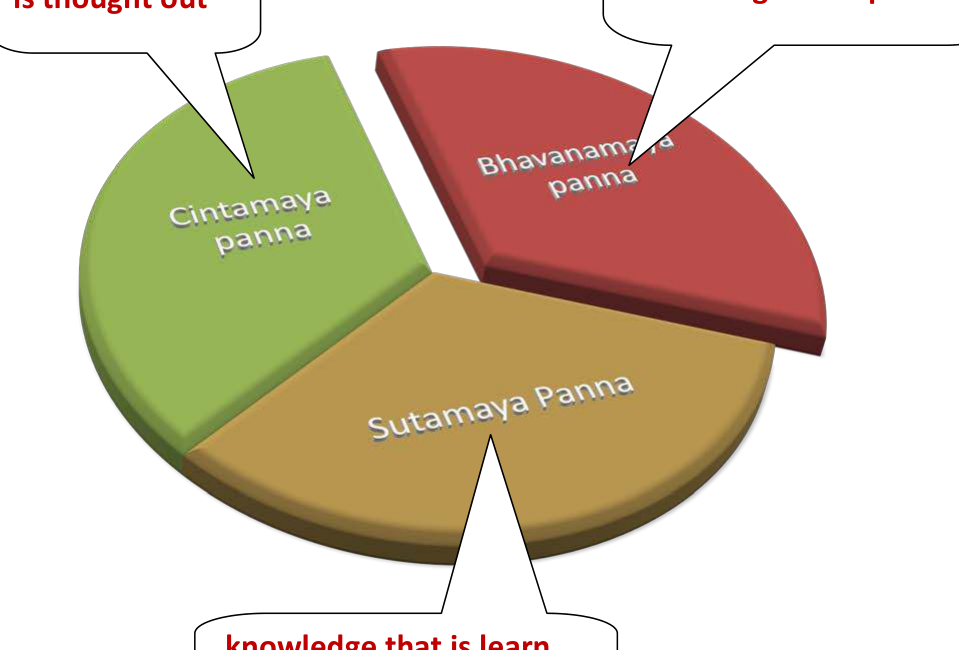
2.4.3.4 ) Wisdom classified by origin: divided into 3 types, namely:
2.4.3.4)依来源分类的智慧:分为三种,即:
(1) Sutamayapaññā or wisdom acquired by acceptance of a transfer of knowledge from other persons, e.g. wisdom resulting from reading textbooks and listening to teachings of one’s parents and teachers, etc.
(1)闻所成慧(Sutamayapaññā):通过接受他人所传授的知识而获得的智慧,例如因阅读教材、聆听父母与师长教导等而生起的智慧。
(2) Cintamayapaññā or wisdom acquired by contemplation, reflection or reasoning; or knowledge that is thought out.
(2)思所成慧(Cintamayapaññā):通过思惟、反省或推理而获得的智慧;亦即由思考而推究得出的知识。
(3) Bhavanamayapaññā or wisdom acquired by development of mindfulness.
(3)修所成慧(Bhāvanāmayapaññā):由修习正念而获得的智慧。
This kind of wisdom is further divided into 2 types, namely, wisdom resulting from Samatha kammatṭhāna or meditation, which is knowledge and wisdom of developing the mind towards tranquility, and Vipassanā paññā, i.e. penetration of truths of Matter and Mind through constant mindfulness of Matter and Mind.
此类智慧又可进一步分为两种:其一为由奢摩他业处(Samatha kammatṭhāna)或禅修而生起的智慧,即令心趋向寂静与安止(tranquility)的修习之知与慧;其二为毗婆舍那慧(Vipassanā paññā),即以对色与名(Matter and Mind)持续不断的正念,洞彻色与名之真实。
This wisdom will arisen up by observation, we observe the body and mind spontaneously and not to interrupt in it , we let the nature arise up by separate the mind to be the observer.
此智慧由观察而生起:我们自然而然地观照身与心,不加干扰、不予打断;让诸法随其自性如实生起,并令心退居为“观察者”,以观照之心与所观之身心相分离。
Page 60
51
51
knowledge that is thought out
经过思辨而得的知识
Cintamaya panna
思所成慧
wisdom resulting from mental development or knowledge from practice
由心智培育(禅修)所生起的智慧,或源于修行实践的知识
Bhavanamaya panna
修所成慧
knowledge that is learn from others
从他人处学习而得的知识
Sutamaya Panna
闻所成慧
Types of Wisdom
智慧的类型
Page 61
Now we come to the lesson on the arising of insight wisdom which sees the true nature of the body (rupa) and mind (nama). But first we must see the mistakes that meditators make which create obstacles to path of insight. We must not falter to either of the two extremes that block our progress in Vipassana and in the arising of wisdom. The first extreme is controlling our mind to the point of suspending it, making it frozen stiff or overly fine and subtle. The other extreme is letting the mind get lost, mindlessly following our ignorant and indulgent thoughts. These are the two directions we can falter — total control, or mindlessly following the lure of the defilements.
现在我们进入关于观智生起的课程:这种观智能如实照见身(色,rupa)与心(名,nama)的真实本性。然而首先,我们必须看清禅修者常犯、会在观智之道上造成障碍的错误。我们不可堕入任何一种会阻碍内观(Vipassanā,毗婆舍那)进展与智慧生起的两种极端。第一种极端,是控制心到近乎将其“悬置”的程度,使心僵硬冻结,或变得过分纤细、微妙。另一种极端,则是放任心迷失,毫无觉照地追随我们无明而放纵的念头。这就是我们可能偏离的两条方向——全然控制,或无觉知地随逐烦恼的诱引。
Buddhism teaches the middle way. It is important to remember that everything starts in the mind, and then action follows. So whether we tortuously keep our bodies under control, or have them mindlessly go unchecked and do whatever they please, the physical world is not where the root of the mistakes in our practice lies.
佛教教导中道。务必记住:一切先从心起,继而才有行为相续。因此,无论我们痛苦地把身体紧紧控制住,还是在缺乏觉照之下放任身体不加检束、随其所欲,修行中的错误根源并不在外在的物质世界,而在于这颗心如何被对待、如何运作。
We must try to open our minds to what is being said here and practice it. Then we will see for ourselves whether or not suffering subsides in our lives. If we want to know the Buddha’s middle way in our experience then we should gradually keep learning until genuine mindfulness arises, the automatic and impartial awareness of mental and physical phenomena as they arise in our experience. Genuine mindfulness (sammasati) will occur as a result of clearly recognizing mental states as they arise, not from holding concentration in one spot, or mental noting, or forcing it into being.
我们应当努力敞开心,领会这里所说,并加以实践。如此,便能亲自检验:生活中的苦是否随之减轻乃至止息。若希望在自身经验中了解并体证佛陀所说的中道,就应循序渐进地持续学习,直到真正的正念生起——对身心现象在我们经验中随缘生起时的、自然而不偏不倚的觉知。真正的正念(sammāsati,正念)之所以生起,是由于清楚地觉知并辨识当下所生起的心所状态;它不是靠把定力死守在某一点上,也不是靠心中作“标记式”的观照记录,更不是靠用力强迫它出现。
Page 62
The Abhidhamma teaches that the proximate cause that enables genuine mindfulness to arise is the recognizing of mental and physical phenomena.
《阿毗达摩》(Abhidhamma)教导说,使真正的正念生起的近因,在于对名色法(身心现象)的如实辨识。
When we first practice using the four foundations of mindfulness (satipatthana) that were taught by the Buddha (namely, the body, feelings, mind and Dhamma), we do so to achieve this mindfulness. We practice watching the body until we can see the truth of physicality (rupa).
当我们最初依佛陀所教的四念处(satipaṭṭhāna,即身、受、心、法)来修习时,目的正是为了成就这种正念。我们练习观身,直到能够看见色法(rūpa)的真实。
We practice watching feelings until we truly see the reality of feelings (vedana).
我们练习观受,直到真正看见受(vedanā)的真实相。
We practice watching the mind until we come to know the truth of the mind (citta). Genuine mindfulness arises on its own when we see the reality of these things. Usually we should watch the mind.
我们练习观心,直到逐渐认识心(citta)的真实。当我们看见这些法的真实相时,真正的正念便会自然生起。通常我们应当观心。
2.4.3.4 ) Those two kinds of people : This is because most of those who come are city people with busy minds. They are thinkers. Their jobs involve thinking all day. Watching the mind is the practice most suitable for such people. Those who are greedy, who want the comforts in life and enjoy fashion and beauty should practice by watching the body. Take a look at the decision to go to practice a meditation center. We don’t think about what type of personality we have. We want to go, so we do. We don’t notice our mental states. Our friends decide to go, so we go too. We unwittingly believe that if a meditation center becomes popular, it must be a good one. The truth is it may or may not be. Furthermore, the master may be first-class, but if the practice doesn’t suit our aptitudes and we merely follow the technique as directed, we
2.4.3.4)那两类人:这是因为来的人大多是心思繁忙的都市人。他们习于思辨,工作也整天离不开思考。对这类人而言,观心是最适合的修行。至于贪欲较重、追求生活享受并喜爱时尚与美的人,则应当以观身来修行。再看看我们决定去禅修中心修行时的情形:我们往往不会思考自己属于哪种性格类型;想去,就去了。我们不留意自己的心理状态。朋友决定去,我们也跟着去。我们不知不觉地相信:若某个禅修中心变得很热门,那一定就是好的。事实是,未必如此。此外,老师或许是一流的,但若修法不契合我们的根器,而我们只是照着指示机械地跟随技巧,我们
Page 63
won’t accomplish much. So before we practice we need to observe ourselves and determine where our abilities lie. If we are the kind that is happy with worldly pleasures, beautiful things, comfortable surroundings, and like being left alone in peace and quiet, we may be best suited to watch the body. This is because when we watch the body, we will easily come to know that it is not happy, comfortable or beautiful. Those who think too much, who are caught up in their heads, should watch the mind. We should discern which of these two main personality types matches us best: sensual or analytical; that is, do our passions lie primarily with worldly pleasures or intellectual ones? Let the choice here act as a guideline for what our objects of meditation should be when we begin our practice. If we are primarily sense driven, we should watch the body, and if we are analytical we should watch the mind. The other two areas to watch (according to the teachings of the Buddha on the four foundations of mindfulness, the Satipatthana Sutta) are feelings (Vedana-Nupassana) and the true nature of phenomena (Dhamma-Nupassana). We should not watch those two areas until our minds are a little more advanced, a little more ripe for wisdom. Watch the mind and the body first as they are fundamental. It is important to note, however, that watching body is most appropriate for those that are skilled in the absorption concentration levels (jhana). Unskilled minds that concentrate hard will completely lose themselves in the body. For example, if we watch the abdomen rising and falling, the mind will be motionless and
不会有太大成效。因此,在开始修习之前,我们需要先观察自己,辨明自己的能力侧重何处。若我们这一类人乐于世间欲乐,喜爱美好事物与舒适环境,又偏好在宁静清幽中独处,那么或许更适合观身。这是因为当我们观身时,容易如实了知:此身并不真正快乐、安适或美丽。那些思虑过度、总困在头脑里的人,则应当观心。我们应当辨别自己更符合两种主要性格类型中的哪一种:感官型(sensual)或分析型(analytical);也就是说,我们的热情主要偏向世间欲乐,还是偏向智性追求?让这个选择成为我们初学时确定禅修所缘的指引:若以感官欲乐为主,就应观身;若偏于分析思惟,就应观心。另有两处可观(依佛陀关于四念处的教导,即《四念处经》(Satipatthana Sutta)):受随观(Vedanānupassanā)以及法随观——诸法的真实相(Dhammānupassanā)。在心尚未更进一步成熟、足以承载智慧之前,不宜先从这两处下手。应先观心与观身,因为它们是根本。然而需要注意的是:观身最适合那些已熟练于诸禅那定(jhāna)等吸收定层次的人。若心力未娴熟却强行用力专注,往往会完全迷失于身体之中。譬如,当我们观腹部起伏时,心将变得凝住不动,并且
Page 64
completely latched to the abdomen, thus rendered ineffective. In walking meditation, the mind will be latched to the feet lifting and moving. In watching the breath, the mind will stick to the breath so completely that we lose ourselves in it. It is difficult to watch the body correctly if the mind is not firmly rooted in awareness, that is, if our mind tends to slip down into the object of observation.
(心)会完全贴附在腹部上,从而失去应有的作用。在行禅中,心会贴附于双脚抬起与移动;在观呼吸时,心会如此彻底地黏着于呼吸,以至于我们迷失其中。若心未能牢牢安住于觉知——也就是说,若心总是滑入所观对象之中——便很难如实、正确地观身。
If we can reach the peace and higher concentration of the second jhana, something arises that masters in the forest monk tradition call “the knower” or “the watcher”. This watcher is the awakening of right concentration, an unshakable awareness that clearly sees that the body, the feelings, the good and bad thoughts, and the mind that watches are all distinct and separate entities. The body moves; the mind is the watcher. The body sits, and the mind is the watcher. This point is clearly presented in the Abhidhamma when it shows the distinction between the knower and the known. This means that when we watch the body, we should not get immersed in it. The mind should be independent and watch from a distance as if we are watching someone else. We see this body stand, walk, sit and lay down. The mind is the watcher. When we practise in this way, we will see directly that the body is not us. There will be no need to think about it; the body will be clearly and directly seen as not us or ours. The body stands, walks, sits and lies down and the mind is the watcher.
如果我们能够达到第二禅那(second jhāna)的宁静与更高层次的定力,就会生起一种境界,森林僧传统中的诸位导师称之为“知者”(the knower)或“观者”(the watcher)。这个“观者”是正定(right concentration)的觉醒:一种不可动摇的觉知,能清楚照见色身、感受、善与不善的念头,以及那能观照的心——这一切都是彼此不同、相互分离的法。身体在动;心是观者。身体在坐;心仍是观者。《阿毗达摩》(Abhidhamma)对此有清楚的开示:它显示“能知者”与“所知”(the known)之间的区别。这意味着,当我们观身时,不应沉浸在身体里;心应保持独立,从一定距离观照,仿佛在看另一个人。我们看见这个身体站、走、坐、卧;心是观者。当我们如此修习时,会直接照见:身体不是“我”。无需再用思惟推论;身体会被清晰而直接地照见为非我、非我所。身体站、走、坐、卧,而心是观者。
This is how to watch the body. One day the truth will show itself that the body
这就是观身的方法。终有一天,真相将自行显现:身体
Page 65
is just flesh and bones, water, heat and movement. The body is under constant oppression by unsatisfactoriness (dukkha), always in some form of discomfort. Then the mind orders the body to move or act to try to relieve the discomfort. When we practice correctly we will see the true characteristics of the body for ourselves. Watching the mind is easier than watching the body.
(身体)不过是皮肉与骨骼、水、热与动。此身恒常受不圆满(dukkha,苦)的逼迫,始终以某种形式处于不适之中。于是心便指使身体移动或作种种行为,试图缓解这种不适。若我们如法修习,便会亲自如实见到身的真实特相。观心比观身更为容易。
When we watch the mind we will see that there are two things that arise in each moment: a mental phenomenon and consciousness. This is because one’s consciousness does not arise unless there is an object of consciousness — they appear in unison. We cannot watch the mind without mental phenomena (cetasika) because the mind has no body or form of its own. So first we should watch each mental phenomenon, whether it is classified as a feeling or sensations (vedanā), memory (sañña), or active thinking or mental formations (sankhara). All such phenomena arise and fall in conjunction with consciousness. For example, at times we have a virtuous mind and at times we do not. Our impression is that the mind that belongs to us is now virtuous, or it is greedy, averted or lost in thought or sense perceptions. This is how we perceive it at first. But when the mind that is ripe with wisdom arises, it will see clearly that consciousness is one thing and greed is another. Consciousness is one thing and disliking is another. Consciousness is one thing and thought is
当我们观心时,会见到每一刹那都有两种法生起:一者为心所法,一者为识。之所以如此,是因为识若无所缘境便不能生起——所缘与识必相应同时出现。离开心所法(cetasika),我们无法观心,因为心本身无形无相、无自体可见。因此,首先应观照每一种心所法:无论被归类为受(vedanā,感受)、想(sañña,记忆/表象),或是主动思惟与诸行(saṅkhāra,行、造作)。凡此诸法皆与识相应而生、相应而灭。譬如,有时我们起善心,有时则不然。我们最初的印象是:这颗“属于我们”的心此刻是善的,或是贪的、嗔的,或是散乱于思绪,或沉溺于诸根所缘的境界。起初我们便如此认知它。但当智慧成熟之心生起时,便能清楚照见:识是一回事,贪是一回事;识是一回事,不喜(disliking)是一回事;识是一回事,而想(thought)是
Page 66
another. They will show themselves as separate and distinct processes. Later we will be able to directly watch their true nature (Dhamma-Nupassana). But first, keep watching and knowing the phenomena that arise in the mind.
另一个。它们会显现为彼此分离、各自不同的过程。之后,我们将能够直接观照它们的真实本性(Dhamma-Nupassana)。但在此之前,要继续观照并如实知觉在心中生起的诸现象。
If we have already been practicing a certain meditation technique which involves watching the body and/or the mind, I recommend we stay with it. There is no need to stop or change what we do.
如果我们已经在练习某一种包含观身和/或观心的禅修方法,我建议继续坚持,无须停止或更改现行做法。
When we understand the principles correctly, we should integrate them into our present practice. If the fundamental principles behind our practice are lacking or misconstrued, then it doesn’t matter how gracefully we walk or how still we sit; we will not be practicing Vipassana and what we do will not lead to insight wisdom. Those in marching bands have beautiful posture and perform gracefully, but we certainly don’t see much enlightenment going on there! Our posture and technique is not the least bit relevant. We can just keep practicing whatever style we have learned in the past, though we must bring a correct understanding into it. If we have practiced watching the in-breath and out-breath, and we are comfortable with it, then we should keep at it. If we feel agitated, we may then want to pick another place in the body as a home base for our attention When we watch the body as in Vipassana meditation. We can choose any observable phenomenon of the body, we can see that there is rising and falling occurring there, and the mind merely watches this. The mind must be the watcher, an independent phenomenon from the object. The mind does not
当我们正确理解这些原则时,就应当把它们融入当下的修行之中。若支撑我们修行的根本原则欠缺或被误解,那么无论我们走得多么优雅、坐得多么端正安稳,都无济于事;我们并非在修习内观(Vipassanā),所做之事也不会导向洞见之智。行进乐队的人姿势优美、动作从容,但我们当然看不到那里有什么开悟在发生!姿势与技巧本身毫不相关。我们可以继续练习过去所学的任何风格,但必须将正确的见解带入其中。若我们一直练习观入息与出息,并且对此感到适应,就应当继续用功。若感到躁动不安,那么在以内观禅修观身时,可以在身体中另选一处作为注意力的“驻点”(home base)。我们可选择身体上任何可被观察到的现象;会看到其中有起与落在发生,而心只是如实观照。心必须是观者,是与所缘对象相互独立的一种现象。心并不
Page 67
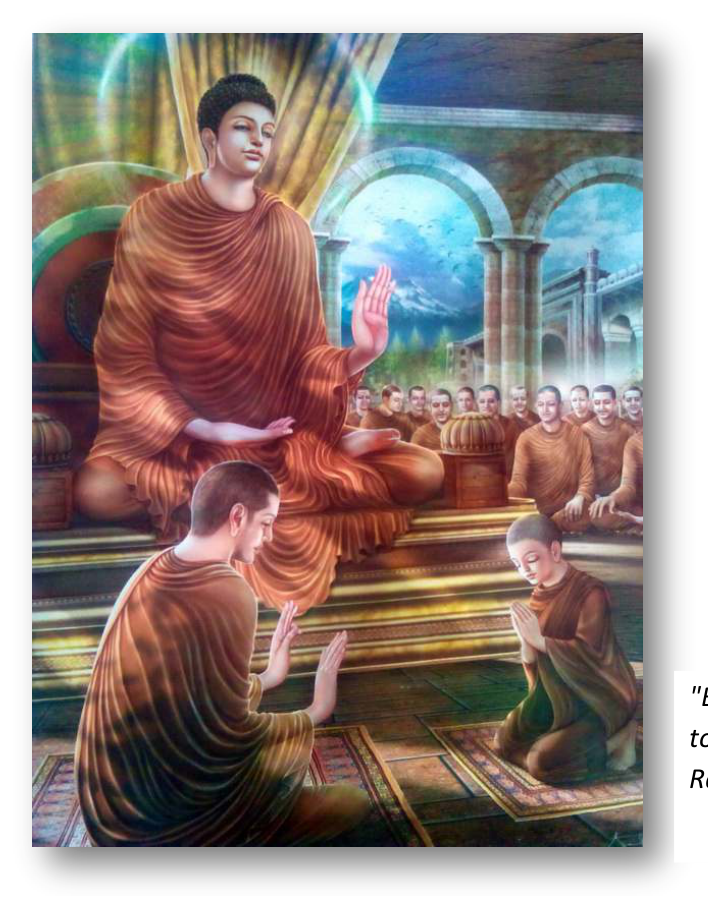
58
58
sink down to the abdomen but is rooted in awareness, and simply sees that the body has this rising and falling motion at the abdomen. Or the mind sees the body is breathing in. It sees the body breathing out. The mind watches the body stand, walk, sit and lay down . The mind is just the watcher. The body moves and the mind watches. The body ceases to be ours. This body moves, but it is not us moving. True mindfulness arises. The mind awakens and sees that the physical form that is moving is not us.
……沉落至腹部,却以觉知为根本,只是如实看见身体在腹部呈现起与落的运动。或者,心如实见到身体正在吸气;如实见到身体正在呼气。心观照身体站立、行走、坐下与躺卧。心只是观者。身体在动,心在观照。身体不再被当作“我们的”。这个身体在动,却不是“我们”在动。真实的正念生起。心醒觉而见:正在运动的色身并非“我”,亦非“我所”。
"Buddha gave permission to Saributra to ordain Rahula to be a novice."
“佛陀准许舍利弗(Saributra)为罗睺罗(Rahula)授戒出家,使其成为沙弥。”
Page 68
2.5 ) Maha Satipaṭṭhāna Sutta
2.5)《大念处经》(摩诃念处经,Mahā Satipaṭṭhāna Sutta)
" Thus have I heard, on one occasion the Blessed One was staying in the Kuru country. Now there is a town of Kurus called Kammasadhamma. There the Blessed One addressed the monks ' Monks.'
“如是我闻:一时,世尊住在拘卢国。拘卢人有一城镇名为 Kammasadhamma。世尊于彼告诸比丘:‘比丘们!’”
'Lord,' the monks replied.
“世尊!”比丘们答道。
The Blessed One said this: 'This is the direct path for the purification of beings, for the overcoming of sorrow and lamentation, for the disappearance of pain and distress, for the attainment of the right method, and for the realization of unbinding- in other words , the four frames of reference . Which four?'
世尊说:“这是令众生得以清净的直道,是超越忧悲与哀号之道,是令苦痛与烦恼止息之道,是得正法之道,也是证得解脱(unbinding,涅槃)之道——换言之,即四念处(frames of reference)。何等为四?”
There is a case where a monk remains focused on the body in and of itself- ardent, alert, and mindful-putting aside greed and distress with reference to the world . He remains focused on feelings....mind....mental qualities in and of themselves- ardent, alert, and mindful- putting aside greed and distress with reference to the world."
“有比丘于身观身而住——精勤、明觉、正念——弃舍对世间的贪欲与忧恼;于受观受……于心观心……于法观法而住——精勤、明觉、正念——弃舍对世间的贪欲与忧恼。”
2.5.1) Mindfulness of the body (Kāyānupassanā)
2.5.1)观身(身随观,Kāyānupassanā)
" And how does monks a remain focused on the body in and of itself?"
“比丘们,如何于身观身而住呢?”
2.5.1.1 Mindfulness of breathing
2.5.1.1 入出息念(安般念)
" There is the case where the monk-having gone to the wilderness , to the shade of the tree , or to an empty building- sits down folding his legs crosswise,
“有比丘前往林野、树荫下,或空屋中,坐下,双腿盘起(结跏趺坐),”
Page 69
holing his body erect and setting mindfulness to the fore [lit: the front of the chest]
令身体端正而住,并将正念安置于前方〔直译:胸前〕。
Breathing in long, he discerns that he breathing in long; or breathing out long, he discern that he is breathing out long. Or breathing in short, he discerns that he is breathing in short; or breathing out short, he discern that he is breathing out short.
当长吸气时,他了知“我正长吸气”;当长呼气时,他了知“我正长呼气”。 当短吸气时,他了知“我正短吸气”;当短呼气时,他了知“我正短呼气”。
He trains himself to breathe in sensitive to the entire body and to breathe out sensitive to the entire body . He trains himself to breathe in calming the bodily fabrication and to breathe out in calming the bodily fabrication. Just as a skilled turner or his apprentice , when making a long turn, discerns that he is making a long turn, or when making a short turn, discerns that he is making a short turn, in the same way the monk, when breathing in long, discerns that he breathing in long; or breathing in short , he discerns that , he breathing in short.... He trains himself to breathe in calming the bodily fabrication and to breath out in calming the bodily fabrication.
他训练自己:吸气时遍身觉知,呼气时遍身觉知。他训练自己:吸气时令身行(bodily fabrication)寂止,呼气时令身行寂止。正如熟练的车工或其学徒,作长转时了知“我在作长转”,作短转时了知“我在作短转”;同样地,比丘长吸气时了知“我正长吸气”,短吸气时了知“我正短吸气”……他训练自己:吸气时令身行寂止,呼气时令身行寂止。
In this way he remains focused internally on the body and of itself, or externally on the body in and of itself, or both internally and externally on the body in and of itself. Or he remains focused on the phenomenon of origination with regard to the body, on the phenomenon of passing away with regard to the body , or on the phenomenon of origination and passing away with regard to the body . Or his mindfulness that ' There is the body' is maintain to the extent of
如是,他于身内身而住,或于身外身而住,或于身内外身而住。或者,他于身观生起之相,于身观灭去之相,或于身观生灭之相。或者,他的正念“有身”得以维持,乃至……
Page 70
knowledge and remembrance . And he remains independent, unsustained by ( not clinging to ) anything in the world. This is how the monk remains focused on the body in and on itself."
……具足正知与忆念。而他安住于独立之境,不依止于(不执取于)世间任何事物。此即比丘如何于身、就身本身而住念。"
2.5.1.2 ) The Four Postures
2.5.1.2)四种威仪(四威仪)
" Furthermore , when walking, the monk discerns that he is walking. When standing, he discerns that he is standing. When sitting, he discerns that he is sitting. When lying down , he discerns that he is lying down. Or however his body is disposed, that is how he discerns it.
“此外,当行走时,比丘了知:‘我在行走。’当站立时,他了知:‘我在站立。’当坐时,他了知:‘我在坐。’当卧时,他了知:‘我在卧。’或不论其身体以何种方式安置,他皆如实了知之。”
In this way he remains focused internally on the body in and on itself, or focused externally.....unsustained by anything in the world. This is how a monk remains focused on the body in and on itself.
如是,他于身、就身本身而住念:或内观身,或外观身……不依止于世间任何事物。此即比丘如何于身、就身本身而住念。
2.5.1.3) Clear Awareness in Minor Postures
2.5.1.3)细微威仪中的正知
" Furthermore , when going forward and returning , he makes himself fully alert; when looking toward and looking away..when bending and extending his limbs....when carrying his outer cloak, his upper robe and his bowl....when eating, drinking, chewing, and savoring...when urinating and defecating...when walking, standing, sitting, falling asleep, walking up, talking, and remaining silent, he makes himself fully alert.
“此外,当向前行与返回时,他令自己具足警觉;当向前看与移开视线时……当屈伸肢体时……当携带外衣、上衣与钵时……当食、饮、嚼、尝时……当小便与大便时……当行走、站立、坐、入睡、醒起、说话与保持沉默时,他令自己具足警觉。”
In this way he remains focused internally on the body in and on itself, or focused externally.....unsustained by anything in the world. This is how a monk remains focused on the body in and on itself.
如是,他于身、就身本身而住念:或内观身,或外观身……不依止于世间任何事物。此即比丘如何于身、就身本身而住念。
Page 71
2.5.2 Mindfulness of feelings ( Vedanānupassanā )
2.5.2 受随观(Vedanānupassanā)
" And how does monks a remain focused on the body in and of itself?"
“那么,比丘们如何安住于身,观身为身?”
There is the case where a monk , when feeling a painful feeling, discerns that he is feeling a painful feeling. When feeling a pleasant feeling, he is feeling a pleasant feeling, he discerns that he is feeling a pleasant. When feeling a neither - painful-nor - pleasant feeling, he discerns that he is feeling a neither- painful-nor-pleasant feeling.
在此情形中,一位比丘当感受苦受时,了知自己正在感受苦受;当感受乐受时,了知自己正在感受乐受;当感受非苦非乐受时,了知自己正在感受非苦非乐受。
When feeling a painful feeling of the flesh, he discerns that he is feeling a painful feeling of the flesh. When feeling a painful feeling not to the flesh, he discerns that he is feeling a painful feeling not to the flesh . When feeling a neither - painful-nor - pleasant feeling of the flesh, he discerns that he is feeling a neither-painful-nor-pleasant feeling of the flesh.
当感受身苦受时,他了知自己正在感受身苦受;当感受非身(心)苦受时,他了知自己正在感受非身(心)苦受;当感受身非苦非乐受时,他了知自己正在感受身非苦非乐受。
In this way he remains focused internally on feelings in and of themselves, or externally on feelings in and of themselves, or both internally and externally on feelings in and of themselves Or he remains focused on the phenomenon of origination with regard to feelings, on the phenomenon of passing away with regard to the body ,or on the phenomenon of origination and passing away with regard to feelings. Or his mindfulness that 'There are feelings' is maintain to the extent of knowledge and remembrance . And he remains
如是,他或于内安住于受,观受为受;或于外安住于受,观受为受;或于内外安住于受,观受为受。或者,他安住于关于受的生起现象;或安住于关于身体的灭去现象;或安住于关于受的生起与灭去现象。或者,他令“有受”的念得以维持,乃至仅为知与忆念之程度。而他仍然
Page 72
independent, unsustained by ( not clinging to ) anything in the world. This is how the monk remains focused on feelings in and of themselves."
独立而不依止世间任何事物(不执取、不执著)。如此,比丘便能安住于“受”(vedanā)本身而观。
2.5.3 ) Mindfulness of the Mind ( Cittānupassanā )
2.5.3)心念处的正念(观心,Cittānupassanā)
" And how does monks a remain focused on the mind in and of itself?"
“那么,诸比丘如何安住于心,而观心本身呢?”
There is the case where a monk, when the minds has passion. discerns that the mind has passion. When the minds is without passion. discerns that the mind is without passion. When the mind has aversion, he discerns that the mind has aversion. When the mind is without aversion, he discerns that the mind is without aversion. . When the mind has delusion , he discerns that the mind has delusion. . When the mind is without delusion , he discerns that the mind is without delusion.
有如是情形:一位比丘,当其心有贪染时,了知“心有贪染”;当其心无贪染时,了知“心无贪染”。当其心有嗔恚时,了知“心有嗔恚”;当其心无嗔恚时,了知“心无嗔恚”。当其心有痴(迷妄)时,了知“心有痴”;当其心无痴时,了知“心无痴”。
When the mind is restricted, he discerns that the mind is restricted. When the mind is scattered, he discerns that the mind is scattered. When the mind is enlarged , he discerns that the mind is enlarged. When the mind is not enlarged , he discerns that the mind is not enlarged. When the mind is surpassed , he discerns that the mind is surpassed. When the mind is unsurpassed , he discerns that the mind is unsurpassed. When the mind is concentrated , he discerns that the mind is concentrated. When the mind is not concentrated . he discerns that the mind is not concentrated. . When the mind is released , he discerns that the mind is released. . When the mind is not released , he discerns that the mind is not released.
当其心受拘束时,了知“心受拘束”;当其心散乱时,了知“心散乱”。当其心广大时,了知“心广大”;当其心不广大时,了知“心不广大”。当其心为他胜(被超越)时,了知“心为他胜”;当其心不为他胜(未被超越)时,了知“心不为他胜”。当其心定(集中、专注)时,了知“心定”;当其心不定时,了知“心不定”。当其心解脱时,了知“心解脱”;当其心未解脱时,了知“心未解脱”。
Page 73
In this way he remains focused internally on the mind in and of itself, or externally on the mind in and of itself, or both internally and externally on the mind in and of itself. Or he remains focused on the phenomenon of origination with regard to the mind, on the phenomenon of passing away with regard to the mind ,or on the phenomenon of origination and passing away with regard on the mind. Or his mindfulness that ' There is a mind' is maintain to the extent of knowledge and remembrance . And he remains independent, unsustained by ( not clinging to ) anything in the world. This is how the monk remains focused on the mind in and of itself"
如是,他于内观心——仅就心本身(citta)而住;或于外观心——仅就心本身而住;或于内外观心——仅就心本身而住。或者,他于心观察其生起之相;或于心观察其灭去之相;或于心观察其生起与灭去之相。或者,他保持“有心存在”(There is a mind)的正念,唯至于知与忆念的程度而已。并且,他住于独立,不依止(不执取)世间任何法。这就是比丘仅就心本身而住的方式。
2.5.4 ) Mindfulness of the Mental-Quality( Dhammānupassanā)
2.5.4)心法随观之念(Dhammānupassanā)
" And how does monks a remain focused on the mind in and of itself?"
“那么,比丘们如何仅就心本身而住(观心)呢?”
2.5.4.1 ) The five Hindrances
2.5.4.1)五盖
" There is the case where a monk remains focused on the mental qualities in and on themselves with reference to the five hindrances. And how does a monk remain focused on the mental qualities in and on themselves with reference to the five hindrances? There is a case where, there being sensual desire present within me , a monk discerns that 'There is sensual desire present within me' or there is no sensual desire present within me , a monk discerns that ' There is no sensual desire present within me' He discerns how there is the arising of unarisen sensual desire. And he discerns how there is the abandoning of sensual desire once it has arisen. And he discerns how there is no future
“有如是情形:比丘就五盖而观诸法(dhamma),于诸法之中、于诸法本身而住。比丘如何就五盖而观诸法,于诸法之中、于诸法本身而住呢?有如是情形:当内心有欲贪(sensual desire)现前时,比丘了知:‘我内有欲贪现前’;当内心无欲贪现前时,比丘了知:‘我内无欲贪现前’。他了知未生之欲贪如何生起;亦了知已生之欲贪如何舍断;并且他了知如何于未来不复……”
Page 74
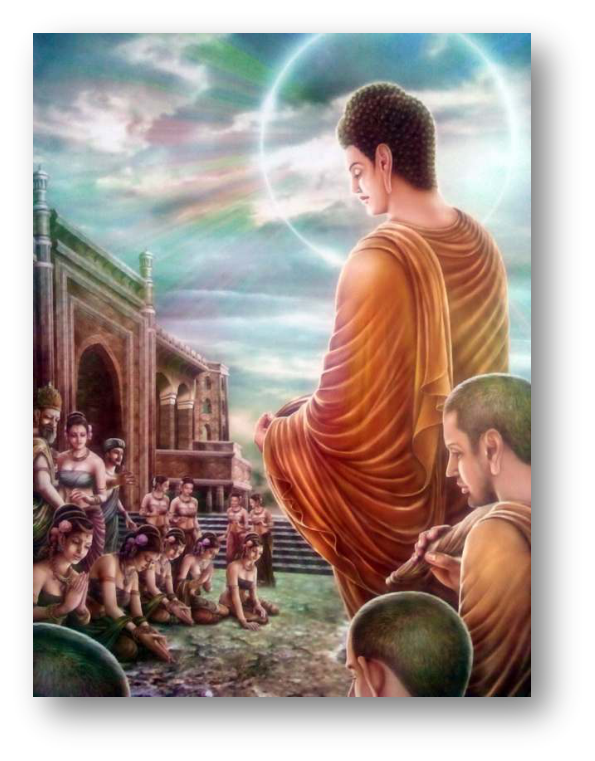
arising of sensual desire that has been abandoned. [ The same formula is repeated for the remaining hindrances: ill will, sloth and torpor, restlessness and anxiety, and doubt]
已舍离的欲贪复又生起。[其余诸盖亦复如是:瞋恚、昏沉睡眠、掉举与恶作,以及疑。]
In this way he remains focused internally on mental qualities in and of themselves, or externally on mental qualities in and of themselves, or both internally and externally on mental qualities in and of themselves Or he remains focused on the phenomenon of origination with regard to mental qualities, on the phenomenon of passing away with regard to mental qualities ,or on the phenomenon of origination and passing away with regard to mental qualities. Or his mindfulness that ' There are mental qualities' is maintained to the extent of knowledge and remembrance . And he remains independent, unsustained by ( not clinging to ) anything in the world. This is how the monk remains focused on mental qualities in and of themselves with reference to the five hindrances"
如是,他于内在之诸心法,安住于对其“如其本然”(in and of themselves)的观照;或于外在之诸心法,安住于对其“如其本然”的观照;或于内外之诸心法,安住于对其“如其本然”的观照。或者,他安住于观察诸心法之生起(origination)现象;或安住于观察诸心法之灭去(passing away)现象;或安住于观察诸心法之生起与灭去(origination and passing away)现象。或者,他将“有诸心法”(There are mental qualities)之念住,维持到仅足以成就知与忆念(knowledge and remembrance)的程度。而他保持独立,不依止于世间任何事物(不执取、不黏著)。这就是比丘以五盖为所缘,安住于对诸心法“如其本然”的观照。"
( The Buddha came back to Kabillabhat Town . )
(佛陀回到迦毗罗跋陀镇。)
Page 75



PART THREE :) practice meditation
第三部分:)修习禅修
PRACTICE MEDITATION Saupadisesa Nibbana Nibbana with the substratum of life remaining Anupadisesa Nibbana : Nibbana without the substratum of lifre remaining
禅修实践 有余依涅槃(Saupadisesa Nibbāna) 生命之依处尚存的涅槃 无余依涅槃(Anupadisesa Nibbāna):涅槃 生命之依处不复存留的涅槃
The purpose of to practice meditation is to achieve the NIBBANA.
修习禅修的目的,是为了证得涅槃(Nibbana)。
Nibbana is the state whereby all the burning desires, piecing pains, passions and sufferings closely associated with the human mind are being extinguished. The manner by which the "burning heat " of the mind is being extinguished refers to the manner by which the mind reaches the extinguishing point which is called " Nibbana"
涅槃(Nibbana)是一种境界:与人类心识密切相系的一切炽燃的欲望、刺痛的苦受、激情与诸般苦恼,皆于其中止息、熄灭。所谓熄灭心的“burning heat(炽热)”,即指心如何趋入并抵达那名为“涅槃(Nibbana)”的寂灭之点。
Thus " Nibbana' in the human and spiritual context implies a condition in which our mind is absolutely not being burnt and pierced by all sorts
因此,在人类与灵性(spiritual)语境中,“涅槃(Nibbana)”意指一种状态:我们的心绝不再被种种(烦恼等)所灼烧、所刺穿。
Page 76
of desires and other associating feeling of binding attachment and cravings
欲望,以及其他与束缚性的执取与渴爱相应的诸受
3.1) Tools for Practicing Dhamma
3.1)修习佛法(Dhamma)的工具
An important tools for observing mind is mindfulness and clear comprehension (sati and sampajanna) As a matter of fact, the word “mindfulness” in the Tipitaka means recollection. The Abhidhamma further explains that mindfulness is characterized by the presence of mind. It also indicates that the proximate cause of mindfulness is a strong perception of the condition. which mean awareness, attentiveness, and constant observation. The vipassana meditation is to be aware of the feelings that are happening in our mind. Some examples are feelings of doubt, greed, worry, happiness and sadness. This is the practice of being mindful, which is the tool to be aware of the objects of consciousness that arise. We are all encouraged to be aware and not to get lost through the six sense doors, namely, the eyes, ears, nose, tongue, body (tactile sense) and mind, of which most common are through the eye and the mind doors, intently focusing on an object or getting lost in the world of thoughts. By consistently being aware, not getting lost in thoughts or over-focusing, we can achieve clear comprehension, clarity of consciousness.
观察内心的重要工具,是正念与正知(sati 与 sampajañña)。事实上,在《三藏》(Tipiṭaka)中,“mindfulness”一词意为“recollection”,即忆念/不忘失。《阿毗达摩》(Abhidhamma)进一步说明:正念的特相在于“心之现前”(令心不失)。又指出,正念的近因,是对当下所缘状态强而有力的认知/辨识(perception of the condition),亦即觉察、专注与持续观察。内观(Vipassanā)禅修,是如实觉知我们心中正在发生的诸受,例如疑、贪、忧虑、喜与悲等。这就是修习正念;正念作为工具,使我们能够觉知随时生起的识所缘境(objects of consciousness)。我们都被鼓励保持觉知,不要在六门(六根门)中迷失:眼、耳、鼻、舌、身(触觉)与意;其中最常见的是由眼门与意门而迷失——或执着地盯住某一对象,或沉溺于思绪的世界。借由持续的觉知,不随念头迷失,也不落入过度用力的专注,我们便能成就正知,并获得清明的心识(clarity of consciousness)。
Through continuous practice , your mindfulness and clear comprehension will gain strength and your awareness becomes more refined . Each time the mind tell you to do something , you do not take
通过持续不断的练习,你的正念与正知将逐渐增强,觉知也会愈加细腻。每当心指使你去做某件事时,你都不轻易采取
Page 77
action immediately but mindfulness and clear comprehension will assist in determining whether your mind 's command should be followed: the four type of clear comprehension are :
未必需要立刻行动;正念与正知(sampajañña)能帮助你判断是否应当听从内心的“指令”。正知有四种:
3.1.1) Clear comprehension of purpose ( Satthaka - sampajanna)
3.1.1)有益性(目的)明了正知(satthaka-sampajañña)
informs you whether an action is useful or not . The main you types of usefulness are :usefulness for the body and for the development os wholesome states . For example , when someone is walking nex t to you as you are practicing walking meditation ,you are incline to turn into that direction to find out who that person is . But you clear comprehension will ponder whether that action is . useful or not . If it is determined to be useful ,You can take a look at the person . if not , then you should not pay attention . Observe yourself during mindfulness practice if you have ever felt this way .
它告诉你某个行动是否有益。主要的“有益”包括两类:对身体有益,以及有助于培育善法(wholesome states)。例如,当你在练习行禅时,有人从你身旁走过,你会倾向于转向那边,想看清对方是谁。但正知会审量:这样做是否有益。若判定有益,你可以看对方一眼;若无益,则不应分心去注意。在正念练习中,若你也曾有过这种心态,请如实观察自己。
3.1.2 . Clear comprehension of suitability ( Sappaya - sampajanna) decides whether an action commanded by the mind will lead to danger or not .
3.1.2.适宜正知(Sappāya-sampajañña)用于判断由心所驱动的行动是否会导致危险。
3.1.3. Clear comprehension of the domain ( Gocara - sampajanna) contemplates all movements of the body, from the beginning to the end . For instance , you are aware of your hand reaching out, being lowered , touching something , or yourself drinking
3.1.3.行境正知/领域正知(Gocara-sampajañña)观照身体一切动作的全过程,从开始到结束。例如,你能觉知手伸出、放下、触及某物,或觉知自己在饮用。
Page 78
something , putting something down. You are completely aware of all physical activities.
……做某件事、放下某件事。你对一切身体活动都能完全清楚地觉知。
3.1.4. Clear comprehension of reality (Assmoha- sampajanna ) contemplates the action between the mind and the body .As the mind commands it, the body's action follow in order to satisfy the mind . For instance , you become instantly aware that you are standing up as a result of the mind's command. This kind of awareness is called awareness through existence, sense-doors and the Four Primary Elements . element of extension ( solid element ) , element of cohesion ( fluid element) element of heat or radiation ( heating element) element of vibration or motion ( air element )
3.1.4. 对真实的清晰理解(Assmoha-sampajanna;亦可作“无痴正知”)观照的是心与身之间的作用过程。随着心的指令,身体的行为随之发生,以满足心的意向。例如,你会立刻觉知到:你之所以站起来,是由于心的命令所致。这种觉知称为通过“存在”、根门(sense-doors)以及四大(Four Primary Elements)的觉知:延伸要素(坚固要素),凝聚要素(流动要素),热或辐射要素(加热要素),振动或运动要素(风要素)。
3.2 Samatha and Vipassana Meditation
3.2 奢摩他与毗婆舍那禅修(止观禅修)
3.2.1 The differentiation between Samatha and Vipassana
3.2.1 奢摩他与毗婆舍那的区分
Headings | Samatha | Vipassana The Purpose | Tranquillity | Enlightenment Level of Important | Secondary | Primary Characteristic | 1.lustful 2.Dosa | 1.Conventional
项目 | 奢摩他(Samatha,止) | 毗婆舍那(Vipassana,观) 目的 | 宁静(寂止) | 觉悟 重要性层级 | 次要 | 主要 特征 | 1.贪欲(lobha) 2.瞋恚(dosa) | 1.世俗(俗谛)
Page 79
of a person | 3.Deluded4.Faithful 5.Intelligent6.speculative | 2.Thinkable
就个人而言|3.迷妄型 4.信心型 5.智慧型 6.推理型|2.可思议
The Objects | Any objects | Foundation of Mindfulness 4
所缘境|一切所缘境|四念处
Practicing | Object examination | Characteristic of examination
修习|所缘观察|观察的特相
Practicing | Need quiet places | Daily life practicing
修习|需要安静处|日常生活中修习
The result | Happiness | Nibbana
结果|安乐|涅槃
The practice of insight meditation or vipassana bhavana ,inwhich mindfulness in Satipathan 4, is the most important element. The kind of insight practice is based on the state of the mind in between momentary concentration( khanika samathi) and neighborhood samadhi.
内观禅修,或毗婆舍那修习(vipassanā bhāvanā),其中最重要的要素,是四念处(Satipaṭṭhāna)中的正念。此类内观修习所依之心的状态,介于刹那定(khaṇika samādhi)与近行定(upacāra samādhi)之间。
The second is Samatha meditation, in which highly concentration of jhana has been already attained in this stage, the mind is completely controlled by the force of will power into the tranquil state of absorption , which actively prepare for application all duties including realization of the true nature through Satipatathan 4 and three kinds of wisdom.
第二种为止禅(Samatha meditation)。在此阶段已成就禅那(jhana)的高度专注;心在意志力的作用下被完全调御,进入寂静的禅定安止(absorption)状态,并积极为一切修行的开展作好准备,包括通过四念处(Satipatathan 4)与三种智慧而证悟真实本性。
Page 80
To practiced Samatha meditation , a properly structured environment is required. For example, it should be relatively seclude and quiet place , somewhat segregated from other activities and completely free from disturbances.
要修习奢摩他(Samatha)禅修,需要一个结构完善、布置得当的环境。例如,应选择相对僻静安宁之处,与其他活动适当隔离,并尽可能完全免于外界干扰。
Contrarily, vipassana meditation does not need any of these requirements. Although Samatha, in the initial states of practice, may prove valuable, but this training employs only one object as a tool for cultivating one - pointedness of mind, whereas meditation in the form of vipassana meditation , use all available experiences as the primary matrix by which mindfulness and insight may be developed.
相反,内观(Vipassana)禅修并不需要上述条件。尽管在修行的初期阶段,奢摩他(Samatha)可能确有助益,但这种训练仅以单一所缘为工具,用以培养心的一境性(one-pointedness of mind);而以内观(vipassana meditation)形式进行的禅修,则以一切可得经验为根本依托(primary matrix),由此发展正念与观照之智(insight)。
In this way , this kind of insight meditation can take place in all experiences, physical, emotional, and psychological, as its objects of training. It also means that one can practice it in all activities and situation that Samatha can not enjoy this kind of free range. So we may asset that Vipassana meditation in this kind of vipassana samadhi is one spiritual discipline that can be practiced in all times, in all places and all under circumstances.
因此,这类洞见禅修(insight meditation)可以在一切经验之中展开,将身体、情绪与心理等各类经验皆作为训练的所缘。这也意味着,人们能够在一切活动与情境中修习它;而奢摩他(Samatha)并不具备这种广泛而自由的适用范围。由此我们可以断言:在这种内观三昧(vipassana samadhi)中的内观(Vipassana)禅修,是一种可于任何时间、任何地点,并在一切境遇之下实践的精神修持。
Samatha and Vipassana meditation are also different in terms of the objectives and goals each aims to achieve . The former is connected with one pointed-ness of mind, tranquility , psychic powers , whereas the latters
奢摩他(Samatha)与内观(Vipassana)禅修在各自所欲达成的目的与目标上亦有所不同。前者侧重于心的一境性、寂静(tranquility)与神通(psychic powers),而后者则……
Page 81
aims as increased awareness, knowledge, wisdom, right understanding , virtues and purification of the mind and the realization of Nibana.
其目标在于增进觉知、知识、智慧、正见(正当理解)、诸德行与心的净化,并证悟涅槃(Nibana/Nibbāna)。
To practise this kind of meditation, Satipathana , the foundation of mindfulness is the key factor in the development of Vipassana . This mindfulness is the quality of awareness, which is applied to four groups of experiences , namely the body, the sensation , the mind and the mental objects ( particularly in reference to moral and spiritual experience of dhamma) . Thus the discourse is divided into four principal sections each dealing with and individual class of experiences on which mindfulness should be cultivated.
要修习这种禅修,Satipathana(Satipaṭṭhāna,念处/四念处)——作为正念的基础——是发展 Vipassana(Vipassanā,内观)的关键要素。此处所谓“正念”,是一种觉知的品质,应用于四类经验:身、受、心与法(心所缘对象;尤指与法——dhamma/Dhamma——相关的伦理与灵性体验)。因此,这部开示分为四大部分,分别论述应当培育正念的各类经验对象。
Beginners may find it more practicable to begin training with mindfulness with the first section of Satipathana on the body , particular the breathing exercises. Once the basic technique has been mastered, it becomes increasingly more natural to " ever dwell in meditation" constantly and effortlessly observing other parts of the body, the feeling , the mind and the mental objects , even while carrying one's own duties and responsibilities in the daily life.
初学者或会觉得,从 Satipathana(Satipaṭṭhāna,念处)的第一部分——观身(身念处)——开始训练正念更为切实可行,尤其是呼吸练习。一旦掌握基本技巧,便会越来越自然地“常住于禅修”之中,持续而不费力地观照身体的其他部分、感受、心与法(所缘对象),甚至在日常生活中履行自身职责与责任时亦复如是。
a ) Kāyānupassanā : Contemplation to the body
a)身随观:观身(Kāyānupassanā)
The first section of mindfulness deals with the body ( kayanupassana) This includes the breath , the physical postures, the body activities, the analysis of various physical components, the material
正念的第一部分讲的是身体(kayanupassana/Kāyānupassanā)。其内容包括:呼吸、身体姿势、身行(身体活动)、对各种身体成分的分析,以及物质(色法)
Page 82
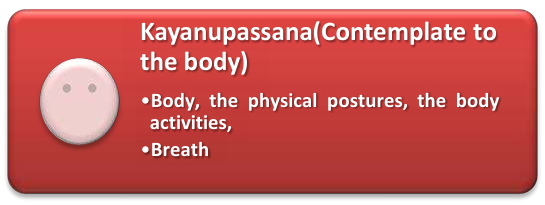
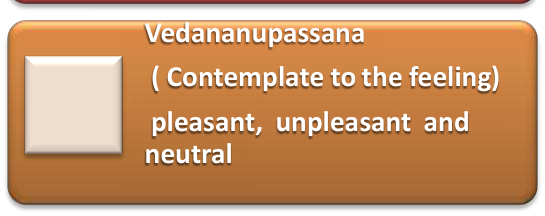
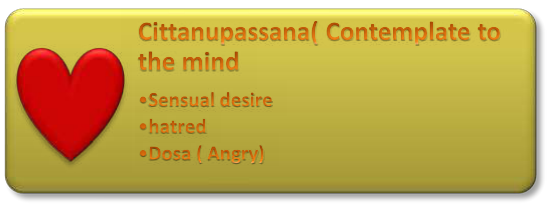
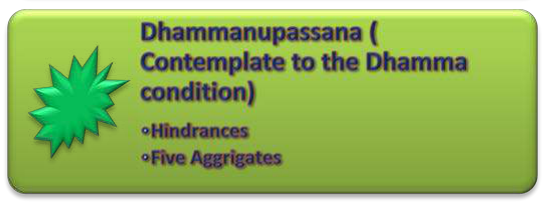
elements, and death. These are realities of life one has to deal with. One should practice constantly applying mindfulness to all these experiences founded on the body, for instance, mindful of the breath, whether short or long , shallow or deep, refined or crude, regular or irregular, and so forth. The purpose is to train the mind is on the present, by being constantly aware of what is going on at the moment. The same principle may be applied to the body posture, as standing, walking , sitting or lying down as well as to other physical activities like eating or drinking.
诸元素以及死亡,皆是人生必须面对的现实。应当恒常修习:对一切以身为依处的经验持续运用正念,例如于呼吸保持正念——无论呼吸是短或长、浅或深、细或粗、规律或不规律,等等。其目的在于训练心安住于当下,藉由持续觉知此刻正在发生之事。同样的原则亦可应用于身体姿势,如站立、行走、坐下或卧下;以及其他身体活动,如进食或饮水。
3.3) Foundation of Mindfulness
3.3)正念的基础(四念处)
Kayanupassana(Contemplate to the body) •Body, the physical postures, the body activities, •Breath
身随观(Kāyānupassanā,观身) • 身体、身姿(威仪)、身行(身业) • 呼吸
Vedanānupassana ( Contemplate to the feeling) pleasant, unpleasant and neutral
受随观(Vedanānupassanā,观受) 乐受、苦受与舍受(不苦不乐受)
Cittanupassana( Contemplate to the mind) •Sensual desire •hatred •Dosa ( Angry)
心随观(观心) • 欲贪 • 嗔恚 • 瞋(dosa,忿怒)
Dhammanupassana ( Contemplate to the Dhamma condition) •Hindrances •Five Aggregates
法随观(Dhammānupassanā,观法) (观照诸法的状态) • 五盖 • 五蕴
Page 83
b) Vedanānupassanā : contemplation to the feeling
b)受随观:观受(Vedanānupassanā)
The second section deals with feeling ( vedanānupassanā) of three types ,pleasant, unpleasant and neutral. These feelings keep arising one after another that mindfulness and circumspection should be applied to them at the moment they arise, understanding them objectively as conditioned phenomena that rise and fall according to the law of causality, not subjectively as " my feeling". According to the Buddha, the false belief in the existence of soul or self is largely due to our feelings. It is there for important that one should train oneself to perceive reality as it is, by simply observing one's own feelings for what they really are, natural phenomena that constantly arise and disappear in accordance with their conditionality. The other ways to consider feelings is the careful analysis of their nature, their origination and dissolution. In order to achieve this objective by the use of Vedana nupassana , one is fully mindful whether one experiences pleasant, unpleasant, or neutral feeling, and to be aware of the feeling without attachment to them.
第二部分论及感受(vedanānupassanā,受随观)的三种类型:乐受、苦受与不苦不乐受。诸受相续而起,应在其生起当下运用正念与审察(观照),以客观立场了解它们是因缘所生的有为法,依因果法则而生灭流变,而不以主观方式执为“我的感受”。依佛陀所说,对灵魂或自我实有的邪见,在很大程度上源自对感受的执取。因此,重要的是训练自己如实知见:只需如其所是地观察自身诸受,明了它们真实的性质——它们只是自然现象,随其条件而不断生起与消失。观受的另一方法,是细致分析其性质、其生起(缘起)与其灭尽(消逝)。为借由受随观(Vedanā nupassanā / Vedanānupassanā)达成此一目的,行者无论正经历乐受、苦受或不苦不乐受,都应保持圆满正念;只是觉知该感受,而不对之生起贪著与执取。
c) Cittānupassanā: contemplation to the mind
c)心随观:观心(Cittānupassanā)
The third section( Cittanupassana) deals with the mind . It is the spiritual practice involves the ability to understand and control one's own mind and thoughts, in various conditions such as sensual desire, hatred, vacillation, concentration, liberation etc, ever mindful of their origination
第三部分(Cittānupassanā,心随观)论及心。此为一项修习:于欲贪、嗔恚、心之动摇与散乱、定(专注)、解脱等诸种状态中,培养如实了知并调御自身之心与诸念的能力,并恒常保持对这些心态生起之觉知。
Page 84
and dissolution. Besides observing how they change and are conditioned, the meditators should constantly apply full awareness of the present moment of experience only, not the past of the future and simply acknowledging the existence and nature of those mental phenomena .There is no conscious intervention involved to suppress one thought or encourage another. It is a simple, uncomplicated process of recognizing the realities as they are, a pure psychological act of detached understanding and acceptance.
……以及灭去。除了观察它们如何变易、如何为诸缘所制约之外,禅修者还应持续将圆满的觉知安住于当下这一刻的经验本身,而非落入过去或未来;只是如实承认那些心理现象的存在及其性质。整个过程中不作任何有意的干预:既不刻意压制某一念头,也不刻意助长另一念头。它是一种简单而不繁复的如实认知过程——如其所是地认识实相;这是一种纯粹的心理活动,体现为超然的理解与接纳。
By continually practicing according to this method, one not only comes to understand oneself better, but will eventually be able to penetrate deeply into the most remote reaches of one's own consciousness . This kind of practice is not only valuable as far as Vipassana is concerned, but substantially contributes to peace and harmony , both within the individual and society.
通过依此方法持续练习,人不仅能更深入地认识自己,终将亦能透彻洞见自身意识最幽微、最深远的层面。这类修习不仅对内观(Vipassana)具有重要价值,也将显著促进和平与和谐——无论在个体内在层面,抑或在社会层面。
d) Dhammānupassanā , discuss the dhamma as a system of ethical and spiritual experiences . In the practical term, This may also include mindfulness in contemplation, deliberation, and investigation of the Buddha's teachings in the context of one's own perception at the present moment. Because these Dhamma experience are subjected to the contemplation and investigation of mind, they are referred to as mental objects. A few categories of Dhamma are listed in Satipathana Sutta such
d)法随观(Dhammānupassanā):将法(Dhamma)作为一套伦理与灵性经验的体系加以观照与阐述。在实践层面,这也可包括:在当下自身知觉的语境中,以正念对佛陀教法进行观想、审思与探究。由于这些法的经验会成为心所观照与考察的对象,故称为“心所缘境”(mental objects)。在《念处经》(Satipaṭṭhāna Sutta)中列举了若干类法,例如
Page 85
as ; the five hindrances, the five aggregates, The six Senses Bases, the seven Factors of enlightenment, the Four Noble Truths.
例如:五盖、五蕴、六处(六入处)、七觉支、四圣谛。
3.4) The purpose of Samatha and Vipassana
3.4)奢摩他与毗婆舍那的目的
As mention earlier, there are two main types of meditation found in Buddhism: Samatha and Vipassana. In coming to the practice of Samatha or Vipassana, we need to have the mental clarity to know which one we have selected and for what purpose. The purpose of Samatha is to bring a mind that is not peaceful to a state of peace, to bring a mind that is not happy to a state of happiness, and do bring an unwholesome mind to a state of virtue.
如前所述,佛教中主要有两类禅修:止(Samatha)与观(Vipassanā)。开始修习止或观时,我们需要具备清明的心,知道自己选择的是哪一种,以及为此而修的目的。止的目的,是令不安宁的心归于安宁,令不快乐的心转为快乐,并使不善心转为善、趋向德行。
In Vipassana, we do not practice to change anything in this way, but to gain a proper understanding of the way things are (sammā-ditthi). We practice so we can see the true nature of body and mind. The body and mind were seen by the Buddha as five distinct groups or aggregates called the five khandhas. Each of which has the inherent characteristic that is called non-substantiality and unsatisfactoriness (dukkha). We must come to know the truth of this in our experience. So our job is to become aware of the body and mind regularly with an inner watchfulness.
在观(Vipassanā)中,我们并非以这种方式去改变什么,而是为了如实获得对事物的正确理解(sammā-diṭṭhi,正见)。我们修习,是为了亲见身心的真实本性。佛陀将身与心观察为五个彼此区分的组(蕴),称为五蕴(khandha)。每一蕴都具有内在的特相:无实体性(无我性)与不圆满/不满足性,即苦(dukkha)。我们必须在自身经验中亲证这一真理。因此,我们的任务是以内在的警觉(守护心),持续而规律地觉知身与心。
This is the practice of Vipassana. When we practice in this way with frequency, wisdom arises – we come to know the true nature of the body and mind. This kind of wisdom is called right understanding (sammāditthi). We come to know that the body and mind are impermanent, suffering and are not
这就是观(Vipassanā)的修习。当我们经常如此练习时,智慧便会生起——我们将认识到身与心的真实本性。这种智慧称为正见(sammā-diṭṭhi)。我们会认识到身与心是无常的、是苦的,并且并不
Page 86
our self, not us. When we have enough wisdom to see the truth of this clearly, authentically, consciousness can then let go of any attachment to the body and mind, and automatically comes to know nirvana (Nibbāna), the end of suffering.
只是“自我”的错觉,并非“我们”本身。若我们具足足够的智慧,能够清晰、如实地洞见这一真理,心识(consciousness)便能放下对身与心的一切执著,而自然证知涅槃(Nibbāna)——苦的终止。
If we practice watching the body and mind a great deal, one day we will truly see that the body and mind are just aggregates, elements of nature, fractions of the earth. They are not us, nor do they belong to us. When we see the truth that there is nothing we can constitute as being ourselves, we will reach the first stage of enlightenment called stream-entry (sotāpanna). If we continue watching the body and mind carefully to the point of letting go of all attachment to them, then we become an arahant - one who has completely ended suffering. An arahant is not someone who is able to make the mind something permanently good, or create permanent happiness or permanent peace. He or she is one who no longer takes interest in such things. Peace, happiness and the like are worldly endeavors. An arahant knows the futility in trying to pursue satisfaction through worldly measures. He or she knows the true nature of body and mind and is beyond any attachment to them. We need to practice Vipassana to learn the truth about the body and mind that we consider our own. True liberation, the end of suffering, is not in trying to make the mind permanently happy or peaceful, but in seeing the nature of the body and mind as
若我们勤修观照身与心,终有一日会真正见到:身与心不过是诸蕴(aggregates,khandha)、自然界的诸元素、乃至大地的一分。它们非我,亦非我所。若我们如实见到:实无一法可被构成为“我”或“我自己”,便能证入初果——入流(stream-entry,sotāpanna)。若继续细致观照身与心,乃至对它们的一切执著彻底放下,便成阿罗汉(arahant)——已全然止息诸苦者。阿罗汉并非能令心恒常“善好”,或造作永久的快乐、永久的安宁者;而是对这些不再起兴趣的人。安宁、快乐等,皆属世间的经营。阿罗汉了知:以世间尺度追逐满足终归徒劳;他/她洞悉身心的真实本性,超越对其任何执取。故我们应修习内观(Vipassanā),以了知我们误以为“属于自己”的身与心之真相。真正的解脱——苦的终止——不在于企求令心恒常快乐或安稳,而在于如实观见身与心的本性为
Page 87
impermanent, suffering and not us – and then letting go. Wisdom arises when there is concentration or samadhi. Formally put, samadhi is the proximate cause for wisdom. However, samadhi is of two kinds and only the second one is conducive to wisdom.
……观照无常、苦、非我——继而放下。智慧在定力或三摩地(samādhi)具足时生起。严格地说,三摩地是生起智慧的近因。然而,三摩地有两类,只有第二类才有助于智慧。
3.5 ) Two kinds of Samadhi
3.5)两种三摩地
The first kind of samadhi is calld object-examination (aramma- n’upanijjhana).and another one is characteristic -examination (lakkha-n’upanijjhana).
第一种三摩地称为“所缘审察”(巴利语:阿拉玛那·乌帕尼迦哈那),另一种称为“特相审察”(巴利语:拉克卡那·乌帕尼迦哈那)。
a) Aramma-n’upanijjhana : or (object-examination): when there is just one object of attention and the mind sticks to this object and is rendered still. The mind is very focused and peaceful in this state. An example is meditation on breathing. The mind moves down into the breath and clings to it. Another choice for this type of meditation is the rising and falling of the abdomen. The meditator will let his mind sink down into the movement of the abdomen and rest there peacefully. In walking meditation, those who hold their focus on the feet are also exhibiting this first type of samadhi . This first type of samadhi, object-examination, is accomplished during calmness meditation, otherwise known as Samatha meditation. Even using the mind itself as the object of meditation can bring us into this type of samadhi. Watching the mind isn’t always Vipassana. If we watch the mind incorrectly, and hold it still, we are just doing Samatha. It is the same as intently keeping our mindfulness on the
a)Aramma-n’upanijjhana:或称“所缘审察”(object-examination):当注意仅有一个所缘时,心黏著于此所缘而被令其寂止、静止。在这种状态下,心非常专注且安宁。一个例子是观呼吸的禅修:心往下沉入呼吸之中并执著于它。此类禅修的另一种选择是观腹部的起伏。禅修者会让心沉入腹部运动之中,并在其中安然住着。于行禅中,那些把专注保持在脚上的人,也是在展现这种第一类三摩地。这第一类三摩地——所缘审察——是在寂止禅修中成就的,也就是所谓的止禅/奢摩他(Samatha)禅修。甚至以心本身作为禅修所缘,也能令我们进入这种三摩地。观心并不总是内观/毗婆舍那(Vipassana)。如果我们观心的方法不正确,并把心固定不动,那我们只是在修止(Samatha)。这就如同一味地把我们的正念紧紧放在……
Page 88
breath. The mind is of the nature to know an object. The object is that which is of the nature to be known. So if we watch the breath, the breath is the object; the breath is what is known. If we watch the body standing, walking, sitting and lying down, the body is the object; the body is what is known. Greed, anger and delusion are things that are known. The mind is what knows these things. The mind itself can be both known and that which knows, but it is not both at the same time. Everything happens in succession. The process can only be described as a succession of minds or mental moments. At one mental moment the mind is angry. In the next moment, the mind knows this. The mind that is angry is gone and replaced by the mind that knows. The mind is the one that knows all of the khandhas or aggregates When the mind itself is known, it is functioning as the object. No matter what the object of meditation may be, if we are focusing on it, we are practicing Samatha and will achieve aramma-n’upanijjhana, the first kind of samadhi. If we are looking to practice Vipassana meditation, then we need to learn about the second kind of samadhi. It is called characteristic-examination(lakkha-n’upanijjhana).
……呼吸。心的本性是能知所缘;所缘的本性是被知。因此,当我们观呼吸时,呼吸即是所缘(对象),亦即被知之法。当我们观身的站立、行走、坐下与躺卧时,身体即是所缘(对象),亦即被知之法。贪、嗔、痴是被知之法;心则是知此诸法者。心本身既可成为被知之法,也可作为能知者,但不可能在同一刹那同时兼具二者。一切皆依次相续而起,此过程只能描述为心(citta)或心刹那的相续:某一心刹那中,心生嗔(发怒);下一刹那,心知此嗔。生嗔之心已灭,取而代之的是知嗔之心。心是能知一切五蕴(khandha;aggregates,蕴)之法者。当心本身被知时,它便作为所缘(对象)而起作用。无论禅修所缘为何,只要我们将注意力系念于其上,即是在修习奢摩他(Samatha,止),并将成就 aramma-n’upanijjhana(所缘随观禅那/安止),这是第一类三摩地(samadhi,定)。若欲修习毗婆舍那(Vipassana,观),则需学习第二类三摩地,称为 lakkha-n’upanijjhana(特相省察/观照特征)。
Samadhi is stability of mind, not just concentration. When the stable observer is achieved, it witnesses the antics of the body and mind at a distance. It is a feeling of separation, not an action separation or " out of the body" experience. The mind, or the consciousness does not leave the body, but is seen as something completely distinct from the body.
三摩地(samadhi,定)是心的安住与稳定,而不只是专注。建立起稳定的“观察者”之后,它仿佛在一定距离外观照身心的种种造作与起伏。这是一种“分离感”,并非身体真的分离开来,也不是所谓“出体”的经验。心或识并不会离开身体,而是被清楚地如实见到:它与色身截然有别。
Page 89
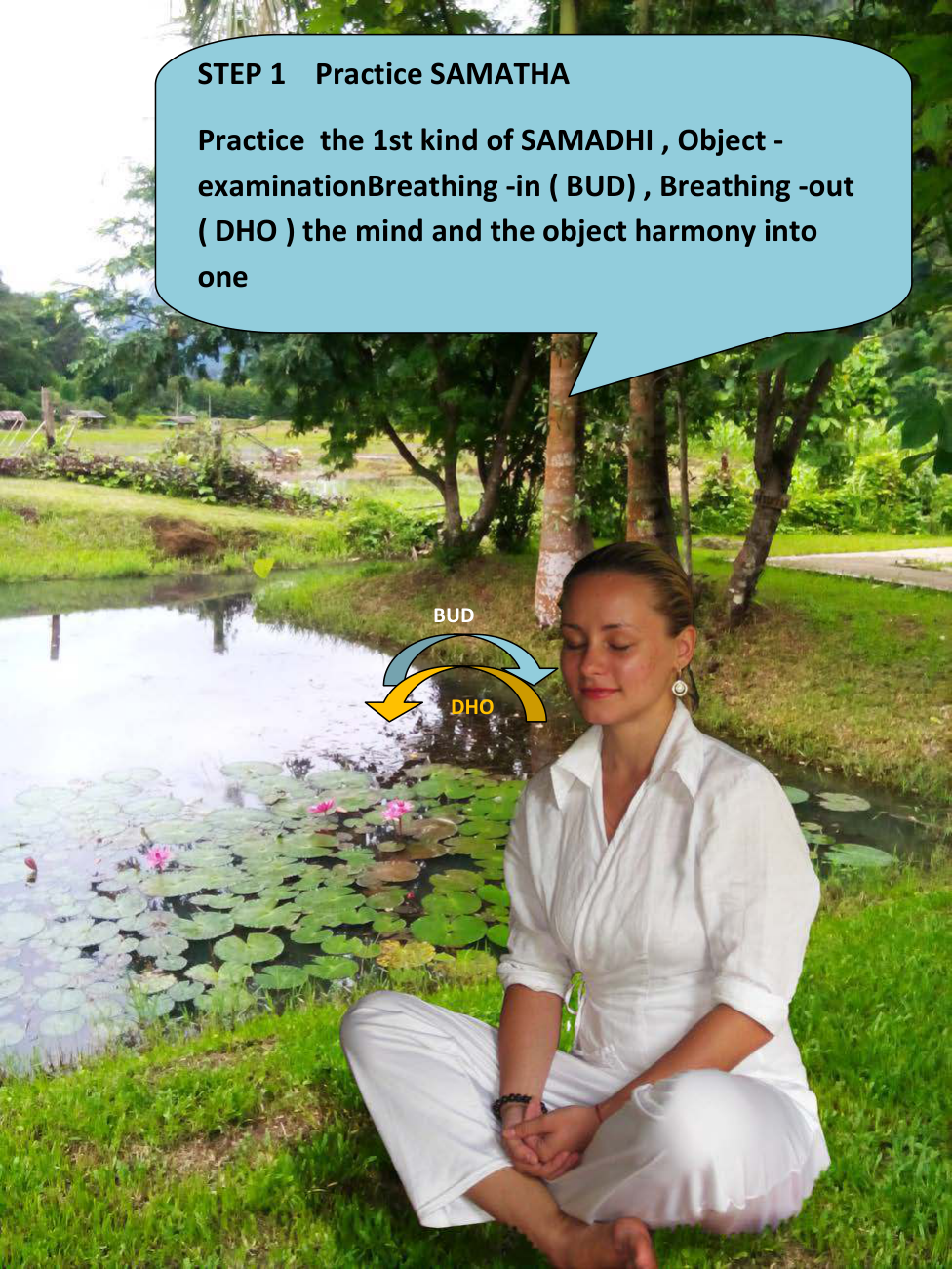
STEP 1 Practice SAMATHA Practice the 1st kind of SAMADHI , Object - examination Breathing -in ( BUD ) , Breathing -out ( DHO ) the mind and the object harmony into one
步骤 1 修习 SAMATHA(奢摩他) 修习第一种 SAMADHI(三摩地):以所缘(Object)为观察对象;吸气时默念“BUD”,呼气时默念“DHO”,令心与所缘相应、和合为一。
BUD DHO
BUD DHO
Page 90
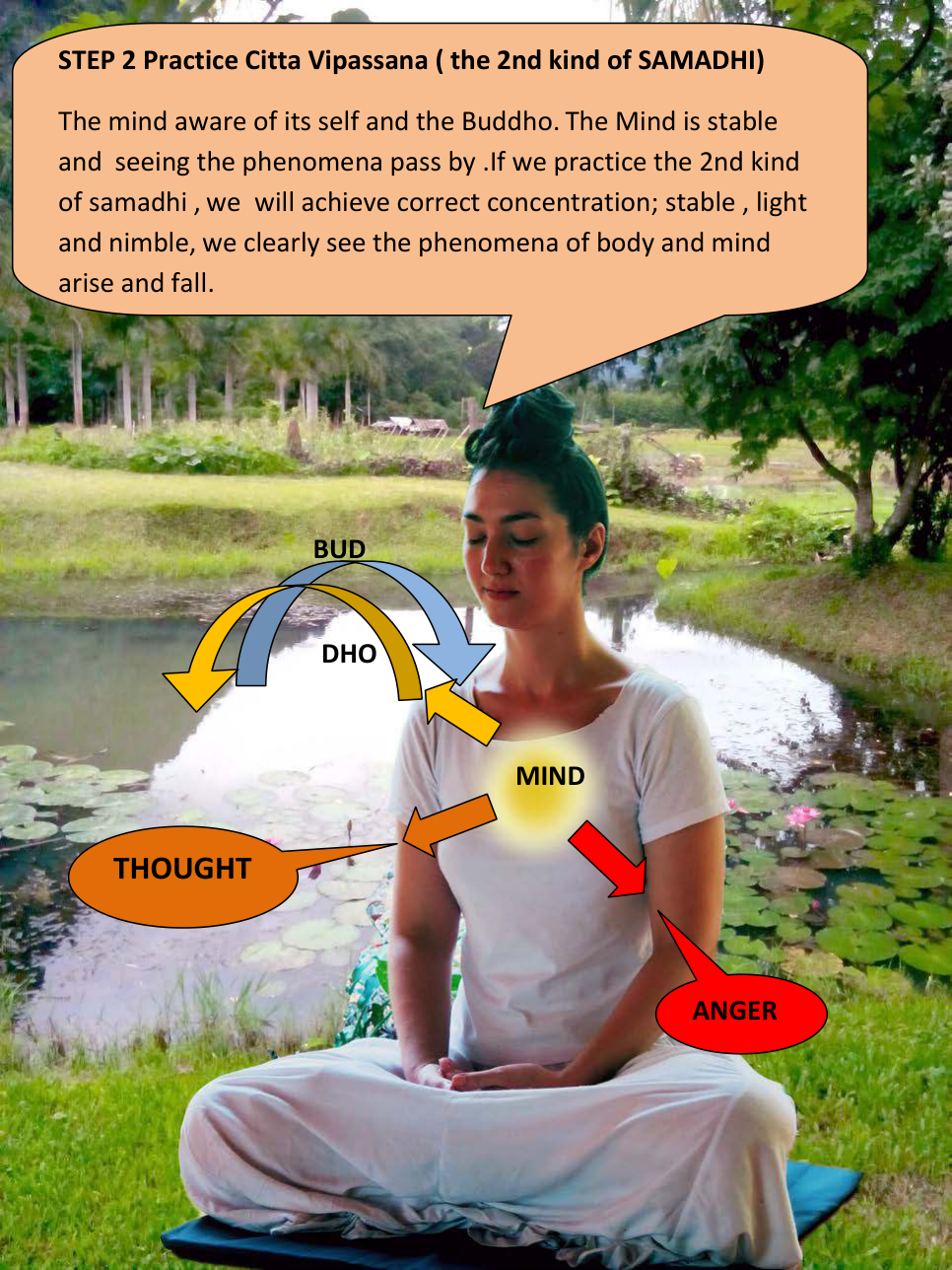
81
81
STEP 2 Practice Citta Vipassana ( the 2nd kind of SAMADHI)
STEP 2 练习心内观(Citta Vipassanā:第二种三摩地)
The mind aware of its self and the Buddho. The Mind is stable and seeing the phenomena pass by .If we practice the 2nd kind of samadhi , we will achieve correct concentration; stable , light and nimble,we clearly see the phenomena of body and mind arise and fall.
让心觉知自身以及 Buddho(佛陀随念/“Buddho”)。此时之心安住稳定,能观诸现象次第流过。若我们修习第二种 samadhi(三摩地),便能成就正定:安稳、轻安而敏捷;并能清楚观见身心诸法的生起与灭去。
BUD DHO MIND THOUGHT ANGER
BUD DHO MIND THOUGHT ANGER
Page 91
The first type of Samadhi Know only Bud-dho. But the second type of Samadhi know both the mind and the Bud-dho.
第一类三摩地只觉知“佛陀”(Bud-dho)。但第二类三摩地既觉知心,也觉知“佛陀”。
b ) (lakkha-n’upannijjhana).or (characteristic -examination )
b)(lakkha-n’upannijjhana),即“特相审察”
This samadhi is one that is stable in the sense that it remains separate from phenomenon. It allows us to see the characteristics of body and mind, of mental and physical phenomena (rupa-nama). We may see the body is not us but is just matter, or the working of elements, or just processes of sensory input and interpretation. In the second type of samadhi, the mind is the stable and unattached watcher or knower. The kind of samadhi where the knower arises is essential for seeing the truth, seeing the three Characteristics. The knower is the colloquial term for concentration of the characteristic examination variety. It is the place from where we can practice Vipassana. In a few moments, I will describe how we can practice so that the knower can arise.
这种三摩地之所以稳定,是因为它不与现象相混,能与境保持分离。它使我们得以看见身与心的特征,即身心的名色现象(rupa-nama)。我们可能会看到:身体并不是“我”,它只是物质,只是诸元素的运作,或只是感官输入与诠释的过程。在第二类三摩地中,心是稳定、无执著的观察者或“知者”(knower)。“知者”生起的这类三摩地,对于见到真相、见到“三相”(three Characteristics)至关重要。“知者”是对“特相审察”(characteristic-examination)这一类定力的通俗称呼。它是我们得以修习内观(Vipassana/Vipassanā)的立足处。稍后我将说明,我们可以如何练习,使“知者”生起。
The reason why the mind runs around looking for this and that is because it is incessantly looking for happiness. Our decision to listen to or to read this Dhamma talk is because we are looking for happiness. After we finish listening or reading, we may look for something tasty to eat to once again in pursuit of happiness. Then after we eat and feel full, we think we will be happier if we take a rest. The mind and body are running around looking for objects to bring happiness constantly. However, if the mind is happy with the object it is involved with already, then it will not go off looking for something else. This is
心之所以四处奔走、寻觅这样那样,是因为它不停地在追求快乐。我们决定来听或来读这篇法谈(Dhamma talk),也是因为我们在寻找快乐。听完或读完之后,我们可能又去找些好吃的东西,以便再次追逐快乐。接着,吃饱之后,我们又会认为:若能休息一下,会更快乐。身与心总在奔走,不断寻找能带来快乐的对象。然而,如果心对它当下所缘的对象已经感到满足,它就不会再跑去寻找别的东西。这就是
Page 92
the secret to proper Samatha meditation. This is how we can stop the busy mind and have a restful time of peace. Samatha has an important purpose. We need it to rest the mind so it can have power and fortitude. If we don’t practice Samatha and achieve the first kind of samadhi, our Vipassana practice will be greatly hindered. We won’t have the fortitude and momentum to keep up the practice. Those of us that watch the mind well will see that the mind cannot walk the path of wisdom all the time. It will need to rest. The mind will move into Samatha automatically at times, staying still in one place. In fact, it does this even more often than Vipassana. Wisdom comes up just for a short while at a time, and then the mind becomes still again. A word of warning to those that prefer to watch the mind: make sure you keep up Samatha practice as well. It is essential in order to keep the mind fresh and powerful enough to walk the path of wisdom well. Those without the first kind of samadhi will have trouble doing Vipassana for longer periods. Wisdom may arise briefly and then the mind will go off on a thinking tangent. Those that are too attached to Samatha should be careful too. The mind may be resting well for a while but then go off into dazes or dream states.
这是如法修习奢摩他禅修(Samatha)的秘诀。如此,我们才能止息纷扰忙乱的心,安住于宁静而安稳的休息之中。奢摩他(Samatha)有其重要目的:令心适当休息,使之具足力量与耐力。若不修奢摩他(Samatha),并证得第一类禅定(samādhi),内观(Vipassanā)的修习将大受障碍;我们将缺乏持续用功所需的耐力与推动力。善于观心的人会发现:心不可能时时都走在智慧之道上,它也需要休息。有时心会自然而然进入奢摩他(Samatha),于一处安住不动。事实上,这种情形出现得甚至比内观(Vipassanā)更频繁。智慧往往只是短暂现起,随后心又复归寂静。提醒偏好观心者一句:务必同时持续修习奢摩他(Samatha)。这对于保持心的清新与充沛力量至关重要,使其足以稳健地行走于智慧之道。若未具足第一类禅定(samādhi),要长时间修习内观(Vipassanā)会较为困难:智慧也许短暂生起,随后心便会转而落入思惟的岔路。对奢摩他(Samatha)过于执著者亦须谨慎:心也许一时休息得很好,但之后可能滑入昏沉、迷糊,乃至梦境般的状态。
For both kinds of samadhi, the principles are quite easy. In the first kind, choose an object in the body or mind that we are happy with. When the mind is happy, it will stay concentrated and have no need to look for happiness
对于这两类禅定(samādhi),其原则都相当简要。在第一类中,选择一个令我们感到安适、欢喜的身或心所缘。当心生起欢喜时,便能自然保持专注,不再需要向外追寻快乐。
Page 93
elsewhere. In the second kind, we watch a meditation object and notice whenever the mind goes away from or towards it instead of just knowing it.
……跑到别处。在第二种情况下,我们观照一个禅修所缘(meditation object),并在心远离或趋向它的任何时候如实觉察,而不是只是一味“知道”它。
3.6 ) Practicing Mindfulness in Daily life
3.6)在日常生活中修习正念
Once we understand the proper principles of Dhamma, it is time to put the teachings to practice in our daily lives . Let's get rid of the image that many of us have in our heads, that a good Vipassana or Dhamma practitioner sits cross- legged with the eyes and closed. The most important part of the practice is mindfulness through our regular activities in daily life. Whenever an impurity arises in the mind , we know that it has right then and there, irrespective of what else we may be doing at the time. That is called Dhamma practice. When the body makes movement and we know it , that is Dhamma practice. When the mind forms a thought or an emotion and we know it has just doneso , we practice the Dhama for that moment
当我们理解了正法(Dhamma)的正确原则之后,就应当把教导落实到日常生活中去实践。让我们放下许多人脑海里固有的印象:以为好的内观(Vipassana)或正法修行者就是盘腿而坐、闭目不动。修行最关键的部分,是在日常生活的常规活动中持续保持正念。每当心中生起烦恼染污(impurity)时,不管当时正在做什么,都要在那一刻、在那当处如实知它已生起——这就叫作正法修行。当身体产生动作而我们如实知其动作时,这也是正法修行。当心生起一个念头或一种情绪,而我们了知它刚刚生起时,在那一刻我们就在修习正法(Dhamma)。
a) Awareness when we get up in the morning , we practice to awareness that we lying down on the bed , and next may awareness the breath, breathing " Bhud" , Breathing out " Dho". Apart from this we may also required to become realize that the body that is lying down is known by the mind , The mind is a " knower" .
a)清晨起身时的觉知:我们练习先觉知自己正躺在床上;接着可以觉知呼吸——吸气时默念“Bhud”,呼气时默念“Dho”。除此之外,我们也需要进一步体会:正躺着的这个身体是被心所了知的;心是“知者”(knower)。
Page 94
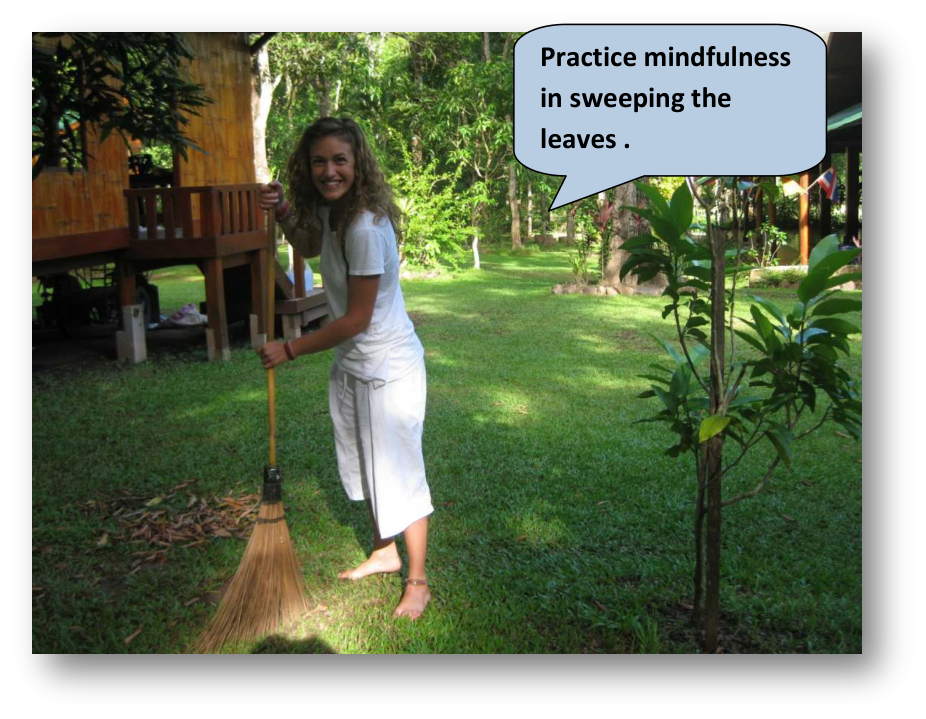
Practice mindfulness in sweeping the leaves .
扫落叶时练习正念。
b) Awareness of the bathroom activities.
b)对浴室活动的觉知。
While taking a shower, brushing our teeth , or performing other activities in the bath room , we should awareness the body is standing or sitting postures while we in the bathroom , and mind is a knower who know this postures .The body is only the mass of something that is observed by the mind.
当我们洗澡、刷牙,或在浴室进行其他活动时,应当觉知:在浴室中,身体处于站立或坐姿等姿势;而心是“知者”,能够了知这些姿势。身体只是被心所观察到的色身聚合。
c) Now when we are at work, we should be focused on our duties at hand. However . if we have a few minutes here and there with nothing to do, we can immediately start to watch the body and mind.
c)当我们在工作时,应当专注于眼前的职责。然而,若间或有几分钟无事可做,便可立刻开始观照身与心。
Page 95
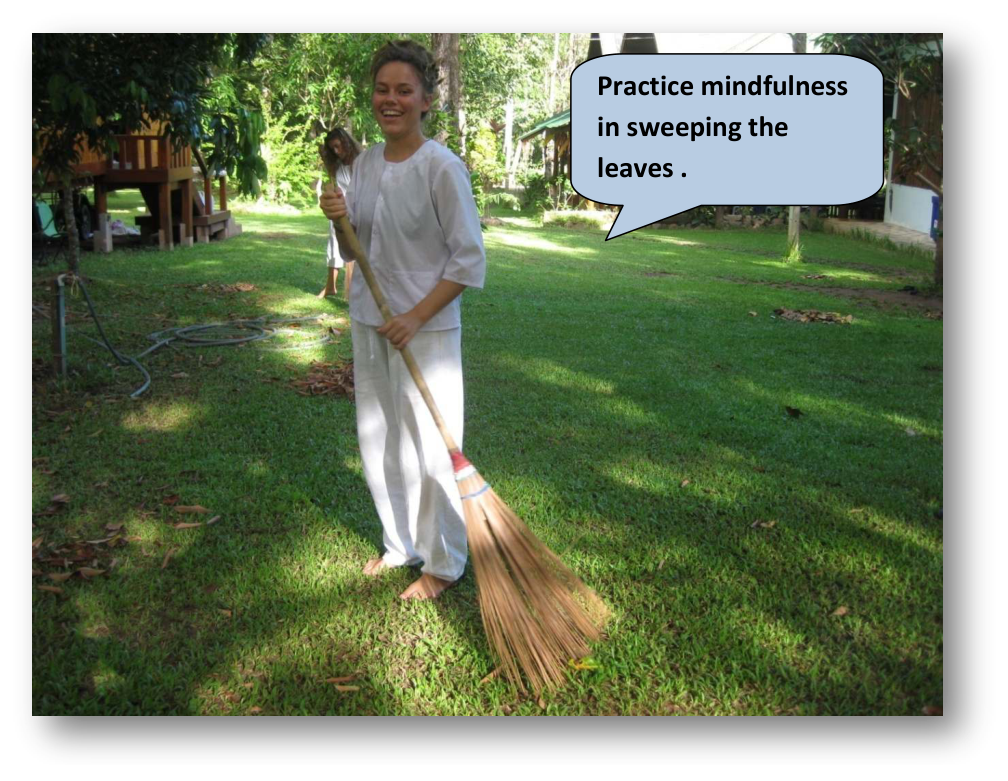
can know the stress has arisen . That is Dhama practice right then and there. Perhaps we are hurry to complete a project and then someone calls and is wasting our time .Our mind feel angry. We then can practice
我们能够觉知到压力(stress)已经生起。这就是当下、此时此地的法(Dhamma)修行。也许我们正赶着完成一个项目,这时有人来电,占用了我们的时间,我们心中生起嗔怒。此刻,我们就可以用它来修行。
Practice mindfulness in sweeping the leaves .
扫落叶时练习正念。
mindfulness and know that anger has arisen. Then we keep working away until we look at the clock and it is lunch time. Satisfaction arises and we become aware and see that it has. This is what a true Dhamma practitioner does.
保持正念,了知嗔怒已经生起。然后我们继续手头的工作,直到看表才发现已是午餐时间。满足感生起,我们也能觉知到它,并如实看见它的生起。这就是真正的法(Dhamma)行者所做的。
Page 96
d) Next we go down for lunch and walk along and watch the body walking . The mind is the observer and the body is being observed. What to eat? There are so many choices today. We must be very hungry as everything looks wonderful . The mind is indecisive. We know that it is. On some days nothing at all looks appetizing and the mind feels annoy, " This cafeteria sucks. Can't they be more original?" If we don't have mindfulness the hungrier we are , the more we complain.
d)接着我们下楼去吃午餐,一边走一边观照身体的行走。心是观察者,身体是被观察的对象。吃什么呢?今天的选择太多了。我们一定很饿,因为什么看起来都很诱人。心犹豫不决——我们知道它就是如此。有些日子里,完全没有一样看起来可口,心里便生起烦恼:“这家食堂真糟糕,难道就不能更有新意一点吗?”如果没有正念(mindfulness),越饿就越爱抱怨。
Sometimes we have to use the washroom really badly! We run to the washroom and see that all the stalls are full. We really start to worry .Now it is an emergency and our belly is in serious pain. We then run to the wash room on another floor and see it is full too, and people are waiting in the line . The mind is in panic. We come to know that this is so. If we can have the mindfulness that see the anxiety, Then our stomach may be in pain, but our mind will not be. This is Dhamma practice.
有时我们真的非常急着要上洗手间!我们冲到洗手间,发现所有隔间都有人。我们立刻开始担忧。此刻已是“紧急状况”,腹部疼痛得很厉害。于是我们又跑到另一层楼的洗手间,发现那里也同样满员,还有人在排队等候。心陷入恐慌。我们会如实地认识到:事情就是这样。若能具备观见焦虑的正念,那么即使腹部在痛,心却不必随之受苦。这就是法(Dhamma)的修行。
Page 97
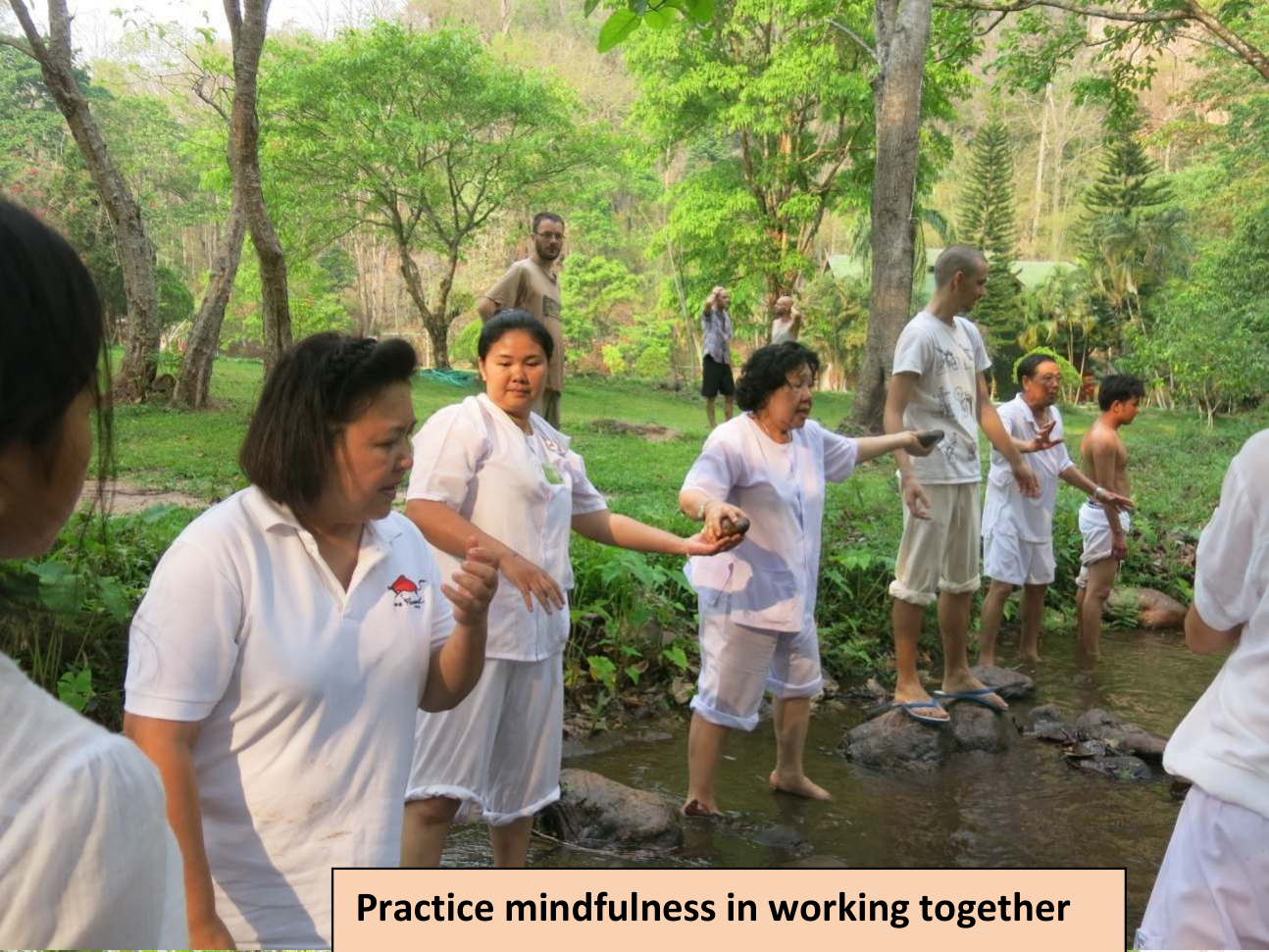
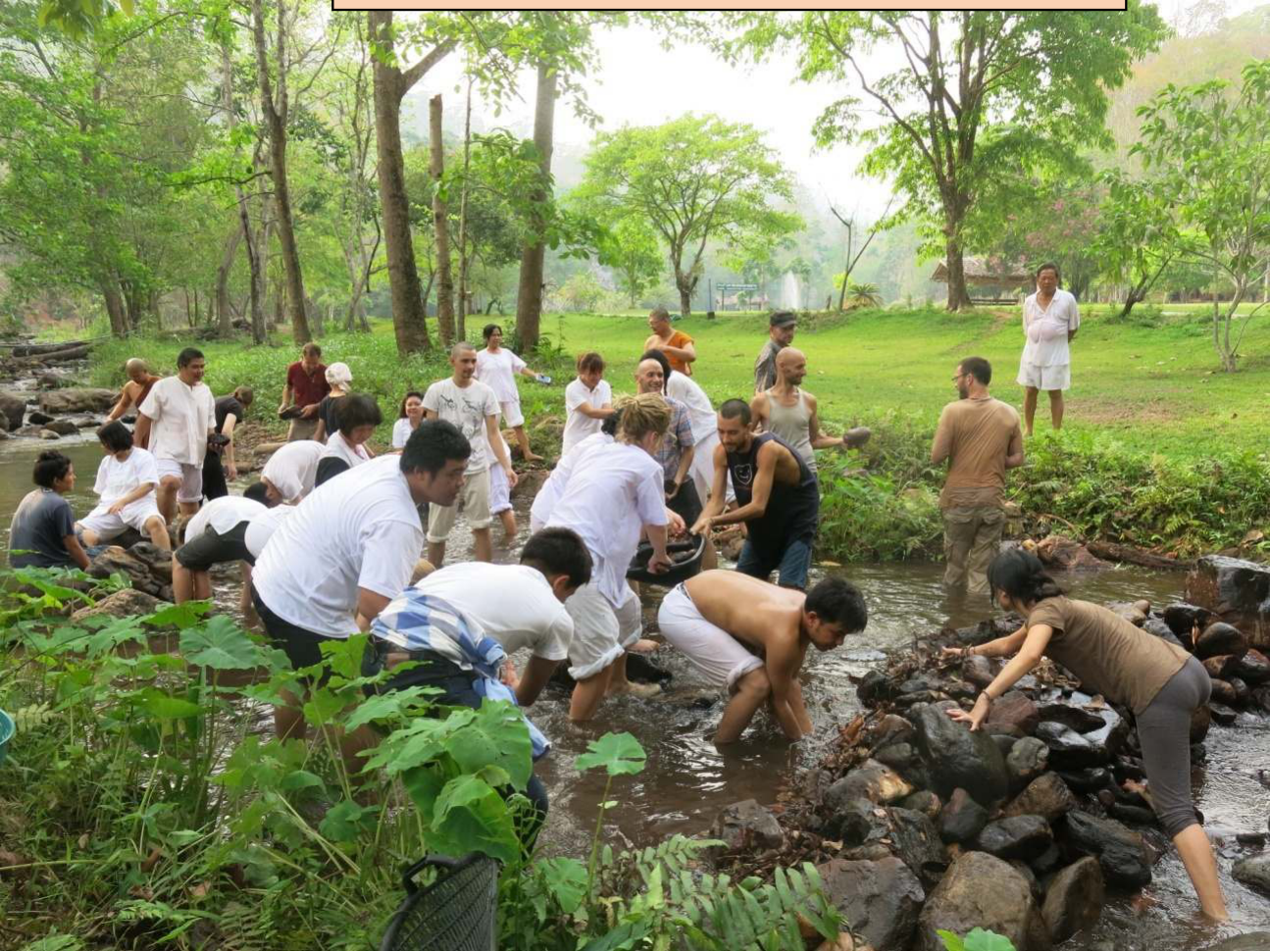
88
88
Practice mindfulness in working together
在协作共事时练习正念
Page 98
We watch our mind and see what happens moment to moment soon, we will see that our mind is always in flux: One moment it is happy and the next it is unhappy and then next it is neutral. One moment the mind is wholesome and joyfully practicing the Dhama, and the next moment it is struggling, lost in the painful story. Can we see this ?The mind in a flash changes from greedy to angry and then off in thought.
我们观照(观察)自己的心,看看它在每一个当下、每一刹那都发生着什么。很快我们就会看见:心始终处在流变之中——这一刻快乐,下一刻不快乐,再下一刻又归于中性。某一刻,心是善的,欢喜地修习佛法(Dhamma);而紧接着下一刻,它又在挣扎,迷失在痛苦的故事里。我们能看见这一点吗?心会在一瞬之间从贪欲转为瞋恚,继而又飘入纷飞的妄想。
We are not practicing to be super human. We are just to be ordinary people like we are now. We keep practicing in daily life to see what our ordinary human body and mind are like , what their true characteristic are. When we understand their true characteristics, we won't be upset when this or that happens to the body and mind . Getting old is normal, getting sick is normal, and dying is normal. Not getting what we want s normal. Getting we don't want is normal. Dream coming true , dream shattered are all normal. They cannot bring us comfort or happiness w can truly rely on. Accept this ,whatever happens in our life will appear as if is happening to someone else and not us. If there is no us , the who is it that acts ?It is the body and mind , The aggregates that act all on their own. And it is the aggregates that receive the results of action too. There is no person to experience the results of our actions; there are only the aggregates of body and mind that do. We break free to the cycle of karma, one could say. There is tremendous relief and
我们修行并不是为了成为“超人”。我们只是如其所是,做一个像现在这样普通的人。我们在日常生活中持续用功,是为了如实看见:这个普通人的身与心究竟是什么样子,它们真实的特相(特征)是什么。当我们明白了它们的真实特相,身心发生这样或那样的变化时,就不再那么烦恼、动摇。衰老是正常的,疾病是正常的,死亡也是正常的。得不到我们想要的,是正常的;遇到(得到)我们不想要的,也是正常的。梦想成真也好,梦想破灭也好,都是正常的。它们都无法带给我们真正可以依靠的安慰或快乐。若能接受这一点,那么无论生命中发生什么,都会显得仿佛发生在“别人”身上,而不是发生在“我们”身上。若无“我”,那么究竟是谁在造作(行动)?只是身与心——诸蕴(aggregates)在自运而已;而领受业果的,也正是诸蕴(aggregates)。并没有一个“人”去经验我们行为的结果;唯有身心诸蕴(aggregates)在经验。可以说,我们就此从业(karma)的轮转中解脱出来。于是便有一种巨大的释然与
Page 99
incomparable happiness when we are no longer living in the delusion that there is a self, with full wisdom, It is the aggregates and not us that move about the functionally , dong this and that. And if there is just an aggregates and the idea of a " me " is just a delusion, then who suffer. The body and mind may suffer, But we certainly don't. We become free from suffering because we have a correct understanding of the way things are. We have enlightened wisdom. The cycle of birth and death is a very long painful one. It is a very rare occurrence that a being will have the chance to listen to and become interested in the Dhamma that liberates us from this cycle of suffering once and for all. Let's not spend our time mindlessly and without meaning. Let's gradually bring awareness to our body and our mind, and practice The bhuddhist way to peace of mind.
当我们不再活在“有一个自我”的迷妄之中时,便会生起无与伦比的喜乐。以圆满的智慧观照,我们会明白:在运作、在行动、在做这做那的,是五蕴(aggregates),而不是“我们”。若唯有五蕴存在,而“我”的观念只是迷妄,那么究竟是谁在受苦?身与心或许会受苦,但“我们”并不会。我们之所以能从苦中解脱,是因为如实正见了事物的真实样貌;我们具足觉悟的智慧。生死轮回是一条漫长而痛苦的道路。众生能有机会聆听并对能使我们从这苦的轮回中彻底解脱的法(Dhamma)生起兴趣,是极其稀有的。让我们不要无明而徒然地耗费光阴;让我们逐步把觉知带到身与心上,依循佛教(Buddhist)通往内心安宁之道而修行。
3.7) Feel your entire body : Two highly Effective Techniques
3.7)觉知全身:两种极为有效的方法
While you continue to observe your breathing so that your mind is used to practice and can firmly concentrate on your breathing . You should add another mindfulness develop wisdom . Observing your breath is a closed and fixed mode of concentration which prevent the mind from acknowledging other sensations. Therefore , mindfulness and clear comprehension cannot be fully developed.
当你继续观察呼吸,使心逐渐熟悉修习并能稳固地专注于呼吸时,应当再加入另一项正念修习,以培育智慧。单一地观呼吸是一种封闭且固定的专注模式,容易使心不去觉察其他身心感受;因此,正念与正知(clear comprehension)便无法得到充分发展。
Page 100
It is recommended that you shift your focus after mastering your breath, to feeling your entire body holistically instead. What you gain from this practice is also mindfulness , but it is a mindfulness that is free to observe other occurrences or emotions.
建议你在熟练掌握观息之后,将注意力转而安住于对全身整体的觉知。你从这一练习中获得的同样是正念,但这种正念更为自在,不再局限于呼吸,因而能够如实观照其他身心现象或情绪。
3.7.1 ) How to feel your entire body
3.7.1)如何整体觉知全身
There are two ways to practice this method:
修习此法有两种方式:
1.Feel your entire body through intense observation
1.通过强力的观察来整体觉知全身
a. Observe your body from top to bottom, from the head to the toes.
a.从上至下观察身体,从头到脚趾。
b. Observe each body part : in detail, the front and the back ,the top, the bottom and the sides. For instance , if you are observing your arm, observe it from the top to the bottom , the front, the back , and the sides.
b.细致观察身体的每个部位:前与后、上与下,以及左右两侧。例如观手臂时,应从上到下,并兼顾其前面、后面与两侧来观察。
c. Then move on to another body part and do the same.
c.随后将觉知移至另一身体部位,依同样方式观察。
d. Once you finish observing all body parts, start from the bottom instead.
d.当完成对所有部位的观察后,改为从下往上开始。
e. Repeat these observation again and again until you can master this practice.
e.如此反复观察,直至熟练掌握此项练习。
Mastery of this skill is highly beneficial to you since being able to move your awareness to different parts of the body strengthens your mindfulness and clear comprehension so that they can see right through
熟练掌握这项技能将令你获益良多:当你能够将觉知灵活移向身体的不同部位时,正念与清楚了知(clear comprehension)便会随之增强,从而更能如实洞见、直透诸法。
Page 101
your body like the x-ray, whether from the front to the back, the top to the bottom or vice versa. You can use this technique to extinguish your suffering during an illness.
就像用 X 光透视你的身体一样,无论从前到后、从上到下,还是反过来。你可以在生病时运用这种技巧来止息痛苦。
The mind, which is not limited to one place but can travel to all area of the body, can develop mindfulness and clear comprehension quickly and effectively . This is a popular method among meditation masters sine it can help the mind maintain concentration all day, and the mindfulness and clear comprehension becomes highly advanced.
心并不局限于某一处,而能遍及身体各个部位,因此可以迅速而有效地培养正念与明觉。这在禅修大师中是一种很受欢迎的方法,因为它能帮助内心整日维持定力,并使正念与明觉趋于高度成熟。
3.7.2. Feel your body through holistic observation
3.7.2. 以整体观照来觉知身体
a. Use mindfulness to observe your body without focusing on any particular state.
a. 运用正念观察身体,而不聚焦于任何特定状态。
b. Observe the state in which the body parts are: its position ( head , neck, back , and arms) movements , and sensations.
b. 观察身体各部位所处的状态:其位置(头、颈、背与手臂)、动作,以及感受。
c. See if you experience any new sensations. Stay with that sensation. Your legs might feel cold, so just observe it. Your back feel hot; Just observe it. When you feel a new sensation, anywhere in your body , move your awareness there and your mindfulness and clear comprehension will become highly developed.
c. 观察是否出现新的感受,并安住于该感受之中。腿可能觉得冷,就只是观察它;背可能觉得热,也只是观察它。当你在身体任何部位觉察到新的感受时,将觉知移至那里,正念与明觉就会得到高度发展。
This technique allow you to use everything that happen to your body and your mind as tools for developing mindfulness and clear
这种技巧让你能够把发生在身体与心上的一切,都作为培养正念与明觉的工具。
Page 102
comprehension , whether it's your breathing, bodily functions, feelings, thought, etc.
正知——无论是你的呼吸、身体现象(生理运作)、感受、思维等等。
Whatever appears at any given time, observe your mind and learn from it. This method is a way to practice mindfulness. When you are able to do this , concentration and wisdom can be achieved, and you become aware of your internal sense-fields: eyes, ears, nose, tongue, body and mind.
在任何当下,无论出现什么,都要观察自心,并从中学习。这种方法是一种修习正念的方式。当你能够如此修习时,便能成就定力与智慧,并觉知到内在的感官处(内六处):眼、耳、鼻、舌、身、意。
Holistic awareness of one's body using these two methods only leads to benefits. There is no negative impact from this practice. Once this practice is mastered, you will no longer need to focus on your breathing.
运用这两种方法对自身身体保持整体性的觉知,只会带来利益;这种修习不会产生任何负面影响。一旦你熟练掌握了这项修习,便不再需要把注意力专注在呼吸上。
Breathing observation and holistic awareness of one's body are ideal when you are sitting, standing and lying down. When you walk, you can practice mindfulness and clear comprehension in specific area.
在坐、立、卧时,观察呼吸以及对身体的整体觉知是最理想的。行走时,则可以在特定对象上修习正念与正知。
3.8) Walking Meditation: the best mindfulness practice
3.8)经行禅修:最佳的正念修持
Contemplation of the steps in walking meditation: If in walking meditation, one is absorbed and mindless, then it is unacceptable. If one gazes so intently that consciousness is firmly fixed to the feet or the walking body, then it is concentration (Samatha) practice. If mindfulness is aware of the walking body and consciousness is a knower that is separate from the body, that is insight (Vipassana) practice on the foundation of body.
行禅中对步伐的观照:若在行禅时只是沉浸其中而失去觉知,这是不可取的。若凝视得过于专注,以致意识牢牢固定在脚或行走的身体上,那就是修止(奢摩他,Samatha)。若正念能够觉知行走的身体,而意识作为“知者”与身体相对分离,那就是依身念处而修观(毗婆舍那,Vipassana)。
If during the walking meditation consciousness is abstracted and mindfulness
若在行禅过程中,意识变得游离,而正念……
Page 103
recollects it, if it gazes at the walking steps and mindfulness recollects it, if it is happy, unhappy or indifferent and mindfulness recollects it, and if consciousness is moral or immoral, mindfulness recollects it, then these are exercises in mindfulness of the condition of Mind. They are stepping stones to mindfulness practice towards insight development on the foundation of Mind. Compared to standing , walking , sitting and lying down. walking is the beat practice for developing mindfulness and clear comprehension . As there is much more phenomena to observe. Taking only one step at a time, one can develop mindfulness and clear comprehension through dedicated and continuous observation.
若心注视行走的步伐,而正念能够如实忆念(觉知)它;若心处于愉悦、苦恼或不苦不乐(舍)的感受,而正念能够忆念它;又若心识为善或不善,而正念能够忆念它——那么,这些就是对“心之状态”的正念修习。这些练习是以“心”为基础、导向观智(内观洞见)发展的正念修习之阶梯。在站、行、坐、卧四威仪之中,行走最适合培养正念与正知,因为可观察的现象更多。一次只迈一步,通过专注而持续不断的观察,便能增长正念与正知。
Walking meditation practice
行禅修习
Step 1
步骤1
• To practice mindfulness effectively through walking , one must be focused and walking in appropriate manner. First, you must stand tall with your hands held together in front . You can also hang your arms on the side or cross your arm on the chest. Try different position that you feel comfortable.
• 要通过行走有效地修习正念,须保持专注,并以适当的方式行走。首先,站立端正,双手在身前相合。也可以让双臂自然下垂于身体两侧,或将双臂交叉于胸前。可尝试不同的手势与姿态,选择自己感到舒适者。
• Maintain your posture by looking straight ahead , not too high, not too low . Remain indifferent towards your surrounding, but you do not close your eyes.
• 目视前方以维持端正姿势,视线不宜过高,也不宜过低。对周遭境界保持不取著、淡然平等,但不要闭眼行走。
Page 104
• Place your feet about three inches wide apart. Check to see if the weight on both feet is equal. Observe carefully with your mind and adjust so that your feet are balanced.
• 双脚左右分开约三英寸。检查两脚受力是否均等。以正念细致觉察,并作适当调整,使双脚保持平衡。
• Pay attention to the right foot. Lift up your right foot slowly , move forward, when your sole touch the ground , you say to yourself " Bud", then observe your weight transfer on the right sole when you move your body to the right foot.
• 将注意力放在右脚。缓慢抬起右脚向前移动;当脚掌触地时,在心中默念“Bud”,随后在身体重心移向右脚时,观察重量如何转移并落在右脚脚掌上。
• Next, pay attention to the left foot. Lift up your left foot slowly , move forward, when your sole touch the ground , you say to yourself " dho", then observe your weight transfer on the left sole when you move your body to the foot.
• 接着,将注意力放在左脚。缓慢抬起左脚向前移动;当脚掌触地时,在心中默念“dho”,随后在身体重心移向左脚时,观察重量如何转移并落在左脚脚掌上。
Be aware both your right and left are moving while you focusing on moving your feet, try to observe your mind too.
当你专注于移动双脚时,也要觉知左右脚都在移动;同时尽量观照自己的心念活动。
STEP 2:
步骤2:
We practice walking meditation like the first step. But when we lift up the right sole we say " Bud" when we put it down , we say " Dho".We do it again in the left foot , when Ift it up we say " Bud", when we put it down we say " Dho" .We will concentrate both when we are lifting the sole and put it down ,quicker than the first step, so the mind has a job to do more than the first step , it won't have time to think.
我们依照第一步的方法练习行禅(行走禅修)。但当抬起右脚脚掌时默念“Bud”,放下时默念“Dho”。左脚同样如此:抬起时默念“Bud”,放下时默念“Dho”。抬起与放下两种动作都要保持专注,速度比第一步略快,使心持续有明确的所缘可安住,比第一步更“有工作可做”,从而不易再起杂念。
Page 105
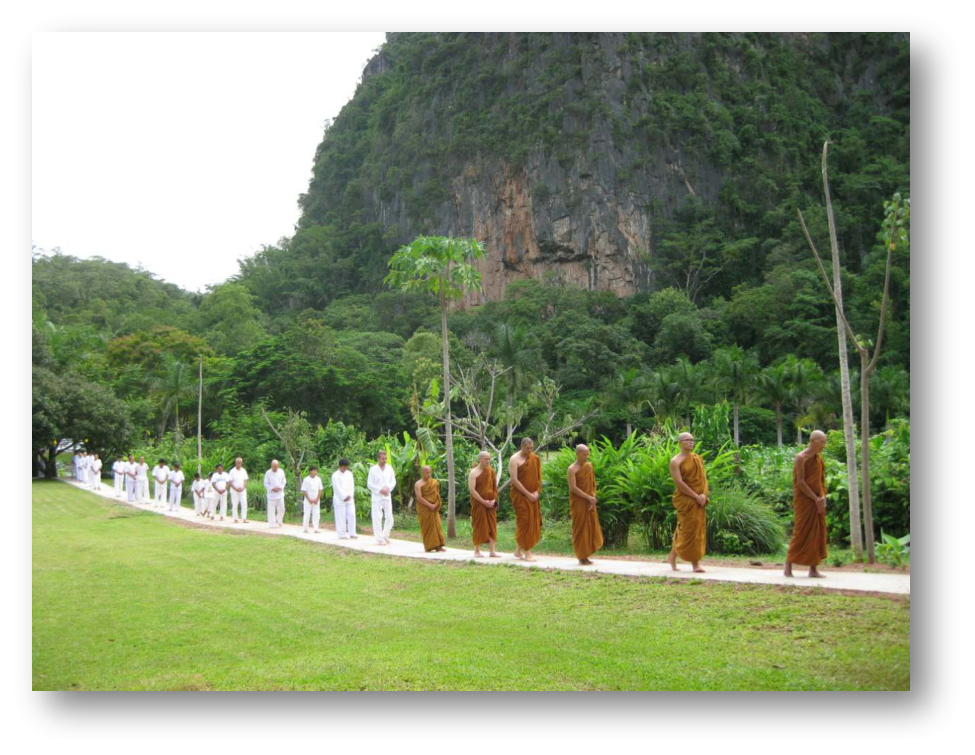
We always practice walking meditation first before parctice sitting meditation. Because practice walking will develop mindfulness more than concentration. Sitting will develop concentration more than mindfulness. So we need it both, cause it support each other. A lot of benefits when we practice walking meditation , it help us to have a good health.
我们总是在修习坐禅(sitting meditation)之前,先修习行禅(walking meditation)。因为行禅更能培育正念(mindfulness),而坐禅则更侧重于培育专注/定力(concentration)。因此两者都不可或缺,且能相互支持、相辅相成。修习行禅有许多利益,也能帮助我们保持良好的身心健康。
Page 106
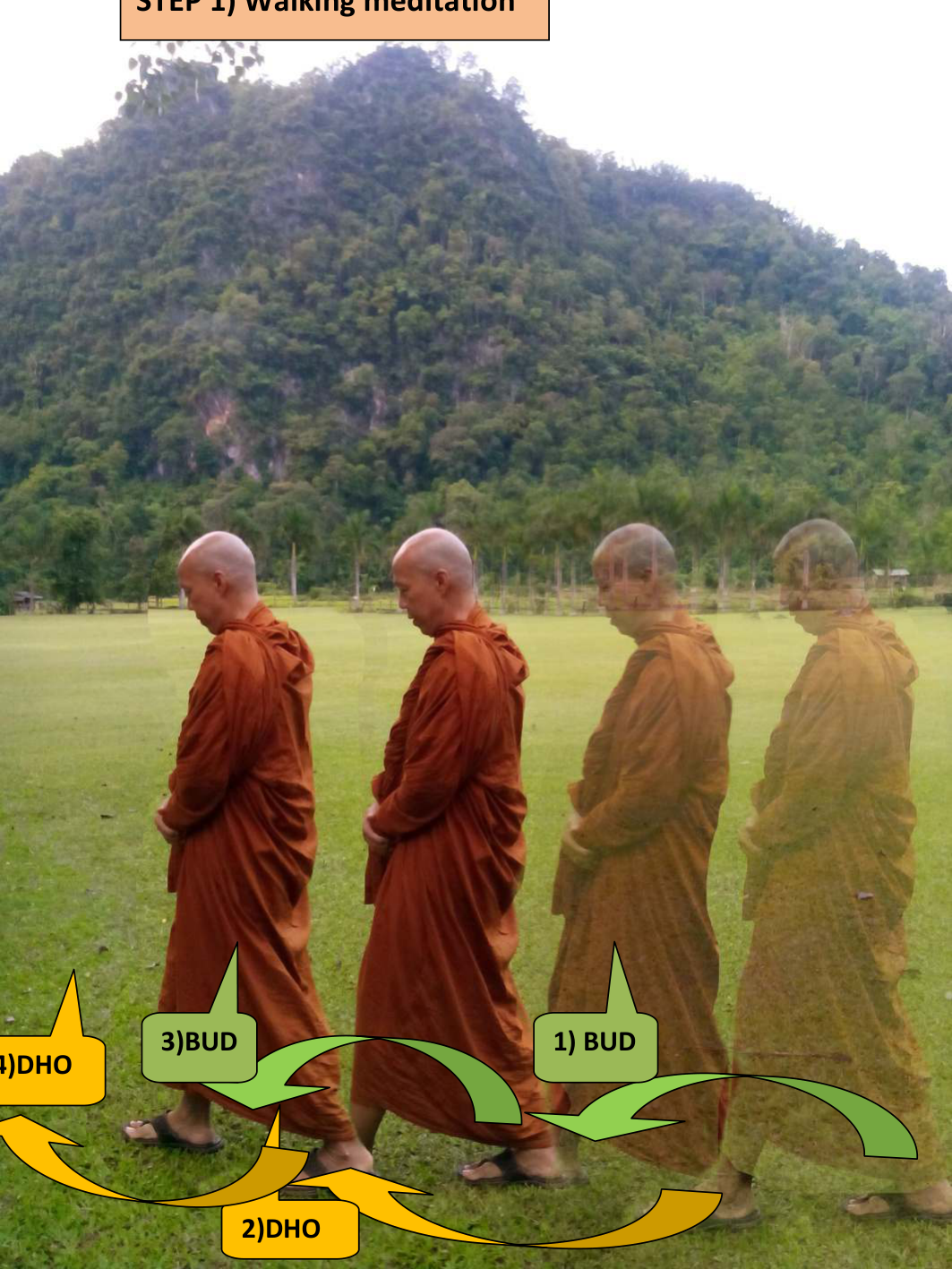
97
97
STEP 1) Walking meditation
步骤1)行禅
4)DHO 3)BUD 2)DHO 1) BUD
4)DHO 3)BUD 2)DHO 1)BUD
Page 107
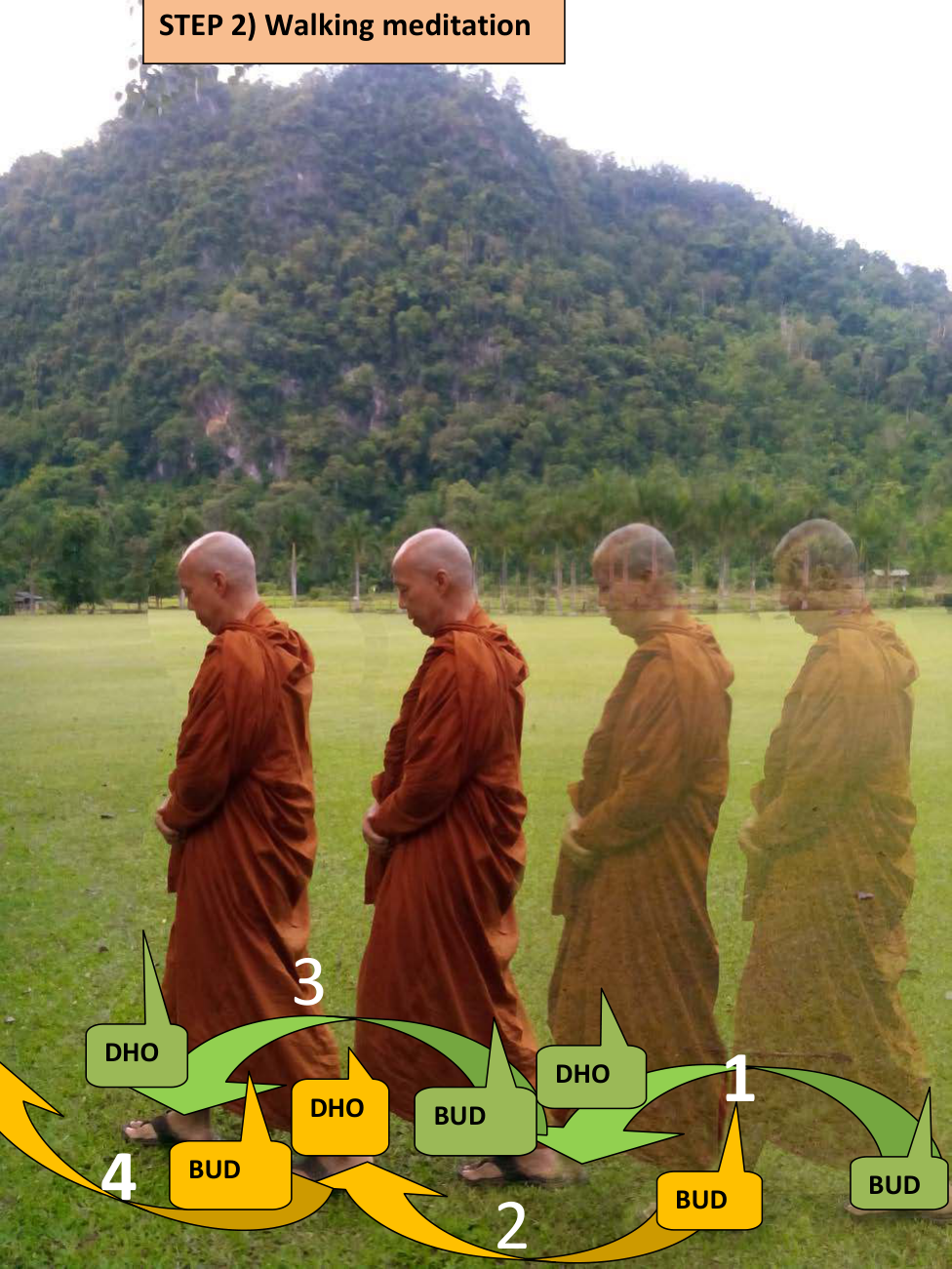
98
98
STEP 2) Walking meditation
第二步)行禅(经行禅修)
DHO BUD DHO BUD DHO BUD
陀·布 陀·布 陀·布(将“佛陀”(Buddho)分作两音:DHO、BUD,于心中交替持念)
1 2 3 4
1 2 3 4
Page 108
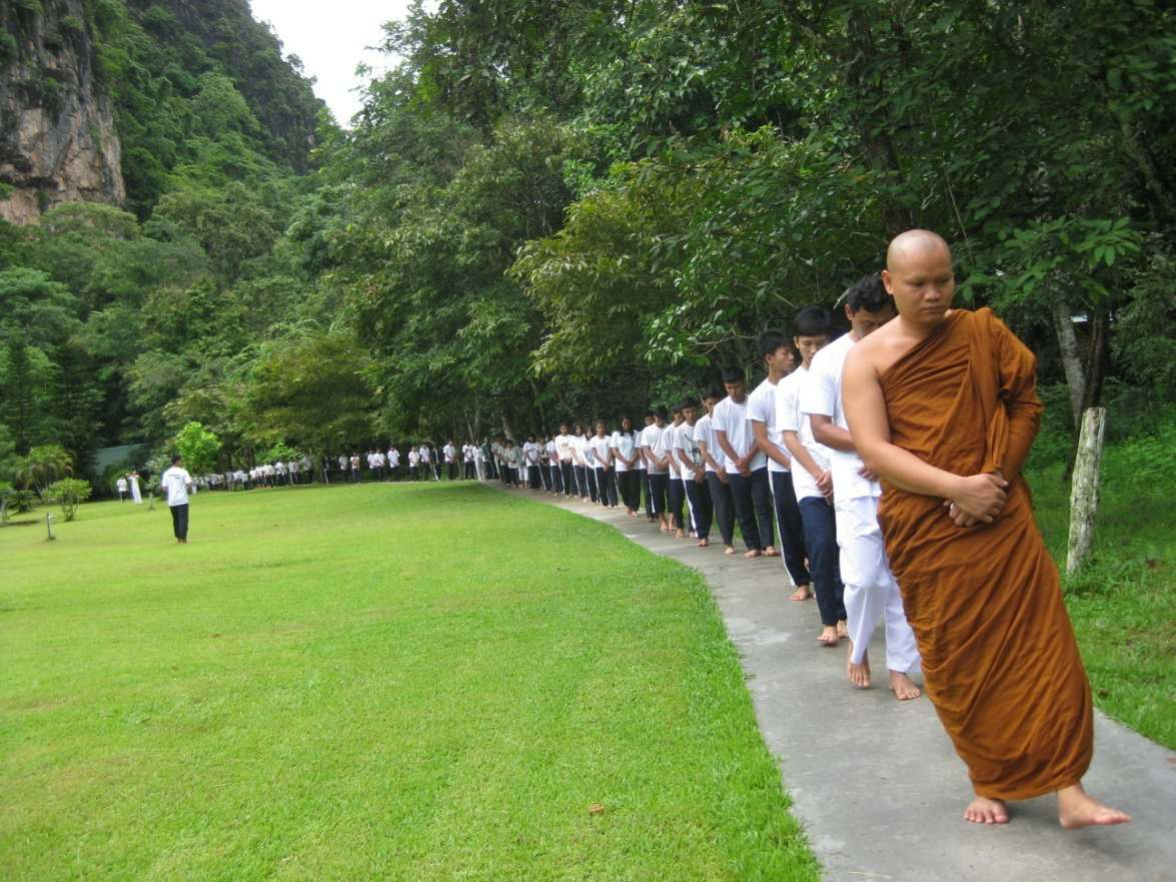
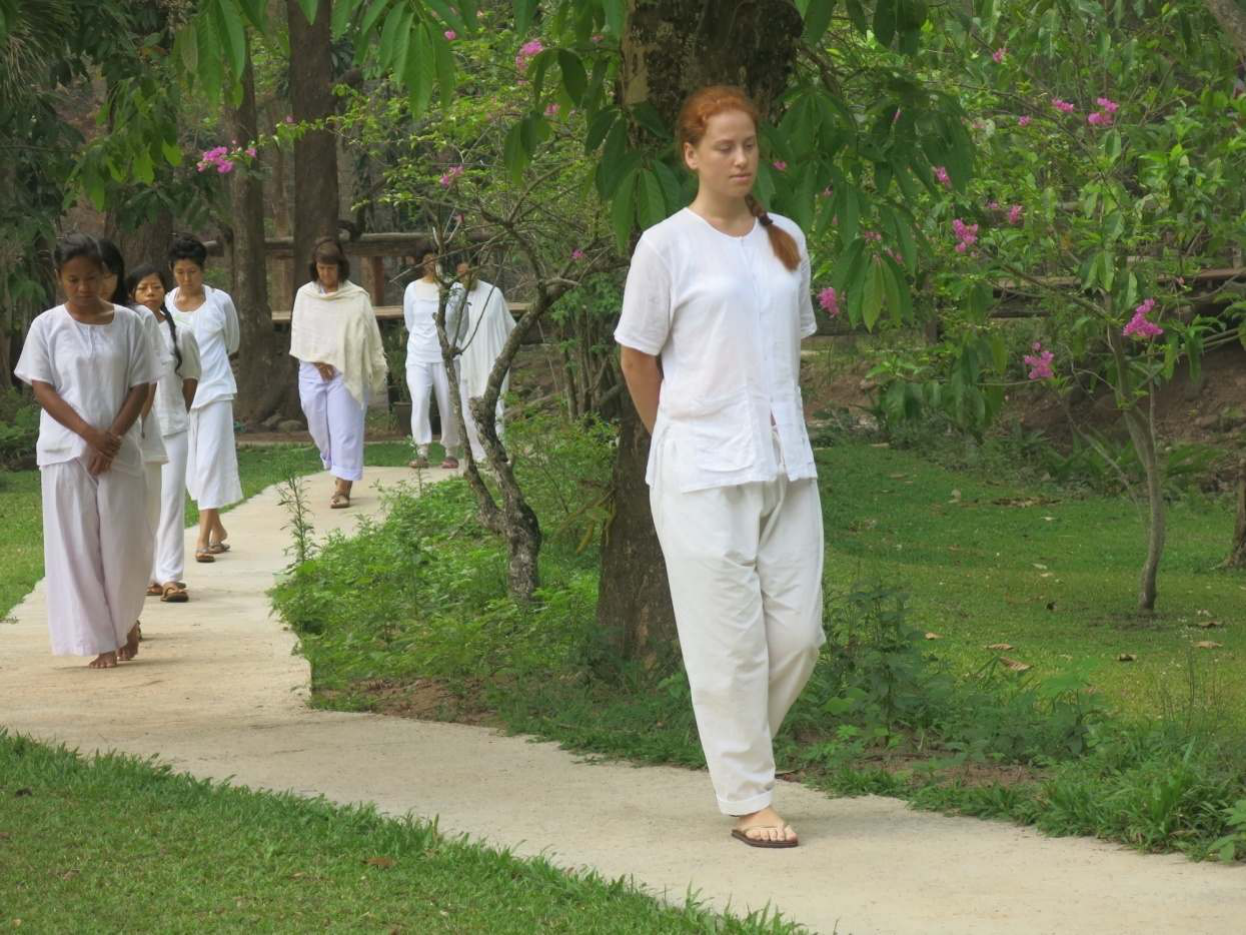
99
99
Page 109
100
100
3.9 ) How to awareness of the mind
3.9)如何觉知心
The phrase ‘awareness of the mind’ is reference to contemplation of feelings or Vedana-nupassana-Satipatthanna, contemplation of mind or Citta-nupassana-sati-patathanna, and contemplation of mind-objects or Dhamma-Nupassana-sati-patathanna (those types which are related to mental phenomena). In short, it means to practice insight meditation by being aware of mind and mental phenomena.
“觉知心”一语,是指对感受的观照,即受随观(vedanānupassanā-satipaṭṭhāna);对心的观照,即心随观(cittānupassanā-satipaṭṭhāna);以及对诸法(心所缘境)的观照,即法随观(dhammānupassanā-satipaṭṭhāna)(这些类别皆与心理现象相关)。简言之,即通过觉知心及诸心理现象来修习内观禅修。
3.9.1 ) Method for practicing insight meditation (awareness of mind)
3.9.1)修习内观禅修的方法 (觉知心)
Practicing all types of insight meditation, including awareness of mind, is not difficult. All we need to do is to be aware of phenomena of the mind that arise, as they truly are, with a stable and equanimous mind. But to be aware correctly, one must (1) have the right quality of mind and (2) have the right object of consciousness. The qualities of mind necessary for practicing the foundations of mindfulness, or insight meditation, are the minds with right mindfulness (samma-sati), clear comprehension or right understanding (samma-dit't hi), and right concentration (samma-samadhi). The right object of consciousness is one that appears at the present, and can show the three characteristics of existence, which a practitioner would call a phenomenon while one studying the scriptures would call an object of ultimate reality (paramattha).Once ready to practice, we should: be aware (or have right mindfulness), of the object of consciousness, or
修习一切类型的内观禅修,包括觉知心,并不困难。我们所要做的,只是以稳定而平等舍的心,如实觉知当下生起的心之现象。然而,要觉知得当,须具备:(1)正确的心之品质;(2)正确的识之所缘。修习四念处(foundations of mindfulness)或内观禅修所必需的心之品质,是具足正念(samma-sati)、明了知(clear comprehension)或正见/正理解(samma-dit't hi),以及正定(samma-samadhi)的心。所谓正确的识之所缘,是当下现起,且能显现存在之三相(three characteristics of existence)者;修行者称之为一种现象,而研习经典者则称之为究竟真实之所缘(paramattha)。一旦准备好开始修习,我们应当:觉知(或具足正念)识之所缘,或
Page 110
phenomenon, or object of ultimate reality, arising at the present moment, with a stable mind which does not wander out and is not controlled or over-focused (or have right concentration), and the mind will see things as they truly are (with clear comprehension and right-view). To be aware means to know when something is arising, changing, and disappearing. For example, when we are happy, know that happiness has arisen; and when happiness gone, know that happiness has disappeared. When there is anger, know that anger has arisen; and when anger gone, know that anger has disappeared. When the mind has craving and clings to sense objects through the eyes, ears, nose, mouth, body or mind, be aware of the force of desire at work. The object of consciousness, or mind-object, that arises has to be of ultimate reality, not conventional reality. We must be able to differentiate between what is absolute reality, or paramattha dhamma and what is conventional reality, or sammuti. For example, when the mind is happy, there must be awareness of the state of happiness. When the mind is angry, there must be awareness of the state of anger. When the mind is in doubt, there must be awareness of the state of doubt. As we continue to practice, we will discover that most mental phenomena arise from somewhere in the middle of the chest, which is regarded as the physical basis of the mind, or hadaya-vatthu. There is no need to search for an exact location, but just be aware of where the defilements arise and disappear. This is because if we focus our awareness at a wrong target, the real truth will never be revealed.
……当下现起的现象,即当下生起的胜义法(究竟法)所缘(对象)。当心安住稳定,不向外散乱,也不被压制或过度用力地紧盯(即具足正定)时,心便能如实知见诸法(具备清楚的正知与正见)。所谓“觉知”,就是如实知道某个法正在生起、变化与灭去。比如:快乐生起时,知道快乐已生起;快乐消失时,知道快乐已灭去。嗔怒生起时,知道嗔怒已生起;嗔怒消失时,知道嗔怒已灭去。当心中生起贪爱,并经由眼、耳、鼻、舌、身、意去执取色、声、香、味、触、法等所缘境时,要觉知欲望之力正在运作。此时所生起的识所缘(心所缘)必须是胜义法(究竟法),而非世俗(概念)所缘。我们必须能够分辨:何者是胜义谛(paramattha dhamma,究竟法/胜义法),何者是世俗谛(sammuti,约定俗成)。例如:心快乐时,须觉知“快乐”的状态;心嗔怒时,须觉知“嗔怒”的状态;心疑惑时,须觉知“疑”的状态。随着持续修习,我们会发现,多数心理现象似乎从胸部中央附近生起;此处被视为“心的色身依处”,即心所依处(hadaya-vatthu)。无需刻意寻找精确位置,只要觉知烦恼从何处生起、于何处灭去即可。因为若将觉知投向错误的目标,真实的实相终将无法显现。
Page 111
For example, if we fix our attention at the middle of the body, two inches above the navel, we will never be able to detect any defilement arising, but instead will only create a mental image or nimitta. To be truly mindful does not mean we have to question ourselves or to guess whether at this moment there is happiness, suffering, anger, doubt or craving. It is very important to stress that we must be mindful of the actual phenomena of the mind, or the absolute reality, because the mind needs to witness and learn from the actual arising, changing and disappearing of all things on its own, and not via the thinking process.
例如,若我们把注意力固定在身体中部——肚脐上方两英寸处——就永远无法觉察到任何烦恼(defilements)的生起,反而只会造作出一个心理影像,即相(nimitta)。真正的正念,并不是不断自我盘问,或猜测当下是否有快乐、苦受、嗔怒、疑惑或贪欲。必须强调的是:我们应当正念于心的真实现象,也就是究竟真实(absolute reality),因为心需要亲自见证并从一切法真实的生起、变异与灭去中学习,而非经由思惟推断的过程来认识。
Once we are mindful of the mental phenomena as they arise, the mind needs to have sufficient stability and firmness to avoid getting lost in thoughts that commonly arise after the awareness. For example, when something arises in the mind, it is ultimate reality. After that, a thought based on conventional reality arises, labeling this mental state as liking, for example. This formulation cannot be avoided, because the mind’s nature is to think and recollect. Therefore, we must not try to prevent or refuse the thinking process based on conventional reality from happening. Just be aware of it but do not get lost in the thinking process. Continue to be mindful of phenomena of mind that arise, such as liking in this case. Only through observation will we be able to see the three characteristics of existence of that condition. On the other hand, a practitioner who is mindful of the mental phenomena must not focus too
当我们在心理现象生起之际保持正念时,心必须具备足够的稳定与坚固,才不致迷失在觉知之后通常随之而起的种种念头中。譬如,当某种东西在心中生起时,它是胜义谛(ultimate reality,究竟真实)。随后,又会生起一个依世俗谛(conventional reality,世间施设)而起的念头,例如把这种心理状态标记为“喜欢”。这种概念化的安立无法避免,因为心的本性就是思惟与忆念。因此,我们不应企图阻止或拒绝基于世俗谛的思惟过程发生;只需如实觉知它,但不要陷溺于思惟之流。接着,继续正念于所生起的心法,例如此处的“喜欢”。唯有经由观察,我们才能看见该状态的三相(three characteristics of existence)。另一方面,能于心理现象保持正念的修行者,亦不应过度专注于
Page 112
intently because this will result in an unrefined mind that cannot gain wisdom.
切勿过于用力、执著地去做,因为这将导致心不得调伏、变得粗糙而不细腻,无法生起智慧。
Instead of being aware of mental phenomena as they truly are, when the mind identifies and grabs on to a state, it will become stagnant.
若不能如实觉知心的种种现象,而是当心一旦辨识并攀取某种状态时,心就会变得凝滞、停滞不前。
We have to let the mind be an observer, like an audience watching a play and not jumping on to the stage to play along with the actors. The mind that has right concentration possesses the following qualities of mind: stability, gentleness, pliability and readiness to work. It does not get lost or over-focused. When there is right concentration, the mind is fully ready for true development of wisdom.
我们必须让心保持为观察者,如同观众看戏,而不是跳上舞台与演员一同演出。具备正定(sammā-samādhi)的心,具有以下心的品质:稳定、柔和、调柔(可塑)以及随时可用、能够投入修习。它既不散失,也不落入过度专注。当具足正定时,心便完全就绪,能够真正开展智慧的培育。
When mindful of objects of ultimate reality, with a stable mind, and not getting lost or over focused, the mind will learn four ultimate truths as follows:
当以稳定之心对胜义谛(paramattha-sacca,究竟实相)的所缘保持正念,不散失、也不过度专注时,心将学习以下四种究竟真理:
a. It will learn of the natural phenomenon as it arises, exists and passes away (awareness of the natural phenomenon).
a. 它将了知自然现象如何生起、住立并灭去(对自然现象的觉知)。
b. It will learn of the role of that natural phenomenon which has arisen (awareness of the function of the natural phenomenon).
b. 它将了知已生起之自然现象所发挥的作用(对自然现象功能的觉知)。
c. It will learn of the outcome of that natural phenomenon (awareness of the consequence).
c. 它将了知该自然现象的结果(对其后果的觉知)。
d. And with constant awareness it will learn of the thing that makes that natural phenomenon arise (awareness of the proximate cause). When the mind itself learns through observation, known as investigation of the truth or
d. 并且在持续的觉知之中,它将了知令该自然现象得以生起的要素(对近因的觉知)。当心本身透过观察而学习时,这称为对真理的探究,或
Page 113
dhamma-vicaya, this process is in fact the cultivation of wisdom, or clear comprehension and right view.
dhamma-vicaya(法择),这一过程其实就是修习智慧,即清明的正知与正见。
An example is when the eyes detect an image. The mind processes the image to be a beautiful girl. Then liking arises. To know that liking has arisen is correct awareness. And sometimes liking is so strong and the mind wants to look some more. At this stage the mind has been dominated by craving, and thinks, acts and desires accordingly. Only if we keep on observing craving with frequency will the mind know that seeing something beautiful is the proximate cause of craving. Therefore it is important to constantly be aware when the eyes see an object. As for the function of craving itself, with mindfulness, it will reveal its impermanent nature instantly that its intensity and duration are neither constant nor long lasting, and will eventually disappear if there is no new input (such as looking back at the beautiful woman).
例如,当眼睛接触到一个影像时,心会对该影像作出加工,把它认定为“美丽的女孩”。随即便生起喜爱。能够如实知“喜爱已生起”,就是正确的觉知(正念)。有时这种喜爱非常强烈,心还想再多看几眼。此时内心已被贪爱(craving)所主导,便随之而思、而行、而欲求。唯有持续且频繁地观照贪爱,心才会明白:见到美好的所缘,是贪爱生起的近因。因此,当眼睛见到所缘时,持续保持觉知尤为重要。至于贪爱本身的作用,在正念之下,它会立刻显现其无常相:其强度与持续时间既不恒常,也不长久;若没有新的输入(例如回头再看那位美丽的女人),它终将消退。
This shows the unsatisfactoriness inherent in this state of mind. The arising and passing of all things are the result of some set of causes and conditions, not of our wishes or how we would like them to be. Furthermore they are just objects of consciousness and not within our control, showing the non-self nature of craving.
这表明此种心态内在含有苦(不圆满)。一切法的生起与灭去,都是一系列因缘和合的结果,并不随我们的愿望或我们希望它们成为什么样而转。进一步说,它们只是意识中的所缘境,并不在我们的掌控之内,由此显示出贪爱之无我性。
Page 114
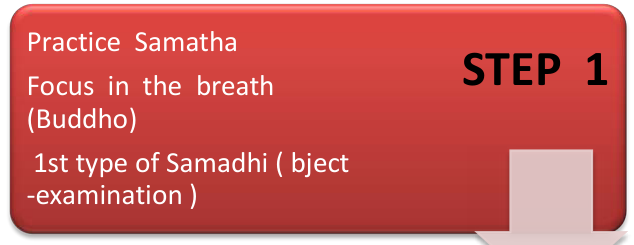
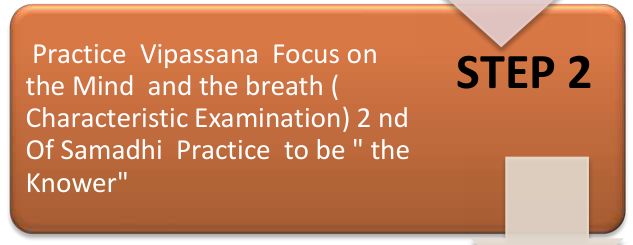
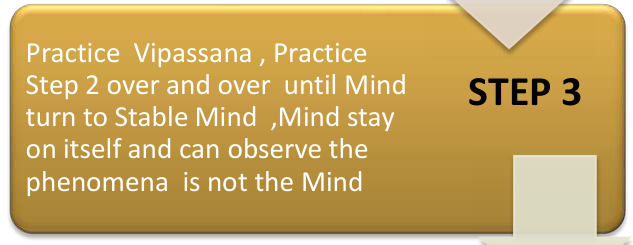
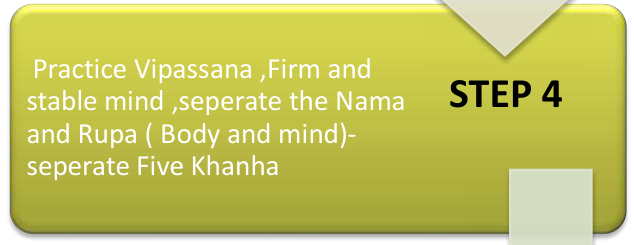
105
105
3.10 ) Process of Practicing Vipassana
3.10)内观(毗婆舍那,Vipassanā)修习过程
Practice Samatha Focus in the breath (Buddho) 1st type of Samadhi ( ject -examination ) STEP 1
修习止(Samatha) 专注于呼吸(Buddho) 第一类三摩地/定(Samādhi)(对象审察) 步骤 1
Practice Vipassana Focus on the Mind and the breath ( Characteristic Examination) 2 nd Of Samadhi Practice to be " the Knower" STEP 2
修习内观(Vipassanā),专注于 心与呼吸(特相审察) 第二类三摩地/定(Samādhi)的修习,成为“知者”(the Knower) 步骤 2
Practice Vipassana , Practice Step 2 over and over until Mind turn to Stable Mind , Mind stay on itself and can observe the phenomena is not the Mind STEP 3
修习内观(Vipassanā),反复修习 步骤 2,直至心 转为稳定之心;心安住 于自身,并能观察到: 诸现象并非是心。 步骤 3
Practice Vipassana ,Firm and stable mind ,seperate the Nama and Rupa ( Body and mind)- seperate Five Khanha STEP 4
修习内观(Vipassanā),令心坚固、 稳定,分别名(Nāma) 与色(Rūpa)(身与心),并 分别五蕴(Five Khandha)。 步骤 4
Observe the three characteristic of the Five Khanhas STEP 5
观察五蕴的三相(无常、苦、无我) STEP 5
Page 115
3.10.1) STEP 1 ) practice Samatha Concentration
3.10.1)第1步)修习奢摩他(Samatha)专注(定)
( A mindfulness of the body -KAYANUPASSANA)
(身随观——Kāyānupassanā)
The purpose : To make your mind calm down and peaceful and to study about the first type of samadhi. which will bring your mind to rest and in peaceful state.
目的:令心平静、安宁,并学习第一类三摩地(samādhi)。此将令心安住,处于寂静祥和的状态。
The first kind of samadhi is called object-examination (aramma-n’upanjjhana). This is when there is just one object of attention and the mind sticks to this object and is rendered still. The mind is very focused and peaceful in this state. An example is meditation on breathing. The mind moves down into the breath and clings to it. the first type of samadhi, object-examination, is accomplished during calmness meditation, otherwise known as Samatha meditation. Even using the mind itself as the object of meditation can bring us into this type of samadhi.
第一类三摩地称为“所缘审察”(object-examination,aramma-n’upanjjhana)。这是指心只取一个所缘(注意对象),并紧贴于该所缘而止息不动。处于此状态时,心极为专注且安宁。其例为观呼吸:心沉入呼吸之中,执持于呼吸。第一类三摩地——所缘审察——是在寂静禅修中成就的,亦即奢摩他(Samatha)禅修。甚至以心本身作为禅修所缘,也能令我们进入这种三摩地。
1. To begin the practice, you should sit in a comfortable position, cross- leg on the floor or on the chair. It is important to sit up straight to assist your breathing, make it easier to observe in- breath ( inhalation) and out- breath ( exhalation ).
1. 开始练习时,应以舒适的姿势端坐,可在地上盘腿坐,或坐在椅子上。关键是保持脊柱挺直,以助呼吸,并更易观照入息(in-breath,吸气)与出息(out-breath,呼气)。
2.Once seated , Pay attention and focus in your nose only when you breathing in you say with yourself " Bhud" and when you breathing out you say to yourself " Dho" Just be aware when you are inhaling or
2. 坐定之后,将注意力专注于鼻端;吸气时在心中默念“Bhud”,呼气时在心中默念“Dho”(可理解为“Buddho/佛陀”的分音念诵)。只需觉知当下是在吸气或……
Page 116
exhaling. You may take a deep breath for a couple of times and then let it go normally and naturally .
呼气。你可以先深吸几次气,然后让呼吸自然地回到平常、自然的状态。
3.Observe your inhalation and exhalation when it's a long breath and sometimes it's short. And observe the feeling when you have a long breath and the short breath. How is it different ?
3. 观察你的吸气与呼气:有时是长呼吸,有时是短呼吸。并观察在长呼吸与短呼吸时的感受分别如何,它们有什么不同?
4.Observe the area that your inhalation make a contact in your nostril and you see it clear when you breath in. Observe the area that your exhalation make a contact when you breath out . After this fix one spot that you feel your inhalation and exhalation touch this spot every time and pay attention in this spot only. and then keep on breathing in " Bhud" breathing out " Dho"
4. 观察吸气时气息在鼻孔内所接触的区域,吸入时清楚地觉知它;也观察呼气时气息所接触的区域。然后选定一个点:你每次都能感觉到吸气与呼气都会触及此点,并只将注意力安住在这一点上。接着继续呼吸:吸气念“Bhud”,呼气念“Dho”。
5.The technique of the practice Samatha is that The meditation object that we choose should make the mind happy and the mind should enjoy watching it . If our mind likes the breath and feels good watching the breath, then we use the breath. If it feels good with the mantra " buddho" then we use a mantra. Whatever we do , the mind has to be comfortable and like being with the object. When the mind is very happy with something it will stay with it. It won't go anywhere else on its own. This is the attitude we need in order to bring the mind into the peaceful states of absorption concentration or jhana.
5. 修习奢摩他(Samatha,止)的要领是:我们所选择的禅修所缘应当令心生欢喜,而心也应乐于观照它。若心喜欢呼吸、观呼吸时感觉良好,就以呼吸为所缘;若配合念诵“buddho”这一咒语(mantra)更觉受用,就以咒语为所缘。无论采用何种方法,心都必须感到舒适,并且愿意与所缘相伴。当心对某一所缘非常欢喜时,就会自然安住于其上,不会自行跑到别处去。这正是我们所需要的心态,使心进入寂静的安止(吸收)定,或禅那(jhana)。
Page 117
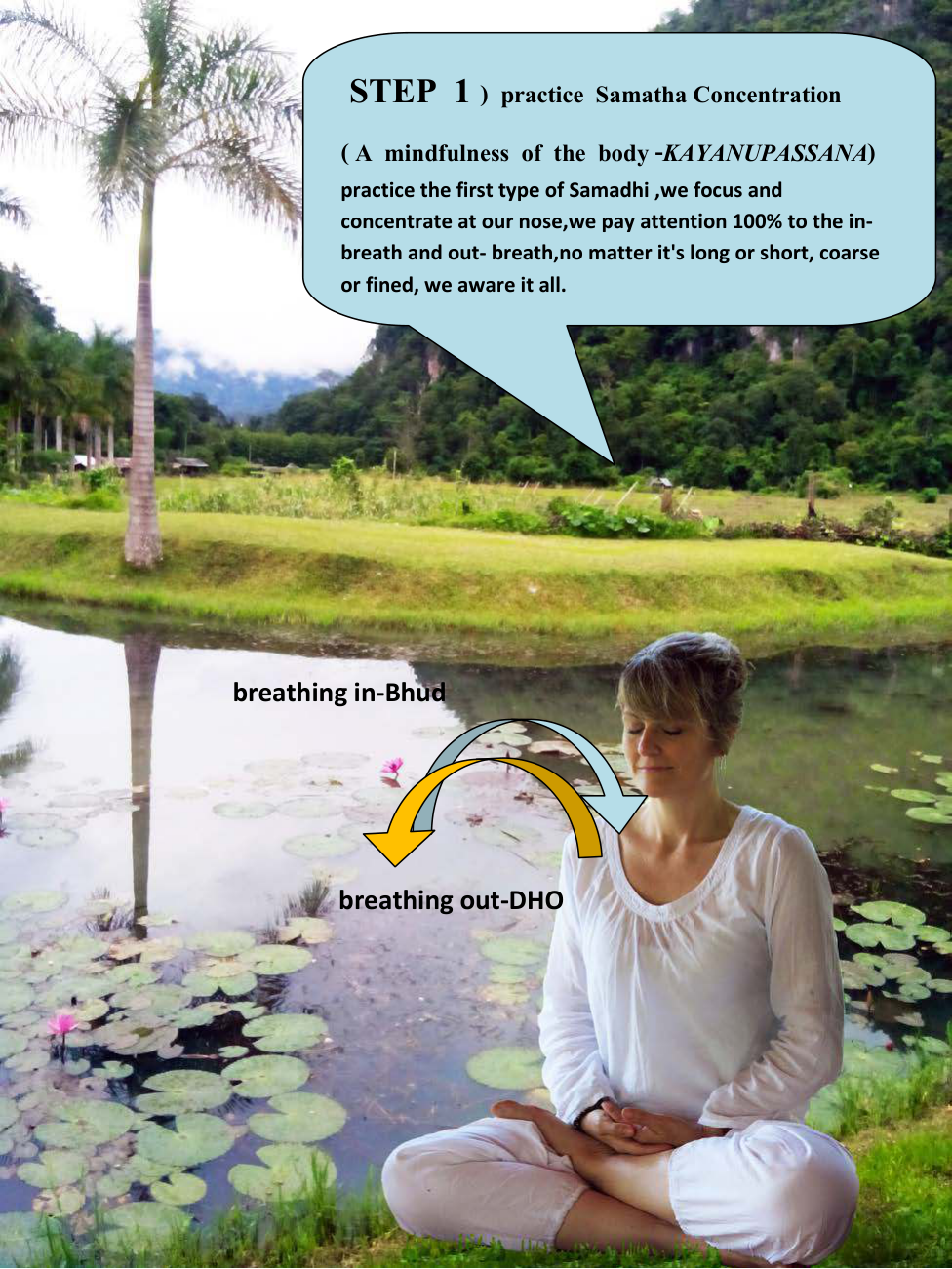
STEP 1 ) practice Samatha Concentration ( A mindfulness of the body -KAYANUPASSANA) practice the first type of Samadhi ,we focus and concentrate at our nose,we pay attention 100% to the in-breath and out- breath,no matter it's long or short, coarse or fined, we aware it all.
步骤 1)修习奢摩他(Samatha)专注 (身随观——Kāyānupassanā/KAYANUPASSANA) 修习第一种三摩地(Samādhi):将心安住于鼻端,百分之百专注于入息与出息;不论呼吸长短、粗细,我们都能如实觉知。
breathing in-Bhud
吸气——念“佛”(Bhud)
breathing out-DHO
呼气——念“陀”(Dho)
Page 118
Samatha concentration give us a calm down mind and peaceful but not a wisdom. we have to do next step to Vipassana or Insight meditation.
奢摩他(Samatha,止禅)的定力能令我们的心平静、安宁,却不能带来智慧。因此,我们必须进一步修习毗婆舍那(Vipassana,内观)或观智禅(Insight meditation)。
3.10.2 ) STEP 2 : Practicing Vipassana or Insight meditation ( Cittanupassana- A mindfulness of the Mind )
3.10.2)第二步:修习内观禅(毗婆舍那,Vipassanā)或观智禅(观慧禅) (Cittānupassanā——观心念住)
As we mention earlier , when we are looking to practice Vipassana meditation, then we need the second kind of samadhi. It is called characteristic-examination (akkha~nupajjhaana). This samadhi is one that is stable in the sense that it remains separate from phenomena. It allows us to see the true characteristics of body and mind, of mental and physical phenomena (rupa-nama). We may see the body is not us but is just matter, or the working of elements, or just processes of sensory input and interpretation. In the second type of samadhi, the mind is the stable and unattached watcher or knower.
如前所述,当我们准备修习毗婆舍那(Vipassana)禅修时,就需要第二种三摩地(samādhi)。它称为“特相审察”(characteristic-examination,akkha~nupajjhaana)。此种三摩地之所以稳定,在于它能与诸现象保持分离而不混杂;由此令我们得以如实观见身与心,以及名与色(rūpa-nāma,色—名)的真实特征。我们可能会看见:身体并不是“我”,它只是物质,是诸元素的作用,或只是感官输入与诠释的过程。在第二类三摩地中,心成为稳定而不执著的观照者/知者。
" The Knower" VS. " The thinker"
“知者”与“思者”之对照
First of all before we do the practice , we should know the nature of our mind , " If our mind be a knower it can't be a thinker. In the same way if our mind be a thinker it can't be a knower. It means that our mind can be both a knower and a thinker but not in the same time."
首先,在开始修习之前,我们应当了解心的本质:“如果我们的心处于‘知者’(knower)的状态,就不可能同时处于‘思者’(thinker)的状态;同样地,如果心正在思惟,就不可能同时作为知者。这意味着,我们的心既能成为知者,也能成为思者,但不能在同一时刻同时如此。”
The way to practice this is to pick a meditation object like watching the breath or the mantra" Buddho" , or watching the body walking , sitting , standing like the lesson 1 practicing only, instead of
修习的方法,是选择一个禅修所缘,例如观呼吸,或持诵“Buddho”的佛号(mantra),或如第一课那样观身行走、坐、立等;只需如实练习这些,而不是
Page 119
staying with this meditation object and trying to keep the mind still or stop thinking , we use the meditation object as the background and notice in the foreground instead. We notice the mind who know the breath. When we sit we awareness the body is breathing in and out .We carefully observe the body is sitting the mind is a knower , the body is breathing the mind is a knower. We observe back- and- forth between the breath and the mind. We do it over and over again until we become to feel about the know is knowing the breath not us.
我们不是执着于这个禅修所缘,试图令心静止或停止思考;相反,是以禅修所缘为背景,转而觉察前景中的现象。我们觉察那“知呼吸之心”。当我们坐着时,要觉知身体正在吸气、呼气。我们细致观照:身体在坐,心是知者;身体在呼吸,心是知者。我们在呼吸与心之间来回观照,如此反复练习,直到逐渐体会到:是“知”(知者)在知呼吸,而不是“我”在知呼吸。
While we observing the mind or the knower ,when we see the thought is arisen up , we should aware the thought too. When the mind goes off to think we should know it . We don't try to stop the mind from thinking . We let it think as it does normally, but we notice that it's thinking .We start breathing in, when mind goes off to think, we know it. Then we are breathing out ,the mind goes off to think again , and we know it again. The knower is the mind that knows. The object is that which the mind is knowing. When we are watching an object, know when the mind has gone off to think. Know the body is breathing or the body is moving and then know when the mind has strayed from knowing the chosen object. Keep knowing the object and then know when the mind sinks into the object or when it moves to something else. When the mind moves off to think, know this too. If we continuously are able to notice on time when the mind moves
当我们在观察心或“知者”时,一旦看见念头生起,也要觉知这个念头。心一旦跑去想,就要知道它。我们不试图阻止心思惟;让它如常运作,但要觉察到它正在想。开始吸气时,若心跑去想,我们知道;接着呼气时,心又跑去想,我们也再次知道。“知者”就是那颗能知的心;“所缘”(meditation object)就是心正在所知的对象。当我们观所缘时,要知道心何时已经跑去想。要知道身体在呼吸或身体在移动,也要知道心何时偏离了对所选所缘的觉知。持续觉知所缘,并且知道心何时沉入所缘之中,或何时转向别的对象。心若跑去想,也要知道这一点。若我们能够持续地在心移动时及时觉察
Page 120
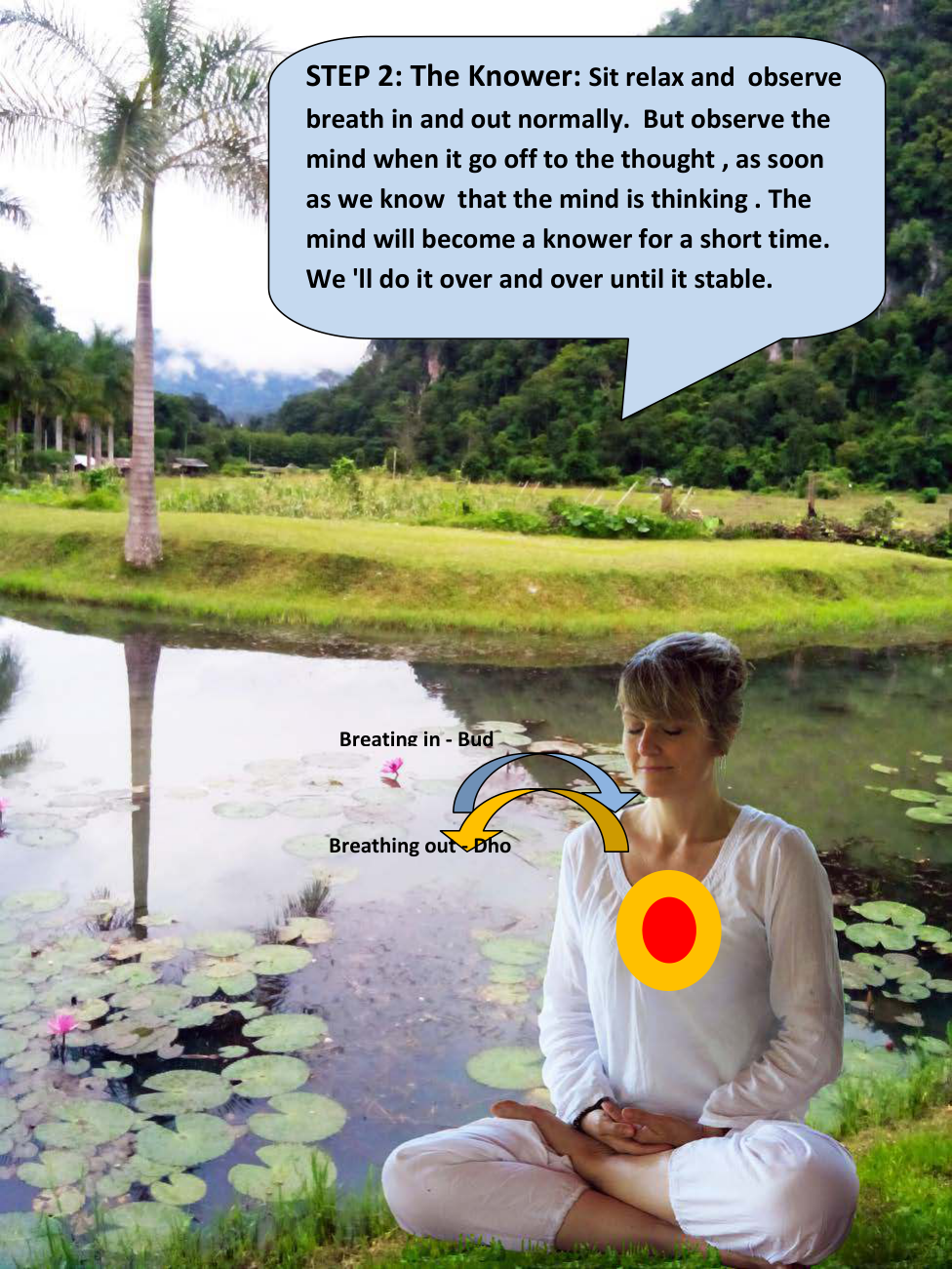
111
111
STEP 2: The Knower: Sit relax and observe breath in and out normally. But observe the mind when it go off to the thought , as soon as we know that the mind is thinking . The mind will become a knower for a short time. We 'll do it over and over until it stable.
步骤2:知者(The Knower):安坐放松,如常观察呼吸的吸入与呼出。但当心偏离而追随念头时,要如实观照这颗心;一旦觉知到“心正在想”,心便会在短时间内成为“知者”。如此反复练习,直到知者趋于稳定。
Breathe in - Bud
吸气——Bud(佛)
Breathing out - Dho
呼气——Dho(陀)
Page 121
mind is moving towards the object to focus in on it, or away from the object to get lost in something else, then the mind will become the knower or watcher. It will separate out as" the one who knows, the awakened and joyful one". It is the opposite of the one who is lost, infatuated or entranced. The lost one is the thinker, deluded and entranced in a fabricated reality. We need to learn to be the watcher or knower and rise above the thinker and the world of fabrication.
当心朝向所缘境移动、专注于它,或从所缘境移开而迷失于其他事物时,心便会成为“知者”或“观察者”。它会从中分离出来,成为“知晓者——觉醒而喜悦者”。这与迷失、沉溺或着迷之人相反。迷失者就是“思惟者”,在自造的虚构现实中颠倒迷惑、沉醉不醒。我们需要学习成为观察者或知者,超越思惟者以及虚构的世界。
The knower (samadhi of the second kind) arises when we practice meditation When it arises, it does so with either happiness or equanimity. We cannot intend for the knower to arise. It arises of its own accord when the mind has enough fortitude. The idea about fortitude can be illustrated in the case of someone who is perpetually bad. Such a person doesn’t need to intend to do bad things because he is bad already. The badness has fortitude and momentum. thus unseemly acts are committed effortlessly, without prompting. Good people do good things with ease as well. Many of us can notice that our minds naturally want to read or listen to the Dhamma without any prompting. Similarly, the knower arises unprompted out of the fortitude of our practice.
知者(第二类三摩地 samādhi of the second kind)会在我们修习禅修时生起。它一旦生起,所伴随的要么是喜乐,要么是舍(equanimity)。我们无法以意志“打算”让知者生起;当心具备足够的坚韧力(fortitude)时,它会自然而然地现起。关于“坚韧力”这一点,可以用一个长期作恶的人来说明:此人不必刻意去做坏事,因为他本就习于为恶;这种“坏”具有坚固与惯性(momentum),因此不端之举会不待外缘推动而轻易发生。善人行善亦复如是,往往做得很轻松。我们许多人也能觉察到:内心常常无需任何提示,就自然想去阅读或聆听佛法(Dhamma)。同样地,知者也会从我们修行所积累的坚韧力中,不待提示而自然生起。
We must practice to wake our minds up out of the world of thought and fabrication. The thinker opposes the knower; when we are not knowing, we are thinking, interpreting, and fabricating. Our practice is to simply know whenever the mind leaves the object of our attention. Notice when it goes out to think, see, hear, smell, taste or feel. Notice when it sinks down to cling to a meditation object as well.
我们必须修行,使心从思惟与虚构的世界中苏醒。思惟者与知者相对;当我们不在“知”时,就在思惟、解读并造作(fabrication)。我们的修行,就是当心一离开所缘境(注意的对象)时,单纯地如实知晓。要觉察它何时向外奔逸而去思惟、看、听、嗅、尝或触受;也要觉察它何时向下沉坠,黏著于某个禅修所缘。
Page 122
If we do this repeatedly, we will reach the second kind of Samadhi, characteristic-examination, and the mind will be in the appropriate state to practice Vipassana. For both kinds of Samadhi, the principles are quite easy. In the first kind, choose an object in the body or mind that we are happy with. When the mind is happy, it will stay concentrated and have no need to look for happiness elsewhere. In the second kind, we watch a meditation object and notice whenever the mind goes away from.
若能如此反复练习,便会达到第二类三摩地(Samadhi)——特征审察(characteristic-examination),此时内心将处于适合修习内观(Vipassana)的状态。这两类三摩地的要领都相当容易掌握:第一类是选择一个令我们心生欢喜的身心所缘境;当心欢喜时,便能安住于所缘、保持专注,无须再向外另觅快乐。第二类则是观照某一禅修所缘境,并在心一旦偏离该所缘时立即觉察。
Let’s take the example of the mantra “Buddho” as our meditation object. We could just as easily choose the breath, the body or part thereof.
以“Buddho”这一佛陀随念语(mantra)作为禅修所缘为例;同样也可以选择呼吸、身体,或身体的某一部分作为所缘。
For the first kind of samadhi, we practice Samatha. We happily keep our attention on the repeated word "Bhuddho". The mind eventually stays with and clings to “Bhuddho”. It becomes still and peaceful. If we are practicing the second kind of samadhi, we keep the mind on “Bhuddho” just the same, but our perspective is different. Instead of staying with “Bhuddho” to become calm and still, our objective is to recognize each time mind has left “Bhuddho” and recognize each time the mind over-focuses on it. The knower will arise and can walk the path of Vipassana wisdom. It will watch mental and physical phenomena passing by from a distance, and it will do so with impartiality. It is as if we are standing on the riverbank and watching the water flow downstream.
第一类三摩地中,我们修习奢摩他(Samatha,止)。我们以欢喜心将注意力持续放在反复念诵的“Bhuddho”上,心最终会安住并黏著于“Bhuddho”,从而变得寂静、安宁。若是修习第二类三摩地,我们同样把心放在“Bhuddho”上,但观照角度不同:不再以停住于“Bhuddho”来令心平静寂止为目的,而是要在每一次心离开“Bhuddho”时如实认出,并在每一次心对它过度专注时也如实认出。如此,知者(the knower)将会生起,得以行走于内观(Vipassana)智慧之道;它会以不偏不倚之心,从一定距离观照身心现象如流水般来去。这就好像我们站在河岸边,观看河水向下游流去。
Page 123
Firstly, we need to have mindfulness recognizing what arises in the body and mind. Then “to know bodily and mental phenomena as they really are” means that wisdom sees their true three characteristics. In order to have the wisdom that sees the Three Characteristics, the mind must be stable and impartial to phenomena. The knower, the awakened one is the one that is stable. By stability, It mean the mind remains rooted in awareness; it is not attached to phenomena and doesn’t slip down into them. It also doesn’t get lost in liking or disliking what arises. It is impartial, unbiased, equanimous. Keep practicing to develop mindfulness, develop samadhi and develop wisdom.
首先,我们需要具备正念,能够如实觉知身与心中所生起的一切。接着,“如其本然地了知身心诸法(phenomena)”是指:以智慧照见它们真实的三相(Three Characteristics)——无常、苦、无我。要生起能见三相的智慧,心必须稳定,并对诸法保持不偏不倚。知者(knower)、觉醒者,就是那位“稳定者”。所谓稳定,是指心扎根于觉知之中;不攀缘、不执著于境界,也不会滑入、陷没在所缘之中。它也不会迷失在对所生起之事的喜欢或不喜欢(贪/嗔)里。它是不偏、不倚、平等舍(equanimous)、中立而清明的。持续练习,以培育正念,培育三摩地(samādhi,定),并培育智慧。
3.10.3 ) STEP 3 ) practice " Stable mind "
3.10.3)第3步)练习“稳定的心”
Next step after we got the knower ,we have to bring our mind to be stable. To do this we need to developing such a mind that is wholesome, that is stable observer of the body and mind and conducive to wisdom, is called momentary concentration. The way to achieve it is to choose an object like the breath from the lesson 1.Instead of to make the mind rest and be comfortable and peaceful with the object, we observe the mind from this place instead. We keep this object as one main object and we set the mind free.
在我们获得知者之后,下一步就是令心稳定。为此,我们需要培养一种善心:它能够稳定地观察身与心,并且有助于生起智慧;这称为“刹那定”(momentary concentration)。达成的方法,是选择一个所缘,例如第一课中的呼吸。不同于让心在所缘上停住、变得舒适安宁,我们改为以此为立足点来观察心。我们以这个所缘作为一个主要所缘,同时让心保持开放与自由。
What will happen of course is the mind will go off to think. Then we observe or know the mind went off to think. Then the mind may go back and try to hold to that meditation object. Then we observe or know
当然会发生的是:心会跑去想事情。然后我们观察或了知:心已经跑去想了。接着,心可能会回到禅修所缘,并试图抓住那个禅修对象。然后我们观察或了知
Page 124
that it has gone to hold to the object. Then right away it might go off to think again. We observe or know that the mind has gone off to think again right away. The mind will oscillate between going off to think and going back to the object and trying to hold to it. We must observe the movements of the mind.
……它已转而去抓住所缘对象。紧接着,它可能立刻又跑去想别的。我们要观察或如实了知:心马上又跑去想了。心会在“跑去想”与“回到所缘对象并试图抓住它”之间来回摆动。我们必须观察心的动向。
It's important to know that we are not practicing this to try to keep the mind peacefully with the object . If we choose the breath, we are not trying to stay with the breath . We are just trying to see what the mind does from this place. We start by breathing and then the mind goes to think . We know that it went to think. The mind goes back to the object , and we know it went back to the object. The mind goes to think again , and we know that it went to think again.
关键要明白:我们这样练习,并不是为了让心安静地停留在所缘对象上。若选择以呼吸为所缘,我们也不是在努力让心一直待在呼吸上;只是借此如实观察:心在此处会做什么。我们先从呼吸开始,随后心跑去想了,我们了知它跑去想了;心又回到所缘对象,我们了知它回到了所缘对象;心再次跑去想,我们了知它又跑去想了。
We do this over and over again and the experience of the observer or knower , the stable mind , that has this correct type of concentration will arise. Only it will arise just for a very short moment, each time that we notice that the mind moves out to think, see, hear or feel. When we observe or know the mind goes out to think, the mind will be the stable mind or the observer for just a moment. If we do this again and again ,over and over , the experience of the observer or the stable mind will stay longer. The mind will be light and bright and comfortable and will be the observer of body and mind.
我们如此一遍又一遍地练习,“观察者”或“知者”(knower)的经验——亦即具备这种正确类型专注(concentration)的稳定之心——便会生起。不过,每当我们觉察到心向外移动去想、去看、去听或去感受时,它都只在极短的刹那生起。当我们观察或如实了知心跑出去想时,心就在那一刹那成为稳定之心或观察者。若不断反复地练习——一遍又一遍——“观察者”或“稳定之心”的经验便能停留更久。心将变得轻安、明净、舒适,并成为身与心的观察者。
Page 125
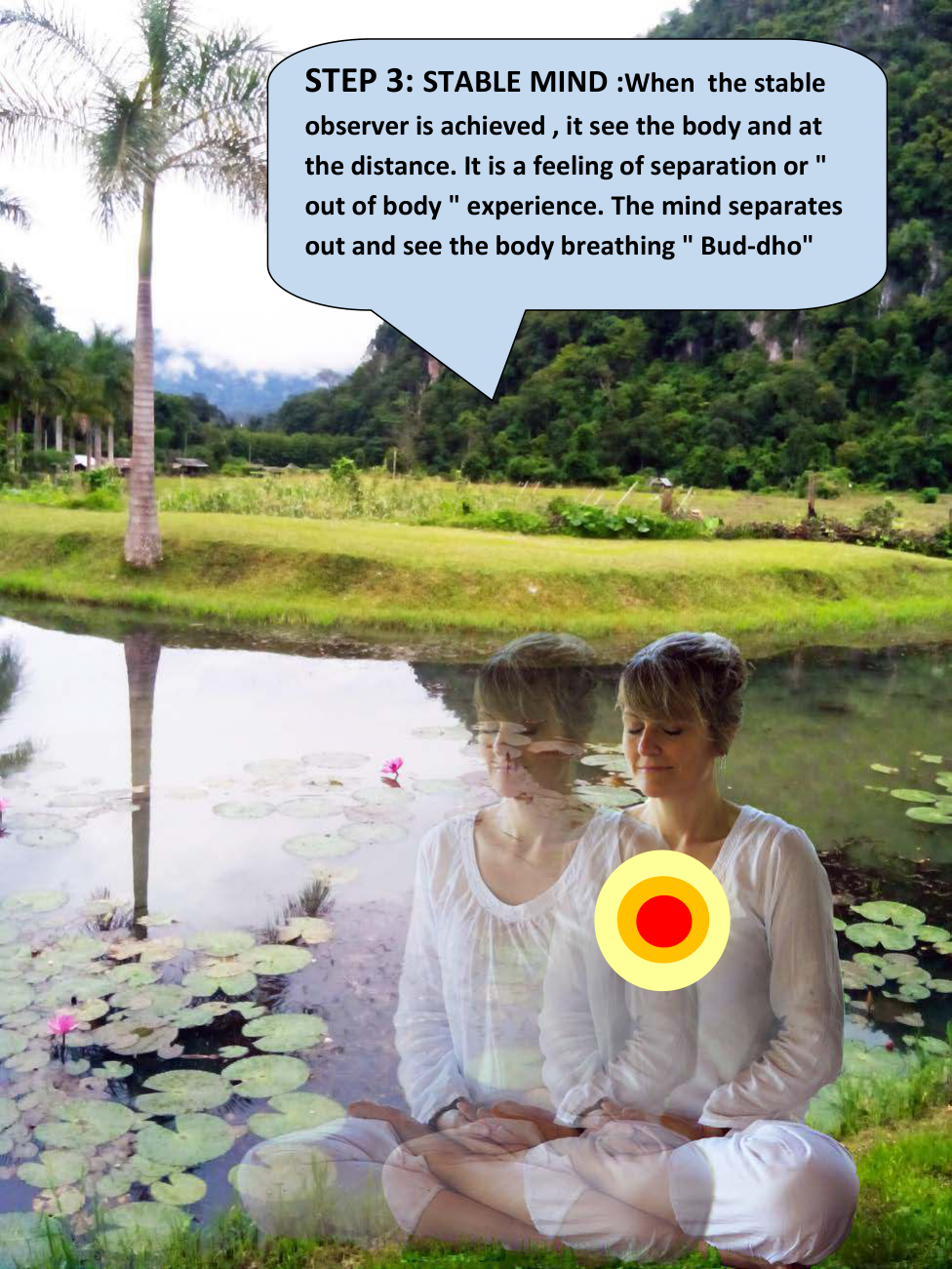
116
116
STEP 3: STABLE MIND :When the stable observer is achieved , it see the body and at the distance. It is a feeling of separation or " out of body" experience. The mind separates out and see the body breathing " Bud-dho"
第 3 步:心的稳定:当“稳定的观察者”建立起来时,便会在一定距离中看见身体。这是一种与身体分离的感觉,或所谓“出体(out of body)”的体验。心从身体中抽离出来,看到身体在呼吸“Bud-dho(佛陀)”。
Page 126
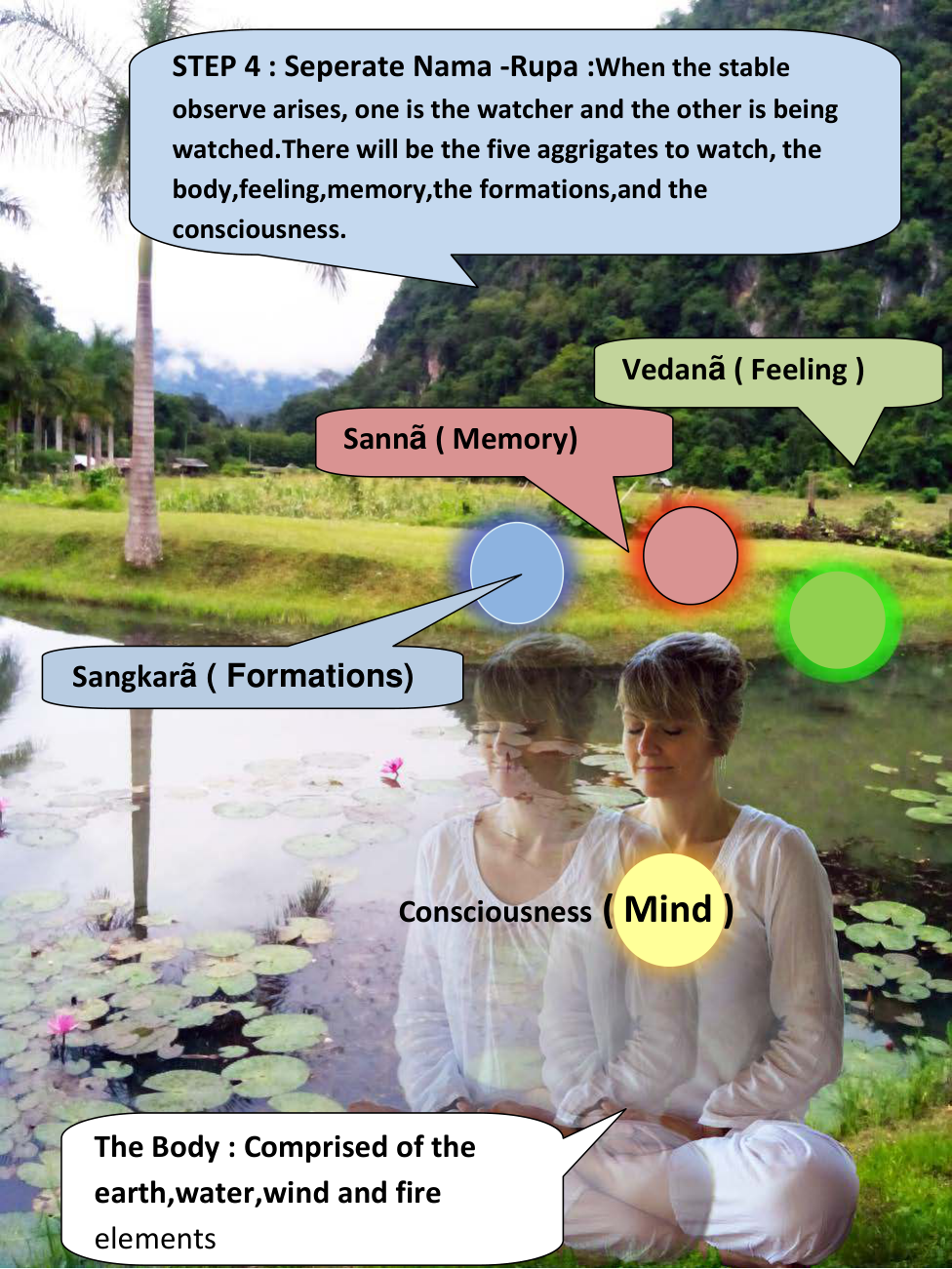
117
117
STEP 4 : Seperate Nama -Rupa :When the stable observe arises, one is the watcher and the other is being watched.There will be the five aggregates to watch, the body,feeling,memory,the formations,and the consciousness.
步骤4:分离名色(Nāma-rūpa;Nama-Rupa):当稳定的观照生起时,一者为观者,另一者为所观。此时可观五蕴:色(身)、受、想、行、识。
Vedanā ( Feeling )
受(感受;Vedanā)
Saññā ( Memory)
想(Saññā,记忆)
Sangkarā ( Formations)
行(行蕴;Saṅkhārā)
Consciousness ( Mind )
识(心)
The Body : Comprised of the earth,water,wind and fire elements
身体:由地、水、风、火四大元素构成
Page 127
3.10.3.1 ) The result after we practice this step
3.10.3.1)练习此步骤后的结果
When we watch the body as in Vipassana meditation. We can choose any observable phenomenon of the body, such as the breath, the rising and falling of the abdomen, In the case of the abdomen, we can see that there is rising and falling occurring there, and the mind merely watches this. The mind must be the watcher, an independent phenomenon from the object. The mind does not sink down to the breath but is rooted in awareness, . the mind sees the body is breathing in. It sees the body breathing out. The mind watches the body stand, walk, sit and lay down. It watches the hands and arms moving and stretching and so on. It sees the body doing what it does. The mind is just the watcher. The body moves and the mind watches. The body ceases to be ours. This body moves, but it is not us moving. True mindfulness arises. The mind awakens and sees that the body is not us , it's only the five aggregates which are
当我们如同在内观(Vipassanā)禅修中那样观身时,可以选择身体任何可观察的现象,例如呼吸、腹部的起伏等。以腹部为例,我们能看见那里确实在发生上升与下降,而心只是如实观照。心必须作为“观察者”,是与所缘(对象)不同的、独立的现象。心并不沉没到呼吸里,而是安住于觉知之中;心看见身体在吸气,也看见身体在呼气。心观照身体的站、行、坐、卧;也观照双手与手臂的移动、伸展等等。它看见身体只是如其所是地在活动。心只是观察者:身体在动,心在看。身体不再被认作“我的”。这具身体在动,但并不是“我”在动。真正的正念(sammā-sati)生起。心觉醒并看见:身体不是“我”,它只是五蕴(khandhas,聚合)而已,而这五蕴是
3.10.3.2 ) Khandhas or Aggregates (body and mind)
3.10.3.2)蕴(身与心的聚合,khandha)或聚(身与心)
Aggregates : The five function that constitute a human life. These groups are not entities in themselves; they are merely the categories into which all aspects of our lives can be analyzed. None of them are a " self" , nor do they have anything to do with selfhood, nor is there any " self" apart from them.The five are:
聚合(Aggregates):构成人类生命的五种作用(功能)。这些“组”本身并非实体;它们只是用来分析我们生活一切面向的分类。它们之中没有任何一个是“自我”,也与“我性”(selfhood)无关;除此之外,也不存在任何脱离它们而独立成立的“自我”。这五者是:
a) Rupa-khanha, body, kaya, the five aggregates
a)色蕴(rūpa-khandha):身体(身),五蕴之一
Page 128
( corporeality)something composed of various elements , organs, or parts. Generally used for the physical body ; refer to either the whole body or its parts ( breath-body and flesh - body)
(色/物质性)由诸多元素、器官或部分所构成之物。 一般用以指称色身;既可指整个身体,亦可指其各部分(息身与肉身)。
b) Vedana - feeling, sensation: the mental quality that sense experiences ( phassa ). There are three kinds:
b)Vedanā——受、感受:由触(phassa)所经验的心所品质。共有三种:
sukkha-vedana, pleasant, nice, delicious feeling
sukkha-vedanā:乐受,愉快、美好、可口的感受。
dukkha -vadana, unpleasant, disagreeable, painful feeling
dukkha-vedanā:苦受,不愉快、令人不悦、痛苦的感受。
adukkha-massukkha-vedana, neither-unpleasant -nor-pleasant
非苦非乐受(adukkha-masukha-vedanā):既非苦受,亦非乐受(中性受)。
c) Sannā- ( perception is awareness resulting from the reaction between the sense organs and sense objects.
c)Saññā——想(知觉):由诸根与诸境相互作用而生起的觉知。
d) Sankhara - Mental formations are volitional activities of the mind to commit wholesome , unwholesome deeds or neutral acts, under the influence of good or bad will, such as fait, mindfulness, conscience and compunction, the four noble sentiments, wisdom, defilement and obsession
d)Saṅkhāra——行(心行/意志造作):在善意或恶意的影响下,心的意志性活动,推动造作善业、不善业或中性行;其所涉如信(faith)、正念、惭与愧、四无量心、智慧,以及诸烦恼与执著。
e) Vinnāna-Sense consciousness: knowing sense objects or concerns through the six sense doors( eyes, ears, nose, mouth, body, mind)
e)Viññāṇa——识(六识):通过六根门(眼、耳、鼻、口、身、意)而了知诸境(所缘)。
Vināña is the fundamental mental activity required for participation in sensual world ; without it there is no experience.
Viññāṇa是参与欲界经验所必需的根本心活动;没有它,便无任何经验。
Page 129
3.10.3.3 ) What will we achieve with mindfulness practice?
3.10.3.3)通过正念修习,我们将成就什么?
After we’ve got the knower and being aware of our mind continuously and with ease, we can see all kinds of objects of consciousness pass through the mind. The mind will select the object that is most prominent at each moment. Therefore any of the four foundations of mindfulness can be practiced. On the contrary, if we cannot distinguish between the mind and the object of consciousness, then development of the four foundations of mindfulness will be difficult. When we say concentration development is the basis for insight development, or concentration is the proximate cause of wisdom, it is because wrong concentration development will make the mind be influenced by the object of consciousness. Right concentration development will make the mind gain clear comprehension, unbiased by the object of consciousness and, therefore, clearly see its true nature, how it arises and passes away, as follow.
当我们已建立“知者”(knower),并能持续、轻松地觉知自心时,就会看到各种所缘境(object of consciousness)不断穿过心识。心在每一刻都会取当下最突出的所缘境为对象。因此,四念处中的任何一处都可以修习。反之,若我们不能分辨“心”与“所缘境”,四念处的开展就会变得困难。我们说修习定(concentration)是修习观智(insight)的基础,或说定是智慧的近因,是因为错误的修定会令心受所缘境牵引与影响;而正确的修定则使心具足清楚的正知(clear comprehension),不为所缘境所偏倚,因此能如实明见其真实本性——它如何生起、如何灭去——如下。
a) Awareness of the body (kāyanupassanā)
a)身随观(kāyanupassanā)
When there is awareness of the body, such as sensing the breathing in and out, or noticing the cold air making contact with and cooling the body, or feeling the body get tired and perspire on a hot sunny day, or observing the body move as we do in walking meditation, those who have developed the conscious mind will see that the body as a collection of many elements that moves around just like a robot, and that there is not a single part that can be
当有对身体的觉知时,例如觉察呼吸的入与出,或注意到冷空气接触身体并令其凉爽,或在炎热晴天感到身体疲惫并出汗,或如行禅时观察身体的移动;那些已培养出觉知之心的人,将会见到:身体只是由诸多元素聚合而成,像机器人一般运作移动,并且并不存在任何一个单独的部分可以是
Page 130
called ours. When doing walking meditation until the legs get sore, we can see that the legs themselves do not complain. The separation between body and mind become distinct, and we can see the three characteristics of existence of the body with clarity.
被称为“我们的”。当经行(walking meditation)至双腿酸痛时,我们会看到:腿本身并不会抱怨。此时身心的分离变得分明,我们便能清楚地观见身体的三相(无常、苦、无我)。
b) Awareness of feelings (vedanānupassanā)
b)感受的觉知(受随观,vedanānupassanā)
Sometimes, when we are aware of the mind, we also become aware of feelings, sometimes through the body and sometimes through the mind, depending on which is more prominent at that moment. For example, when doing walking meditation our legs become stiff, if the conscious mind is present, we will clearly see that this feeling of stiffness is not the legs, but is something that is hidden within the legs. Or when sitting in the heat a cool breeze passes by, we feel comfortable and relaxed. This feeling of comfort and relaxation arises from somewhere within the body, but is not the body. The body itself does not feel the comfort. Or when we have a toothache, if our conscious mind is present, we will clearly see that this aching feeling is not from the tooth, nor from the mind, but is another thing, another aggregate or khandha. The pain is not constant, but changes in intensity all the time, showing the three characteristics of existence of feeling, or vedana-khandha. Feelings can be clearly seen through the mind. For example, pain from a toothache can be felt through the physical body, and sometimes through the mind as well, such as feeling sad and worried in this
有时,当我们觉知到心时,也会同时觉知到受(vedanā);有时是经由身体而觉知,有时是经由心而觉知,这取决于当下何者更为显著。比如,经行时双腿变得僵硬,若清醒的觉知之心在场,我们会清楚地看到:这种“僵硬”的感受并不是腿本身,而是隐伏于腿中、可被觉知到的另一种现象。又如,在炎热中静坐时一阵凉风拂过,我们感到舒适与放松。这种舒适与放松的感受从身体内部某处生起,但并非身体;身体本身并不会“感受”舒适。再如,当我们牙痛时,若清醒的觉知之心在场,我们会清楚地看到:这种疼痛的感受既不来自牙齿,也不来自心,而是另一种事物——另一蕴(khandha)。疼痛并不恒常,其强弱随时变化,显示出“受”(即受蕴,vedanā-khandha)的三相。感受也可以通过心被清楚地观见。例如,牙痛之痛可经由色身而被感受;有时也会经由心而被感受,例如在这种情况下感到悲伤与忧虑
Page 131
case. Sometimes when we eat something we like, even before tasting the food in the mouth, we already feel happy. When aware of feelings while being aware of the conscious mind, the three characteristics of existence of feeling can be seen with clarity.
同样如此。有时当我们吃到自己喜欢的食物时,甚至在食物入口、尚未品尝到滋味之前,就已经感到欢喜。若在觉知“受”(vedanā)的同时又觉知明觉之心,则能清晰地照见“受”的无常、苦、无我三相。
c) Awareness of Mind (cittanupassanā)
c)心的观照(cittanupassanā)
Awareness of mind is actually not awareness of the conscious mind, or the “absolute mind” (also called “one mind” or “pure mind” in Zen) but rather awareness of mental formations, of thoughts and emotions or citta-sankhara that arise. An example is awareness of the arising and passing away of anger, desire, confusion or happiness. These mental formations are not the mind, but just objects of consciousness. Awareness of mental formations while being aware of the conscious mind is the clearest way to see the three characteristics of existence of mental formations.
所谓对“心”的觉知,其实并非对明觉之心的觉知,也不是对“绝对心”(禅宗中亦称“一心”或“清净心”)的觉知,而是对所生起的心行(citta-sankhara)的觉知——即对念头与情绪的觉知。例如,觉知嗔怒、欲望、迷惑或喜悦的生起与灭去。这些心行并非“心”本身,而只是意识的所缘(对象)。在觉知明觉之心的同时觉知这些心行,是最清楚地照见心行无常、苦、无我三相的方法。
d) Awareness of Mind-Objects (dhammanupassanā)
d)心所缘法的观照(dhammanupassanā)
With awareness of the conscious mind, whatever arises will show its true characteristics. For example, while being mindful, if the mind thinks of a loved one, it will become absorbed in the thought process. We will then clearly see that the mind clings to the notion of mind as self because it ignorantly identifies itself with the object of consciousness. This sense of self, aggregate, or heaviness arises from nothingness initially. However, if we are aware that whenever the mind grasps on to something, suffering arises, we will
在觉知明觉之心时,无论何法生起,都会显现其真实特性。例如,当保持正念时,若心忆念所爱之人,便会被思绪过程所吸摄。于是我们将清楚看见:心之所以执著“心即我”的观念,是因为它在无明中将自己与意识的所缘(对象)认同为一。此种我感、凝聚感或沉重感,最初似乎从无中生起。然而,若我们觉知到:每当心抓取、攀缘某物时,苦便随之生起,我们就会
Page 132
let go and return to just being mindful. The aggregate, heaviness, denseness, or suffering will eventually disappear. This in fact is the realization of the Four Noble Truths. We will see that when there is craving, an urge to grasps on to an object of consciousness, the sense of self arises, followed by suffering. If there is no craving, then suffering cannot arise.
放下所缘,回到单纯的正念之中。五蕴的聚合感、沉重感、稠密感,乃至苦受,终将逐渐消退。这其实就是对四圣谛的体证。我们会看到:当贪爱(craving)生起时,便会出现攀取某个意识所缘的冲动,“我(自我)感”随之生起,继而便是苦;若无贪爱,苦便无法生起。
Awareness of natural phenomena while being mindful of the conscious mind is the clearest way to see the three characteristics of existence of the mind. We will see that the mind is not in our control. It goes out and grasps on to objects by itself. And when the mind realizes that grasping causes suffering, it will eventually stop. Nothing is within our control.
在对心的觉知保持正念的同时,如实觉察自然现象,是最清楚地观见“心之三相(存在三特相)”的方法。我们将会看到:心并不在我们掌控之中,它会自行外驰并攀取所缘。当心如实了知攀取会导致苦时,它终将止息。没有任何事物真正处于我们的控制之内。
3.10.4) STEP 4) separation of matter and mind ( nama - rupa)
3.10.4)第4步)色与名的分离 (名色,nāma-rūpa)
When consciousness is firm and neutral in mindfulness of Matter and Mind and is automatically mindful, what is called “a self” will dissipate to show what it actually is, i.e. Matter and Mind. If mindfulness and wisdom mature, insight will further dissipate Mind into feeling, perception, mental formation and consciousness. It will also dissipate Matter into eyes, ears, nose, tongue and body or into earth, water, fire and air elements. The dissipation of Matter and Mind through insight is the beginning of disillusionment of the wrong view of an abiding “self”. This is preliminary insight gained through training in wisdom.
当在对色与名的正念中,心(consciousness)稳固而中舍,并能自然而然地保持正念时,所谓“自我”(a self)便会消融,显现其真实面貌——即色与名。若正念与智慧日渐成熟,观智将进一步把“名(心)”解析、分解为受、想、行与识;也会把“色(身)”解析、分解为眼、耳、鼻、舌、身诸根,或解析为地、水、火、风四界(mahābhūta)。借由观智对色与名的解构与消融,正是对“常住自我”这一邪见开始破除、产生厌离的起点。这是通过慧学训练所获得的初步观智。
Page 133
After we've got the knower so we have the stable mind, we have the mind to be the observer , we can develop the path of wisdom. we will see the truth. We will see that the body that is walking around, sitting , moving , brushing it's teeth , is just a mass. The body is a physical mass that is not owned by anyone, and it isn't anyone. It's not a person . It's just a physical mass that belong to the world, that belongs to the nature.
当我们已获得“知者”(knower),令心稳定,并能以心作为“观察者”(observer)时,就可以开展智慧之道。我们将见到真相:那具走来走去、坐着、移动、刷牙的身体,不过是一团“色身/物质”(Matter)。身体只是一团物质的聚合,不为任何人所有,也不是“任何人”。它不是一个人;它只是一团属于世界、属于自然的物质聚合。
We will see that the body is one thing and the consciousness or the observer that sees the body is a totally separate thing. We will start to gain wisdom into way that things truly are. We will see that the mind with all the different thoughts and the heart with all the different feelings don't belong to anyone either. Feelings are just feelings, emotions are just emotions and thoughts are just thoughts. They don't belong to anyone . We will see this and gain wisdom with the proper type of concentration.
我们会看到:身体是一回事;而看见身体的识/意识(consciousness)或“观察者”(observer)则是完全分离的另一回事。我们将开始生起对事物如实状态的智慧。我们也会看到:充满种种念头的心(mind),以及伴随种种感受的情感之心(heart),同样不属于任何人。感受只是感受,情绪只是情绪,念头只是念头——它们都不属于任何人。以恰当类型的定(concentration),我们将如实见到这一点,并由此增长智慧。
3.10.5 ) STEP 5) See the three characteristics of the Khandha (The five aggregates)
3.10.5)步骤5)观五蕴的三相 (五蕴)
Seeing the rising and falling/changing of Matter and Mind
观察色法与名法的生起、灭去与变易
After Matter and Mind dissipate, we will realize that each Matter and each Mind perform their own functions, including rising, falling and changing at all times.
当色(Matter,rūpa)与名(Mind,nāma)消散时,我们将体会到:每一种色、每一种名都在执行各自的功能,包括在任何时候都不断地生起、灭去与变化。
For example, consciousness will see Matter inhaling and exhaling, sitting and
例如,识/意识(consciousness)会观察到色(Matter)在吸气与呼气、坐着以及……
Page 134
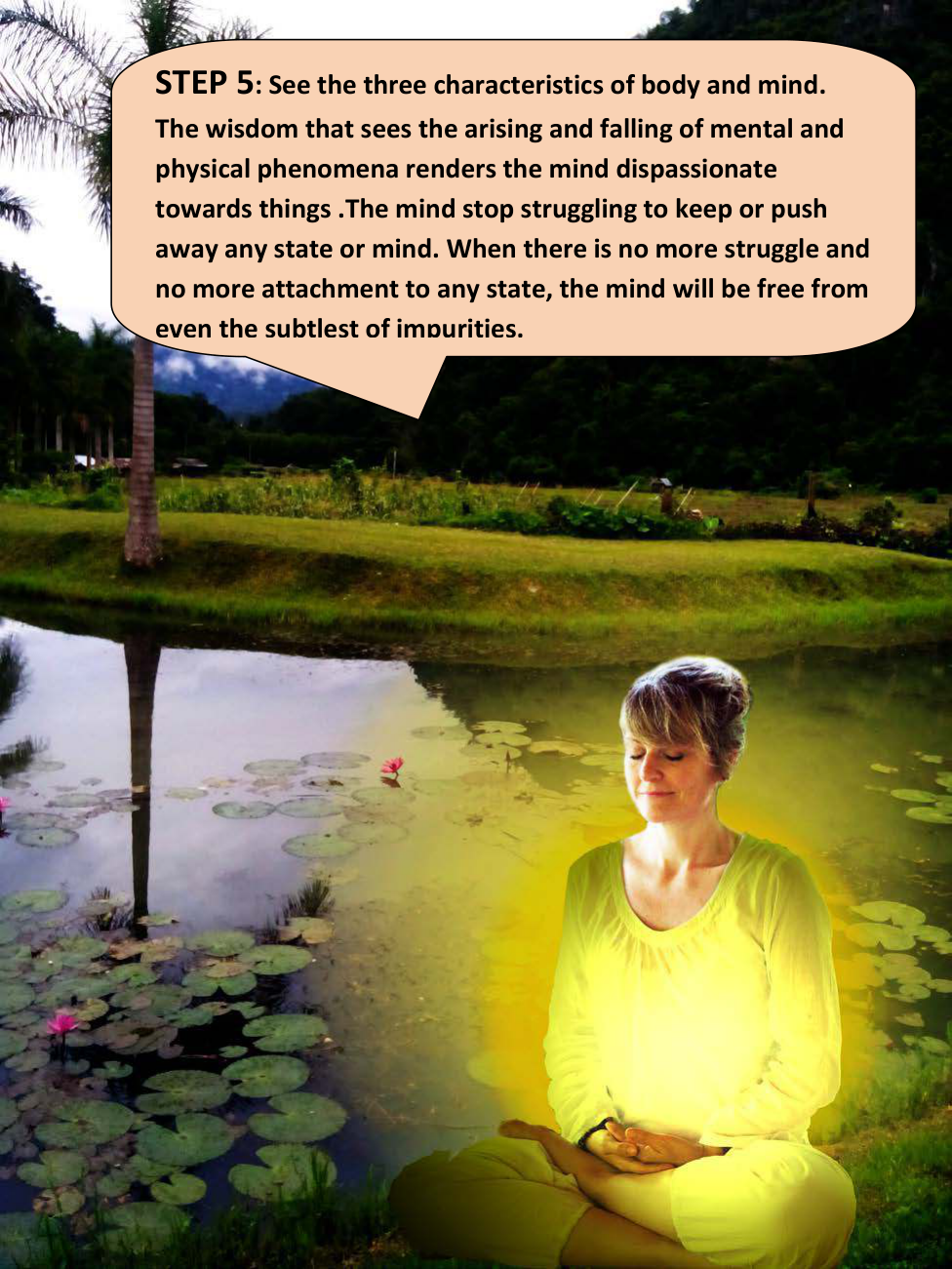
STEP 5: See the three characteristics of body and mind.
步骤5:如实知见身心的三相。
The wisdom that sees the arising and falling of mental and physical phenomenon renders the mind dispassionate towards things. The mind stop struggling to keep or push away any state or mind. When there is no more struggle and no more attachment to any state, the mind will be free from even the subtlest of impurities.
如实观见身心现象生起与灭去(生灭)的智慧,能令心对诸境离贪、趋于淡然。心不再挣扎于想要维持或排斥任何一种状态或心境。当不再有挣扎,也不再执著于任何状态时,心将从乃至最细微的染污中获得解脱。
Page 135
standing, standing and walking, moving and holding still, etc. Alternatively, consciousness will see that mindlessness arises and vanishes, there is little space in between, and the new consciousness arises to recollect that it was mindless just now. All these lead to insight of the rising, falling and changing of Matter and Mind. It is the beginning point of disillusionment of the wrong view of Matter and Mind as an animal, a human being, a self; and liberation from clinging to Matter and Mind will follow.
站立、站立与行走、移动与静止不动等等。或者,觉知会看见无觉知(mindlessness)生起又消失,其间几乎没有间隙;随后新的觉知生起,忆知自己刚才处于无觉知。所有这些都会引导我们洞见色与名(Matter and Mind)的生起、灭去与变异。这是对将色与名误执为动物、人、我(self)之邪见开始生起厌离与幻灭的起点;随之而来的,是从对色与名的执取中逐步解脱。
When the power of our mindfulness is really excelling, we see that the mind or consciousness arises at the eyes and then falls away; it arises in thought, thinking occurs, and then the mind or consciousness falls away. Each mind of wholesome state arises and falls. Each mind moment that is greedy, angry, lost in thought, restless or upset arises and then falls away. Life breaks up into slices. Each mind comes and goes. It is not the same mind from birth until death. That is a delusion. The mind is different one in each moment. Why do we need to see the truth? It is so that we can see that the mind isn't us. It's a new mind every moment. It is never the same mind. It changes from one that is aware., to the new one that is thinking, to the new one that is over-focusing, and so on. If we can see that the mind arises at a time and then falls away, like separate mental moments, we can see the truth is of continuity. Our sense organs that perceive things as fluid and continuous are deceiving us and are thus fabricating a self that doesn't really exist.
当我们的正念之力真正强盛时,我们会看见心或识在眼门生起,随即便灭去;它在念头中生起,思惟活动发生,随后心或识又灭去。每一个处于善状态的心都生起又灭去;每一个贪、嗔、迷失于思绪、躁动或烦乱的心刹那,也都生起而后灭去。生命因此被分割成一片片的片段:每个心都来去不住,从出生直到死亡并非同一个心——那是一种迷妄。心在每一个刹那都是不同的。我们为什么需要见到真相?正是为了看清:心并不是“我”。每一刻都是新的心,从来不是同一个心;它从一个正在觉知的心,转变为一个正在思考的心,再转变为一个过度聚焦的心,如是等等。若我们能如实看见心在某一时刻生起而后灭去,仿佛彼此分离的心理刹那,我们便能看见所谓连续性的真相。我们的感官把所缘认作流动且连续,这正在欺骗我们,于是虚构出一个并不真实存在的“我”。
Page 136
Continuity is just an illusion because things are arising and falling away so quickly. It is an illusion that blinds us from seeing what is really going on. If one day we clearly see in our experience that the mind is not us, then nothing in the world will be mistaken as us ever again.
相续(连续性)只是一种幻相,因为诸法生起与灭去得如此迅疾。正是这种幻相遮蔽了我们,使我们无法如实看见正在发生的一切。 如果有一天,我们在自身经验中清楚地照见:心并不是“我”,那么此后世间再没有任何事物会被误认为是“我”。
The body is experienced not us from much earlier on in our development of mindfulness. Whenever the mind is awake and aware , the body is seen as a separate thing. What is left to unveil, then is that the mind is not us either. We will see that it is running here and there at first, and then as our mindful grows further, we see more clearly that it is not actually running but arising and falling at each place, such as the eyes ,the ears or in thinking.
在培育正念(mindfulness)的过程中,我们往往较早就能体验到:身体并不是“我”。每当心处于清醒而明觉的状态,身体就会被如实观为一个与“我”分离的对象。 那么接下来尚待揭示的便是:心也不是“我”。起初我们会看到它似乎四处奔走;而随着正念进一步增长,我们会更清楚地见到:它并非真的在奔走,而是在每一个处所当下生起、当下灭去——例如在眼处、在耳处,或在思惟之中。
When the continuity is broken like this, we can say that we are truly at the level of Vipassana. If there is not yet discontinuity, then it isn't genuine Vipassana.
当这种相续(连续性)如是被打破时,我们才可以说自己真正进入了内观(Vipassanā/Vipassana,毗婆舍那)的层次。若尚未出现这种不相续(discontinuity),那就不是真正的内观。
We have to keep practicing to see the continuity break. When this insight into the truth first happens, it really can shake up our world. Some people become frightened . Some people become bored. Others feel empty, like their essence is missing, and can't find their footing; they can't find anything solid to rely on anymore. Some people become so bored , they lose passion for everything in the world. They are disinterested in both happiness and un happiness. They lose passion for everything and everyone, include their spouse.
我们必须持续修行,才能见到相续被打破。当这种对真相的洞见首次发生时,确实可能震动我们的整个世界:有些人会感到恐惧;有些人会感到厌倦;另一些人则觉到空落,仿佛自己的“本质”失落了,因而站不稳脚跟——他们再也找不到任何坚实之物可以依靠。有些人甚至厌倦到对世间一切都失去热情:对快乐与不快乐都不再感兴趣;对一切事物与所有人都失去激情,包括自己的配偶。
This dispassion, however, is not an impurity of mind. It is a natural step in the process of enlightenment. This mind is bored or dispassionate because it has
然而,这种离贪(dispassion)并不是心的染污或不净。它是觉悟(enlightenment)进程中的一个自然阶段。这颗心之所以感到厌倦或离贪,是因为它已经
Page 137
mindfulness and wisdom that sees everything is nonsensical and insubstantial. It becomes equally bored of pleasure and pain, equally bored of good and bad, equally bored with thing coarse and things subtle, and equally bored of internal experiences and external experiences. At this stage it is dispassionate to absolutely everything. The mind stops persuing anything. But some people get very frightened indeed. When they practice to the point where they see what they thought was themselves disappear, some people become absolutely terrified.
这种正念与智慧洞见:一切皆荒诞而无实体(insubstantial)。它对乐与苦同样生厌,对善与恶同样生厌,对粗显与微细之法同样生厌,对内在经验与外在经验亦同样生厌。至此,对绝对一切皆离欲、无执。心不再追逐任何所缘。然而,有些人确实会变得非常害怕。当他们修行至看见自己以为是“我”的东西消失时,有些人会陷入极度恐惧。
3.11) Disenchantment and discernment of the truth of unsubstancial nature, suffering and harm from Mind and Matter
3.11)对名色(Mind and Matter)所显现的无实体性之真相、以及由名色而来的苦与过患生起厌离,并如实辨知
After more and more seeing of the rising and falling of Matter and Mind, some may be disenchanted with all conditioned states because they have realized that happiness arises and then vanishes. It is not pleasurable. Suffering arises and vanishes. It is not miserable. Moral consciousness arises and vanishes. It is not pleasant. Immoral consciousness arises and vanishes. It is not unpleasant. Whatever arises will vanish. It is neither pleasant nor unpleasant. Joy and grief are equally boring. Good and evil are equally boring. Some may view Matter and Mind as some natural phenomena of existence that are not self. Their selves are gone. A void, dread or the truth of unsubstantial nature may come to mind.
随着对名与色(Mind and Matter)生灭起伏的观察愈发深入,有些人会对一切有为法(conditioned states)生起厌离,因为他们体悟到:快乐生起随即灭去,它并非可喜;痛苦生起随即灭去,它并非可憎;善(moral)的心识生起随即灭去,它并非可乐;不善(immoral)的心识生起随即灭去,它也并非不可乐。凡生必灭;于此既非乐,亦非不乐。喜与忧同样令人厌倦,善与恶同样令人厌倦。有些人会将名与色视为存在中的自然现象,非我(not self)。其所执“我”已然消融。此时,内心可能浮现空无感、惊惧,或无实体性(unsubstantial nature)的真实相。
These are feelings of insight practitioners. Some may get stuck at this stage for a long time while others may not take a long time to pass through this stage.
这些是内观(insight)修行者在此阶段可能出现的体验。有些人可能会在这一阶段停留很久,而另一些人则能在较短时间内通过这一阶段。
Page 138
3.12 ) Neutrality to conditioned states
3.12)对有为法(受条件制约的诸行)的中舍(upekkhā)
After more and more mindfulness of Matter and Mind, consciousness will realize that boredom, dreadfulness or any other feeling whatsoever is only an object of conscious that passes by. Consciousness will become firm and neutral to all conditioned states despite no will to maintain neutrality. This is a very important step of insight development. One who practices mindfulness up to this stage will be very blissful and will feel unshaken when touched by worldly vicissitudes. However, neutrality at this stage is still uncertain. Some may not be able to sustain it and become biased again while others may unexpectedly progress by leaps and bounds in Dhamma.
随着对名色(Matter and Mind)的正念日益增上,心识将体悟到:无论是厌倦、怖畏,还是任何其他感受,都只是短暂掠过的识所缘(所缘境)。即使并无刻意维持中舍之意志,心识亦会趋于稳固,并对一切有为法保持平等中舍。这是观智发展中极其重要的一步。修习正念达到此阶段的人,将身心轻安喜乐;即使遭遇世间八风等种种变迁触动,也会感到不为所动。然而,此阶段的中舍仍未稳固:有人可能无法持续而再度偏向;也有人可能在 Dhamma(法)上出乎意料地突飞猛进。
3.13 ) Mindfulness of mind may alternate between concentration and insight meditation
3.13)观心的正念可能在 止(定)禅修与观(慧)禅修之间交替
When observing the mind or body, the mind may switch back and forth between concentration and insight meditations. In most textbooks, concentration and insight meditations are differentiated based on the subject of meditation. For example, if we practice the 40 subjects of meditation, such as the 10 recollections or anussati, we are doing concentration meditation. If we practice the four foundations of mindfulness, which are awareness of body, feelings, mind and mind-objects, then we are doing insight meditation. If the object of mindfulness is conventional or relative reality, then we are doing concentration
当观照心或身时,心可能会在止禅与观禅之间来回切换。在大多数教科书中,止禅与观禅通常依据禅修所缘(subject of meditation)来区分。例如,若我们修习四十业处,如十随念或 anussati,便是在修止禅。若我们修习四念处——即对身、受、心与法(mind-objects)的觉知——便是在修观禅。若正念所缘为世俗谛或相对真实,那么我们是在修止禅
Page 139
meditation. But if the object is ultimate reality, then we are doing insight meditation. In actuality there is more to all this. Distinction between concentration and insight meditations can be made based on the type of activity of the mind.
……禅修。但若所缘为究竟实相,则属于内观禅修(vipassanā)。实际上,其中还有更深一层的内容。止(定)禅修与内观禅修的区分,可依据心的运作方式(心的活动类型)来判定。
For example, whenever the mind is mindful of one object continuously, this is concentration meditation. Continuing to be mindful until the mind rests on that object without any added control or intention, the mind will become one with the object, resulting in bliss and tranquility. This is a state of meditative absorption, or jhana, a direct result of concentration meditation. However, when we are mindful of any object of consciousness that naturally arises and at the same time has clear comprehension, this is awareness of mind. In other words, when the conscious mind and the object of consciousness are clearly distinguished, we will see the arising and passing away of ultimate reality. This is insight meditation. At some point in practice, once the mind no longer needs to hold the intention to be aware of objects or to maintain the conscious mind, it will develop mindfulness and clear comprehension on its own. When it all happens automatically, then this is genuine insight meditation.
例如,当心持续不断地对单一所缘保持正念时,这就是止(定)禅修。继续保持正念,直到心能在该所缘上自然安住,而不再需要额外的操控或刻意用功时,心将与所缘相应乃至融为一体,由此生起喜乐与寂静。这是一种禅定的“入定”状态,即禅那(jhāna),是止(定)禅修的直接结果。相反地,当我们对任何自然生起的识所缘境保持正念,并同时具备清楚了知(正知,sampajañña)时,这就是对心的觉知(awareness of mind)。换言之,当能知之心与所知之境清楚分明时,我们便能如实见到究竟实相的生起与灭去。这就是内观禅修。在修习的某个阶段,一旦心不再需要刻意维持“觉知所缘”的意图,或不再需要刻意维持能知的明觉,它便会自行生起正念与正知。当这一切能够自动运作时,这才是真正的内观禅修。
A person doing concentration meditation is like someone who has fallen into a river and, swimming in it, is unable to see things clearly. Whereas a person doing insight meditation is like someone sitting on the bank of the river and, watching the current passing by, is able to see with a clearer perspective
修止(定)禅修的人,好比失足落入河中者:在水里挣扎游动,因而难以看清事物;而修内观禅修的人,则好比安坐河岸者:观照水流来去,从而能以更清明的视角如实看见。
Page 140
the river and all the things floating in it, some of which may be clean and beautiful, while others dirty and unattractive. This is why it is essential to be able to distinguish between the conscious mind and the object of consciousness before doing contemplation of the mind or contemplation of the body. An example is contemplating on human skeleton by focusing the mind on features such as length or shape, concentrating on one of the four basic elements — earth in this case. Focusing the mind on the white color of the bones would be concentrating on the color. This focus of the mind until it attains tranquility and becomes fixed on the bone’s shape or color is concentration meditation. Even by contemplating on the bone as an element, an aggregate or part of a decaying body, we are still doing concentration meditation because the whole process is still a thinking process. But if we are aware of the bones, with the conscious mind stable and separate, and contemplate on the bone’s three characteristics of existence, then this is the beginning of insight meditation. And while doing insight meditation through awareness of the body, sometimes the mind is fixed on to a certain part of the body, briefly switching over to concentration meditation and then back out to awareness of the body again. Or sometimes the mind goes overboard and focuses too strongly on the awareness and becomes scattered and restless. When this happens we must step back and deconcentrate meditation until the mind regains strength and able to separate itself from the object of consciousness, and then resume with insight meditation.
河流以及漂浮在其中的一切事物,其中有些也许洁净美好,另一些则肮脏丑陋。因此,在修习观心或观身之前,必须能够分辨“有意识的心”(conscious mind)与“所缘”(object of consciousness,意识的对象)。例如观人骨:令心专注于骨骼的长度、形状等特征,即是取四大(mahābhūta)之一的地界(paṭhavī-dhātu)为所缘;若令心专注于骨头的白色,则是取颜色为所缘。如此持续令心专注,直至心得寂静并稳固地安住于骨的形状或颜色上,即为奢摩他(samatha)的定修(concentration meditation)。即便将骨观作一种界、一个聚合(aggregate)或败坏身体的一部分,我们仍是在修定,因为整个过程仍属“思惟造作”的过程。若能对骨生起如实觉知,使心稳定而与所缘分离,并进一步观照骨的三相(存在三特征:无常、苦、无我),这便是毗婆舍那(vipassanā,观/内观)的开始。而在以身念住(kāyānupassanā)修观时,有时心会暂时黏着于身体某一部位,短暂转入修定,然后又回到对身体的觉知;也有时用力过度,过分执着于“觉知”而致散乱不安。此时应当退一步,先放松专注、减弱用力,直到心力恢复,能够再次与所缘分离,再继续修观。
Page 141
Mindfulness of mind can be both concentration and insight meditations. If we intently focus on the emptiness of the mind or transfix on any particular part of the mind, this is concentration practice. If, however, we are aware of ultimate reality, which is the arising and passing away of all objects, with the conscious mind clearly separate, then this is insight practice. In fact, when we are aware of the mind doing insight meditation, the mind will occasionally focus on a certain object, switching to concentration meditation on its own. We should be able to differentiate whether the mind is practicing concentration or insight meditation.
心念处(对心的正念)既可以是止禅(concentration),也可以是观禅(insight)。如果我们刻意专注于心的空性,或将心紧紧钉住在心的某个特定部分上,这属于止的修习。若我们觉知到究竟实相——一切所缘对象的生起与灭去——并且能知之心清楚地与所缘相区分,那么这就是观的修习。事实上,当我们觉知到心正在修观禅时,心有时会自行将注意力落在某个对象上,而转为止禅。我们应当能够辨别:此刻心是在修止禅,还是在修观禅。
Otherwise, we may mistakenly think we are practicing insight meditation while actually practicing concentration meditation.
否则,我们可能误以为自己在修观禅,而实际上是在修止禅。
For practitioners whose teachers lack intuitive knowledge of the states of students’ minds, it is easy to get off track without knowing. For example, while doing walking meditation and focusing on lifting, moving, and placing the feet, the mind may be fixed to the feet or get lost in thinking about the lifting, moving, and placing of the feet. This is purely concentration meditation without clear comprehension, or awareness of the mind. Another danger in not being able to differentiate between concentration and insight meditation is it may lead to a refined form of defilement, called defilement of insight, or vipassanupakilesa. This may happen during insight meditation, when the mind switches back to concentration meditation and experiences something that misleads it into thinking that it has been enlightened. Some examples are
对于那些老师缺乏对学生心态状态之直觉了解的修行者而言,很容易在不自知的情况下偏离正轨。比如,在行禅时专注于抬起、移动与放下脚步,心可能紧黏于脚上,或迷失在对“抬起、移动、放下”这些动作的思惟之中。这纯然是止禅,而缺乏清明正知(clear comprehension),亦无对心的觉知。无法分辨止禅与观禅的另一项危险,是可能引生一种更精细的烦恼,称为“观的杂染/观智杂染”(defilement of insight),即 vipassanupakilesa。这可能发生在观禅过程中:当心又切换回止禅,并经历某种体验,从而误导自己以为已经证悟。其一些例子是
Page 142
mindfulness of object of consciousness with a mind that is stiff and unwholesome, as opposed to a mind that is soft, light, pliable and conducive to insight meditation. The mind may reach a wrong understanding and cannot differentiate between conventional truth, or sammati-sacca, and absolute truth, or paramattha-sacca. Or it may have a wrong view that there is no such thing as the Buddha, there is no such thing as parents, and everything in the world is empty. This is in denial of the existence of conventional concepts, thinking that there is nothing at all. With regard to the conventional world, these concepts do exist and should not be denied. In fact, when practicing awareness of mind, the mind naturally switches back and forth between concentration and insight meditations, enabling some practitioners to attain absorption automatically, without any special training at all.
以僵硬而不善的心去修习对所缘境的正念,正与柔软、轻安、调柔、堪任且有助于内观禅修的心相反。此心可能落入错误的理解,不能分辨世俗谛(sammati-sacca)与胜义谛(paramattha-sacca)。又或者生起邪见:认为并无佛陀,并无父母,世间一切皆空。这是在否认世俗概念的存在,误以为全然无有。就世俗世间而言,这些概念确实存在,不应加以否定。事实上,在修习对心的觉知时,心会自然在止禅与观禅之间来回转换,使某些修行者即便毫无特别训练,也能自然而然地证得禅那(jhāna)。
3.14 ) To advance from common objects of consciousness to refined state of void
3.14)从常见的识所缘进展至细微的空寂状态
Once we are skillful at being aware of the mind, we will see that any object that arises in the mind will eventually disappear, just like a moth flying into the fire. At first, we will detect only common emotions, such as anger. But with further practice we will notice with clarity the faintest irritation or satisfaction that arises. For example, on a hot day, when a cool breeze blows softly on the skin, the mind feels pleased and liking arises. Or when we need to go to the toilet, just as we start to release, the mind already feels happy. Or when we are hungry, once we see food approaching, the mind is
一旦我们善于觉知其心,就会看见:凡在心中生起的任何所缘,终将消逝,正如飞蛾投火一般。起初,我们只能觉察到较为粗显的情绪,例如嗔怒;但随着进一步的练习,我们将能清晰地觉察到最细微的烦躁或满足之生起。譬如在炎热的日子里,当凉风轻拂肌肤时,心便感到愉悦,随即生起喜爱。又如需要如厕时,正当开始排泄之际,心已感到欢喜。又如饥饿时,一旦看见食物送近,心便是
Page 143
already satisfied. The examples are numerous. Once refined objects of consciousness can be detected, there is less opportunity for coarse ones to arise. This is because coarse objects of consciousness arise from refined ones. One very important principle, which needs to be stressed in observing the mind, is simply to be aware. We should not try to let go of any object of consciousness, because that would be moving in exactly the wrong direction. All objects of consciousness are aggregates, are suffering. Therefore, we should just be aware, without desire to rid of them. Otherwise this would contradict the Noble Truth, in which the Buddha teaches “be aware of suffering, and eradicate it’s cause.”
已然满足。例证不胜枚举。一旦能够觉察到较为细微的识所缘(objects of consciousness),粗重的识所缘便较少有机会生起。这是因为粗重的识所缘是依细微的识所缘而起的。在观心时,有一条极其重要、必须强调的原则:只是觉知(sati,正念)。我们不应试图“放下”任何识所缘,因为那正是在走完全相反的方向。一切识所缘皆属五蕴(aggregates),皆是苦(dukkha)。因此,我们只需如实觉知,而不生起想要摆脱它们的欲求;否则便与圣谛(Noble Truth)相违——佛陀在其中教导:“应当觉知苦,并断除其因。”
The more we desire to rid of anything, the deeper will we be lost in wrong view. For example, when anger appears in the mind, the Buddha teaches to simply be aware. However, sometimes we try to find a way to get rid of the anger and it disappears. Then we falsely conclude that we are able to eradicate defilement, that the defilement or the mind is self because it can be controlled. When in fact the defilement disappears because it’s cause is gone. Another example is when we get scolded. As we think of the reason why we get scolded, anger arises and grows in intensity. And if we think of ways to get rid of this anger, then the cause of the anger, which is the thought of the harsh words, is no longer there. Once the cause is gone, anger automatically subsides and we will again wrongly believe we can get rid of anger. Repeatedly when we encounter a new defilement, we will try to get rid of it, creating unnecessary burden for the mind.
我们越是渴望摆脱任何东西,就越会更深地陷入邪见之中。譬如,瞋(anger)在心中现起时,佛陀教导我们只是觉知。然而,有时我们会设法把瞋去掉,结果它果真消失了。于是便错误地下结论:我们能够断除烦恼(defilements,kilesa);烦恼或此心是“我”,因为似乎可以被控制。事实上,烦恼之所以消失,是因为它的因已不复存在。再如我们被责骂:当我们反复思惟自己为何被责骂时,瞋便生起并逐渐增强;而当我们又去思量如何消除这份瞋时,瞋的因——也就是对那些刺耳言辞(harsh words)的念头——反而不再现前。因一旦不在,瞋便会自然止息,而我们又会再度误以为自己“能够去掉瞋”。如此反复,每当遭遇新的烦恼,我们便试图将其除去,徒然为心增添不必要的负担。
Page 144
135
135
Once we become aware of the objects of consciousness with more frequency and clarity, accordingly these objects will also become more and more refined. We must understand that the mind, objects of consciousness, mindfulness and clear comprehension, and even concentration development, are all subject to the three characteristics of existence. Therefore, once the mind reaches a state of refinement, it will inevitably switch back to being coarse again. Do not be alarmed, as this is natural. Keep on with the practice. It is all right and the mind will continue to progress. Once the objects of consciousness reach a state of utmost refinement, the mind will appear to be in a state of void. At this point, we may falsely believe that the defilements are completely gone, when in fact this emptiness is just another object of consciousness, though in it’s most refined state. These days, there are many who proclaim to live their lives with void minds. However they don’t know the true meaning of a void mind and they don’t realize that even this void mind is not a true refuge because it is still subject to the three characteristics of existence. More importantly, those who strive to attain a void mind are very far from this state because they do not even understand the common objects of consciousness.
当我们更频繁、更清晰地觉察心识的所缘境时,这些所缘境也会随之变得愈发细微、精炼。我们必须明白:心、所缘境、正念与正知(清明觉知),乃至于修定(定力的培育),都同样受制于存在的三相(无常、苦、无我)。因此,一旦心达到细腻精微的状态,终究也会不可避免地回转为粗重。无需惊慌,这是自然的过程;只要继续用功即可。一切都无妨,心仍会持续向前推进。当所缘境细至极处时,心看起来仿佛处在一种“空”的状态。此时,我们可能会误以为烦恼已彻底断尽;然而事实上,这种“空”仍只是另一类所缘境,只不过处于最精微的形态。如今不少人宣称自己以“空心”生活,但他们并不了解“空心”的真实义涵,也未意识到:即使这种“空心”也并非真正的依止处(皈依处),因为它依然受三相所支配。更重要的是,那些一味追求获得“空心”的人,往往离这种境界仍相当遥远,因为他们连一般常见的所缘境都尚未真正认识。
3.15)To let go of the void mind and reach the ultimate reality
3.15)放下虚空心,证入究竟实相
Once the mind has reached a state of utmost refinement, the next step remains the same, which is to continue to be aware. There is no need to doubt or
当心达到极其精微的状态之后,下一步仍然如前——继续保持觉知即可。没有必要怀疑或
Page 145
investigate to find ways to let go of such void. This is because all of these thought processes are distractions to the mind. All we have to do is simply be aware. Awareness without thinking is insight meditation in its most refined form. Please note that the liberated mind will let go on its own once it knows the truth directly. Through the thinking process, which is based on memories and recollections, we can only gain conventional knowledge. As for the ultimate truth, the mind must learn on it’s own. We need only to prepare a supportive environment for the mind to progress. Do not interfere with the mind, and be mindful with clear comprehension. Be aware without thinking or searching for anything. Eventually, the mind will realize that even a void mind is of no importance. As long as we believe that the mind is self or that it belongs to us and needs to be set free, then craving, which is the cause of suffering, will keep creating the environment for the void mind again and again. Let us be clear that, at this stage, the mind will do insight meditation automatically – it is no longer the work of the practitioner. Therefore, we can say that no one can intentionally or deliberately reach enlightenment or Nibbana, because it is all the mind’s doing.
应当观察、探究,找出放下这种“空”的方法。因为这一切思维活动都会扰乱心;我们所要做的,只是单纯地觉知。不落思惟的觉知,正是内观禅修(insight meditation/vipassanā)最为精炼的形态。请注意:一旦解脱之心直接如实知见真理,它会自然放下。透过以记忆与回想为基础的思惟过程,我们只能获得世俗(约定)的知识;至于究竟真理,则必须由心自己去学习。我们只需为心的进展准备支持性的因缘与环境即可。不要干预这颗心,并以具足明觉(clear comprehension/sampajañña)的正念来照见。只是觉知,不必思考,也不必寻觅任何东西。最终,心会明白:即便“空寂之心”(void mind)也无关紧要。只要我们仍然相信心是“我”,或认为它属于我、需要被解放,那么作为苦因的贪爱就会一再造作出令“空寂之心”重现的条件与环境。务必明了:在这个阶段,心会自动进行内观禅修——这已不再是修行者的工作。因此可以说,没有人能够凭意志、刻意地抵达觉悟或涅槃(Nibbāna/Nibbana),因为这一切都是心自己的运作。
3.16) To attain the first stage of Enlightenment, the Stream-Entry, or Sotāpanna, and follow the Path to attainment of Holiness, or Arahatta-magga
3.16)为证得觉悟的第一阶段——入流(须陀洹,Sotāpanna),并遵循通向圣者果位的道路(阿罗汉道,Arahatta-magga)
When the mind is fully aware and without any thought processes, at some point, when something arises in the consciousness, the mind
当心完全觉知、毫无任何思维活动时,在某个时刻,若意识中生起某种境相,这颗心
Page 146
will not attribute any meaning to it and simply be aware of its arising and passing away. This is the most refined stage of insight meditation. At some point, the mind will go through a major transformation, the details of which will not be elaborated upon here because the reader may try to use the information to mentally fabricate such a phenomenon. To enter the Path to Enlightenment, awareness must always be present without any thinking processes and without giving any significance to the arising of refined mental formations. Some teachers wrongly state that when one attains enlightenment, the mind totally loses consciousness. This is because of misinterpretation in the Buddha’s teaching that “the absolute truth of Enlightenment is void, or Nibbanang paramang sunnang.” This particular wrong view of void is the nihilist view, or uccheda-dit-t·hi. The attainment of enlightenment is not like this. Loss of consciousness is another kind of becoming, or bhava, called asanni, associated with living unconscious beings that the ancient Thais call “phrom-lookfak”, or realm of non-percipient beings. Immediately after the realization of the first stage of enlightenment, the stream-enterer will deeply realize the way of Dhamma — that all that arise will pass away. An entity continues to exist, but there is no longer self, not even a remnant. Seeing the truth that body and mind is not self is the knowledge that is gained at the stream-entry stage. However clinging to self is still there because to release all clinging requires a higher level of understanding. After reaching what is conventionally called stream-
不会赋予它任何意义,只是如实觉知其生起与灭去。这是内观禅修最为精细的阶段。在某个时刻,心将经历一次重大的转变;其细节在此不作展开,因为读者可能会试图依据这些信息在心中“造作”出那样的现象。要进入通往觉悟之道,觉知必须始终现前:不夹杂任何思维过程,也不对微细心行(refined mental formations)的生起赋予任何重要性。有些老师错误地说,一个人证得觉悟时,心会完全失去意识。这是因为误解了佛陀的教导:“the absolute truth of Enlightenment is void, or Nibbanang paramang sunnang.”(“觉悟的胜义谛是空”,Nibbanang paramang sunnang)。这种对“空”的特定邪见属于断灭见(uccheda-diṭṭhi;原文作 uccheda-dit-t·hi)。觉悟的证得并非如此。失去意识是另一种“有”(becoming),即 bhava,称为 asanni(asaññī,无想),与仍然活着却无意识的众生相关;古泰人称之为“phrom-lookfak”,即无想众生之界(realm of non-percipient beings)。在证悟初果(第一阶段的觉悟)之后,预流者(stream-enterer)会深刻体悟法(Dhamma)的运作之道——一切生起者必将灭去。某种“实体”仍持续存在,但已不再有“我”,甚至连一丝残余也没有。洞见身心非我这一真理,就是在入流(stream-entry)阶段所获得的智见。然而,对“我”的执取仍然存在,因为要解除一切执取,需要更高层次的理解。达到通常所谓的 stream- 之后,
Page 147
entry, the practitioner should continue the practice as before. The conscious mind will become more and more prominent until reaching the once-returning or anagame stage, where the conscious mind will be fully eminent because it is free from all sense-desires. This behavior of the mind, where the mind is aware of only itself, shows the full power of concentration meditation. At this point, the primary hindrance to concentration, which is sense-desire, is eradicated from the mind. If a practitioner is to die at this point, he or she would only be reborn in the fine-material or immaterial (Brahma) world and would no longer return to the human realm. Numerous practitioners, who do not have the guidance of a teacher, will think that once this stage is reached, where the conscious mind does not have any impurities, there is no more work to do. On the contrary, Luang Pu Dulya Atulo further instructed that once the knower is discovered, destroy him; and once the mind is discovered, destroy it too. This statement is not just a play on word. The true meaning of this teaching is that we need to again let go of clinging to the mind. This process is so refined that if the awareness is not refined enough, we will not know what to further let go of. Since even the knower or the conscious mind is subject to the three characteristics of existence, sometimes it will have some slight impurity, just enough to reveal the three characteristics. A practitioner under good guidance will just see this attachment without reacting. The mind will maintain awareness without engaging in thinking or searching for anything. It will be utterly still,
入定之后,行者应如先前那样继续修习。有意识的觉知心将愈发鲜明,直至达到一来果或不还果(anāgāmi)的阶段;在此阶段,觉知心将完全显发,因为它已解脱一切感官欲求。此时心的运作——心唯觉知自身——显示了修习止禅之定力的圆满力量。到了这一点,禅定的主要障碍——欲贪(sense-desire)——已从心中断除。若行者此时命终,他或她只会投生于色界或无色界(梵天界,Brahma world),不再回到人间。许多缺乏师长指导的修行者,会以为一旦达到这个阶段——觉知心毫无杂染——便已无事可做。相反地,隆普杜利亚·阿杜罗(Luang Pu Dulya Atulo)进一步开示:一旦发现“知者”,就摧毁它;一旦发现“心”,也要摧毁它。这句话并非文字游戏。其真实义理在于:我们必须再次放下对心的执取。此过程极其精微;若觉知不够细致,我们将不知还应进一步放下什么。因为即使“知者”或觉知心也受存在三相(无常、苦、无我)所制约,有时仍会现起极微细的杂染,恰足以显露三相。在善导之下的行者,只是如实看见这种执著而不随之反应。心将保持觉知,不落入思惟,也不追寻任何所缘;它将全然寂静不动,
Page 148
until at one point it will let go of attachment to itself. Only then will the mind be totally liberated, boundless and free from all objects of consciousness, which is the cause of rebirth.
直至某一刻,它将放下对自身的执著。唯有如此,心才能彻底解脱,广大无边,远离一切心识所缘境——而这正是导致轮回再生的根本因。
3.17 ) Attainment of the Eye of Truth (Suchness)
3.17)证得法眼(真如)
When consciousness is neutral to all conditioned states and mindfulness and wisdom are culminated, it will progress by leaps and bounds in Dhamma, i.e. attaining the Eye of Truth. Consciousness will automatically attain full concentration (appanā51 samādhi) and an insight-examination process that takes seven consciousness-moments will take place. The term “attainment of the Eye of Truth” means that consciousness admits and realizes the truth that by nature body and mind are impermanent, suffering and not-self. This body and this mind, once arisen, will naturally vanish. One who admits to heart and realizes this ultimate truth will feel like a child who has gone astray and found his parents. Consciousness will take warm and firm refuge in the Triple Gem, like a man in the middle of an ocean or a man lost in a jungle who knows the direction to the coast or finds the way out of the jungle. One will have a firm conviction that one day will surely get to the coast or come out of the jungle. Although sometimes consciousness may be swayed by worldly phenomena or defilements, it still has a stronghold, which prevents it from evils and misconduct when overcome by defilements and craving. The merit of attaining the Eye of Truth is that it is regarded as a wholesome immediacy. The
当心识对一切有为法不偏不倚、保持中性,而正念与智慧圆满成熟时,它将在法(Dhamma)上突飞猛进,即证得法眼。心识将自然而然地成就圆满的专注之定(appanā51 samādhi,安止定),并出现一个由七个心识刹那构成的观慧审察过程。“证得法眼”一语,意指心识承认并证知这样一种真实:就其本性而言,身与心皆是无常、苦、无我。此身此心一旦生起,必将自然灭去。凡能由衷承认并体证此究竟真理者,感受将如迷失的孩子重新找到了父母一般。心识会在三宝中获得温暖而坚固的归依,犹如人在大海中央,或迷失于丛林之中,却知晓通往海岸的方向,或找到了走出丛林的道路;因而生起坚固的信念:终有一日必能抵达海岸,或走出丛林。尽管有时心识会被世间境界或烦恼(kilesa)所动摇,但它仍有一处稳固的依止:当被烦恼与贪爱所压倒时,能防止其造作恶行与失德之举。证得法眼之功德在于:它被视为一种善法的当下现证;其
Page 149
140
140
Stream-Winner (Sotāpanna) is perpetually safe from rebirth in lower worlds. It is beneficial both in the present and in the future. It is a great benefit resulting from training in wisdom. So great is the attainment that the Buddha declared it to be of a greater value than being a universal monarch. be very joyful within itself and without having to rely on external sensual pleasure. The existence of this joy is beyond imagination of most human beings. The joyful feeling after renunciation of sensual craving is so overwhelm
预流者(入流果者,Sotāpanna)永远不会再堕入恶趣(下界)轮回。此证得于现世与来世皆有利益。这是由智慧的修习所带来的巨大利益。其成就之殊胜,佛陀曾宣说其价值胜过成为转轮圣王。这种喜乐本自具足,无须依赖外在的感官欲乐。此喜之存在,超出大多数人类所能想象。舍离对感官欲贪之后所生的喜悦之受是如此强烈,乃至……
3.18 ) Realization of Nibbāna
3.18)证悟涅槃(Nibbāna)
This is to explain that previously, consciousness felt that the knower was a good and miraculous thing, and took it as a secure refuge. However, when wisdom through insight development is culminated, keen insight into the Noble Truths will flash forth. It will realize that the five Aggregates, including knowing consciousness, are impermanent, unsatisfactory and not-self (Insight into the Three Characteristics of Existence flashes forth from comprehension of only one of the characteristics, and the mind will relinquish attachment to consciousness). After realizing the truth, striving to condition a natural phenomenon against the law of nature, i.e. striving to make the Aggregates happy and a self will cease. Consciousness will no longer hold to Mind and Matter nor grasp at them to burden and oppress consciousness any more. Nor will Mind and Matter be formed in a new process of becoming (bhava).
这里要说明的是:先前,识(意识)以为“知者”是一种良善而神奇的事物,并将之视为稳固的归依处。然而,当由内观修习所生的智慧臻于圆满时,对圣谛的敏锐洞见将会骤然显现。它将如实了知五蕴(包括了知之识)皆是无常、苦、无我(对存在三相的洞见,往往仅由通达其中一相而刹那现起;心亦将因此舍离对识的执著)。在如实知见之后,企图违逆自然法则去造作、去调控一种自然现象——也就是企图令诸蕴常乐并成立一个“我”——将会止息。识将不再执取名色,亦不再攀缘名色以增重负担、压迫于识。名色也不会再于新的“有”(bhava)之生起过程中被构成。
Page 150
After developing insight to the point that the mind penetrates the Noble Truths with clear comprehension of suffering, consciousness will relinquish abandon the Aggregates. It will be detached from the Aggregates and liberated from cankers (āsava) that confine and conceal consciousness, like a chick forcing a way out of the eggshell. That is the end of study in Buddhism. Rebirth and existence have ceased. Fulfilled is the holy life. The remaining lifetime is totally miraculous because the Aggregates still perform their functions, but consciousness is independent of the Aggregates. There is no more oppression on consciousness. Although it continues to perform various functions, i.e. perception and mental formation, it feels like doing nothing. Every function is purely an action. Consciousness penetrates bliss that is far beyond thought and imagination. It is extreme happiness that is free, transparent, light, clean and clear, boundless, more spacious than the sky and air and more blissful than the most blissful. This type of consciousness is what the Higher Doctrine (Adhidhamma) refers to as “functional consciousness”. Ajahn Mun referred to it as, “persisting citta” (“thiticitta”). Luang Pu Dune referred to it as “one citta”. Luang Pu Thate referred to it as “heart”. Ajahn Buddhadasa referred to as the “Essence of Mind”, and Luang Pu Budda referred to it as the “single citta”. The reason is that it will forever be one and never be two again. Never again will it be deluded with dualistic perception, such as joy/suffering, good/evil, etc.
当观智发展到心能穿透圣谛、于苦得清晰现观之时,识将舍离并放下诸蕴。它将与诸蕴离欲(离系),并从束缚、覆蔽此识的漏(āsava,诸漏)中解脱出来,犹如雏鸡奋力破壳而出。这就是佛教修学的终点:生与有已止息,梵行已圆满。此后余生全然不可思议,因为诸蕴仍在执行其功能,而识却独立于诸蕴;对识的压迫不复存在。虽然它仍继续运作种种作用——如想(perception)与行(mental formation)——却宛如无所作为;每一种作用都只是纯粹的作业。识能契入远超思惟与想象的乐;那是一种极致之乐:自在、通透、轻安、清净明澈、无边无际,比天空与空气更为宽广,比最乐更为殊胜。此类识,上座部“胜法”(Adhidhamma,阿毗达摩)称之为“唯作识/功能识”(functional consciousness)。阿姜曼(Ajahn Mun)称之为“常住心”(persisting citta;thiticitta)。隆普敦(Luang Pu Dune)称之为“一心”(one citta)。隆普塔德(Luang Pu Thate)称之为“心”(heart)。阿姜佛使(Ajahn Buddhadasa)称之为“心之精髓”(Essence of Mind),隆普布达(Luang Pu Budda)则称之为“单一之心”(single citta)。其所以如此,是因为它将永远为一,绝不复成二;亦不再为二元分别所迷惑,如乐/苦、善/恶等。
Page 151
Once consciousness is liberated from cankers, which have confined it, and is independent, “one citta” will realize Nibbāna, which is “One Dhamma”. Nibbāna is a condition that is pure, clean and clear, immaculate, empty, formless, boundless, luminous, sublimely blissful and immortal. The consciousness that penetrates Nibbāna will be overwhelmed with extreme happiness. To compare sensual pleasure and tranquility from absorptions (jhāna) with the bliss from realization of Nibbāna, the distinguishable characteristics are that the sensual pleasure with which human beings are familiar is a kind confined to consciousness at the chest and tranquility from absorptions is pleasant and permeating through every pore; whereas that tranquility of Nibbāna is overwhelming to the sky and air and boundless. No molecule can escape the permeation of that feeling. The bliss from realization of Nibbāna is attained through several approaches. Common to all noble individuals is penetration of Nibbāna at the moment of realizing the path and the fruition (ariya-magga and ariya-phala), but it happens for a very short time. Consciousness belonging to the path (ariya-magga) at each level exists for only one consciousness-moment and consciousness belonging to the fruition (ariya-phala) exists only for a few consciousness-moments. In addition, consciousness will be able to fully penetrate Nibbāna only by consciousness belonging to the fruition (phala-citta) because there is no further task to be accomplished. Consciousness belonging to the path (magga-citta) is supermundane resultant
当识(consciousness)从束缚它的诸漏(āsava,cankers)中解脱而得自在、独立时,“一心”(one citta)便能证得涅槃(Nibbāna),而涅槃即是“唯一之法”(One Dhamma)。涅槃是一种境界:纯净、清澈、无垢;空寂、无相;无边、光明;安乐殊胜而不死。透入涅槃之识,将被极其强烈的喜悦所淹没。若将世人熟悉的欲乐,与由禅那(jhāna,禅定的吸收)所得的寂静之乐,对比于证得涅槃的安乐,其可辨之处在于:欲乐是一种局限于胸部之识的感受;禅那所生的寂静之乐则悦意而遍满全身,仿佛透彻每一毛孔;而涅槃的寂静之乐却充塞穹苍与空气,广大无边。没有任何微粒能逃离那种感受的遍润。证得涅槃的安乐可由多种途径获得;一切圣者(noble individuals)共同之处在于:于证道与证果之刹那——圣道与圣果(ariya-magga 与 ariya-phala)现前之时——皆能透入涅槃,但时间极其短暂。各层次的圣道心(ariya-magga)仅存在一个心刹那,而圣果心(ariya-phala)也只存在数个心刹那。此外,唯有属于果的心——果心(phala-citta)——才能完全透入涅槃,因为此时已无任何进一步的任务需要完成。属于道的心——道心(magga-citta)——是出世间的果报心(supermundane resultant)。
Page 152
consciousness (lokuttara vipāka citta). During the moment of enlightenment that consciousness belonging to the path (magga-citta) flashes, consciousness must perform the function of eradicating subtle defilements. Thus, consciousness belonging to the path (magga-citta) is supermundane moral consciousness (lokuttara kusala citta) that still has a task to accomplish. It is not idle to fully permeate and appreciate the tranquility of Nibbāna as it does during the moments of consciousness belonging to fruition (phala-citta).
意识(出世间异熟心,lokuttara vipāka citta)。在证悟的刹那,当道心(magga-citta)闪现时,意识必须承担断除微细烦恼(随眠)的作用。因此,道心(magga-citta)是出世间善心(lokuttara kusala citta),仍有应作之事;并不像果心(phala-citta)生起之际那样,得以从容安住于涅槃(Nibbāna)的寂静,充分遍入并领受之。
3.19 ) Successive Steps of Vipassana Knowledge or Solasa ñāna
3.19)内观智(Vipassanā‑ñāṇa)的次第阶段,或 十六智(Soḷasa ñāṇa)
1. nāmarūpapariccheda ñāna: knowledge of the delimitation of mentality- materiality
1. 名色分别智(nāmarūpapariccheda ñāṇa):界定名法与色法之智。
2. Paccayapariggaha ñāna: knowledge of discerning the conditions of mentality -materiality
2. 缘摄受智(Paccayapariggaha ñāna):辨别名色之缘(条件)之智。
3.Sammasana ñāna: knowledge of comprehending mentality -materiality as impermanent,unsatisfactory and not-self
3. Sammasana ñāṇa:思惟智——了知名色为无常、苦、无我之智。
4. Udayabbaya ñāna : knowledge of clear realization of the rise and fall of aggregates.
4. Udayabbaya ñāna:生灭智——清晰现观诸蕴生起与灭去之智。
5.Bhanga ñāna: knowledge of dissolution of aggregates.
5. 坏灭智(Bhanga ñāna):了知诸蕴坏灭之智。
6. Bhayatūpatthāna ñāna: knowledge which perceives the appearances of aggregates as terror.
6. Bhayatūpatthāna ñāṇa:怖畏现起智——见诸蕴诸相皆可怖之智。
Page 153
144
144
7.Ādnavanupassānā ñānā: knowledge of danger inherent in the aggregates and danger of attachment to the self.
7. Ādnavanupassānā ñāṇa:如实了知诸蕴内在的危险,以及对“我”之执取所带来的危险。
8.Nibbida ñānā: knowledge of dispassion and boredom with the aggregates that rise and fall nothing except the everlasting flow of rising and falling , nothing except suffering
8.Nibbida ñānā:了知对起灭诸蕴的无欲与厌离;除了永无止息的生灭流动之外,别无他物;除了苦之外,别无他物。
9.Muccitukayatā ñānā: Knowledge of very strong desire for deliverance
9. Muccitukayatā ñāṇa:如实了知极其强烈的求解脱之欲。
10. Patisankha ñānā : Knowledge of reflective contemplation to find the way of escape
10. Patisankha ñānā:了知通过反思观照,以寻得出离之道。
11. Sankharupekkā ñānā : Knowledge of equanimity towards all formations, finally finding the escape from suffering, acknowledging the law of cause and effect , stopping the push and pull of the fruits of karma, abandoning rejection of the rise and fall of aggregates, remaining equanimous, being neither covetous nor dissatisfied towards all phenomena. This knowledge will not lead to creating new causes .
11. Sankharupekkā ñānā:了知对一切行(formations)的平等舍,终于觅得离苦之路;承认因果法则,止息业果(karma fruits)的推拉;舍弃对诸蕴生灭的抗拒,安住于舍与平等;于一切法既不贪著,亦不嫌厌。此智不致造作新的因。
12.Anuloma ñānā: After observing continuously the incessant rising - falling wave , up to a certain point, suddenly all feelings move to the conscious element at the heart which is the main door of all perceptions and consciousness. One feels as if there is a strong pressure over the heart, so suffocating that one can hardly breathe. After a while , there are mental formations arising and falling away- three times for people with moderate wisdom , two times for those with stronger wisdom.
12.Anuloma ñānā:于持续观照那无间断的生灭波流之后,至某一点,忽然一切感受移至心处的觉知要素(conscious element)——彼处为一切知觉与意识之主要门径。会觉心口似有强大压力,窒闷得几乎无法呼吸。稍后,心行(mental formations)生起复灭去:中等慧者三次,慧力更强者两次。
Page 154
is a special type of rising and falling pattern, as it happens and falls apart much more quickly than usual...rising - falling , rising-falling , rising-falling, suddenly the continuity of rising-falling flow of aggregates comes to an end.
这是一种特殊的“上升—下降”模式,因为其生起与瓦解远比平常迅速……上升—下降、上升—下降、上升—下降;忽然之间,诸蕴上升—下降之流的相续性戛然而止。
13. Gotrabhū nānā: Mental state at the moment of the " Change- of -lineage" The mind is release from the gravity of bhava( the state of being) to the state of non rising and non - falling ( it transcends all kinds of dualism)
13. Gotrabhū nānā:于“Change-of-lineage(转种姓)”之刹那的心之状态。此心从 bhava(有、存在之状态)的“重力”中解脱,趋入不生起、不下降之境(超越一切二元对立)。
14. Magga nānā: The state of mind is Nibbana. There is no formation of thoughts. Felters and destroyed according to the power of the wisdom of the path.
14. Magga nānā:此时心之状态为 Nibbana(涅槃)。无任何思惟造作。诸系缚(fetters)依道智之力而被断除、摧毁。
15. Phala nānā : Mental state which during the mind continues experiencing Nibbana for two or three instants.
15. Phala nānā:在此心之状态中,心于两三刹那间持续体验 Nibbana(涅槃)。
16. Paccavekhana nānā : The cessation of aggregates can be grasped only by those who have already reached that state . Paccavekhana nana is the knowledge occurring after the cessation , when the rising and falling of aggregates reappears again. One begins to review all previous processes of being and becoming, how many lives, how many births , how many aeon have passed without experiencing the termination of aggregates."
16. Paccavekhana nānā:诸蕴之止息,唯有已达彼境者方能如实把握。Paccavekhana nana 是于止息之后生起的智:当诸蕴的上升与下降再次显现时,此智随之而起。此时开始回观此前一切“有”与“成为”的历程——历经多少生命、多少次出生、多少劫(aeon)流转,却未曾体验诸蕴之终尽。"
Whatever is of the nature to arise , all that is of the nature to cease )"
“凡属生起之法,一切皆属止息之法)”
When the moment of attaining Nibbana has passed .Bhavangacitta
当证得涅槃之刹那已过……有分心(Bhavaṅgacitta)
Page 155
nana occur. This is the knowledge that contemplates and reviews the enlightenment process, i.e. The characteristics of Maggacitta, Phalacitta, Nibana. It reconsiders the fetters already destroyed and the remaining or yet to be eradicated fetters. As for those who attain Arahantship, there is no need to contemplate the remaining defilements as they have been completely eradicated. No single particle of fetters or mental fermentation of defilement remains to destroyed.
……ñāṇa(智)生起。这是一种观照并回顾觉悟过程的智慧,即对道心(Maggacitta)、果心(Phalacitta)与涅槃(Nibāna)的特征作如实省察。它会重新审视已断除的结缚(fetters),以及仍存或尚待断除的结缚。至于证得阿罗汉果(Arahantship)者,无须再观照残余烦恼,因为诸漏与诸烦恼已被彻底根除。结缚乃至烦恼“漏”(āsava,心之发酵/烦恼渗漏)的一丝一毫都不再残留,更无可再断之处。
3.20 ) Conclusion for practicing Vipassana Meditation
3.20)修习内观禅修(毗婆舍那,Vipassanā)的总结
3.20.1) Observe the five precepts ( Sila ) :Sila watches over and nurtures the practice in the same way as parents look after their children. Maintaining moral restrain means not only to avoid harming others but also to help and encourage them. At the very least you should maintain the five precepts which are:
3.20.1)持守五戒(Sīla,戒):戒(Sīla)守护并滋养修行,犹如父母照料子女。持戒与道德自制不仅意味着不伤害他人,也意味着积极帮助并勉励他人。至少应当持守以下五戒:
a) Not only to kill or deliberately harm others, but also to spread goodwill towards all beings.
a)不仅不杀生或故意伤害他人,也应对一切众生培育并散播慈心/善意(goodwill)。
b) To be honest, refraining from infringing on the rights of others, in others words, not stealing.
b)诚实正直,不侵害他人的权利;换言之,不偷盗。
c) Knowing moderation in sexual relations: Moderation is the best way , just one partner is enough.
c)在性关系上知所节制:节制为上,专一于一位伴侣即可。
Page 156
d) To be honest in speech- this is also the tool for eradicating defilements. You must be honest and straight, truthful and upright.
d)言语诚实——这也是断除烦恼染污的工具。你必须诚恳直率,真实正直。
e) To refrain from taking intoxicants.
e)戒除饮酒及诸致醉品。
3.20.2.) Practice Samatha to make the mind happy and peaceful
3.20.2)修习奢摩他(Samatha),使心欢喜安乐、宁静平和。
If your mind become restless, you should practice Samatha , observe the breath , when you breathing in " Bud" and breathing out " Dho ".This is the first type of Samadhi called aramma-n’upanijjhana, the first kind of samadhi.
如果你的心变得躁动不安,应当修习奢摩他(Samatha),观呼吸:吸气时念“Bud”,呼气时念“Dho”。这是第一种三摩地(Samādhi),称为 aramma-n’upanijjhana,即第一类三摩地。
3.20.3.) Practice your mind to a stable mind ,your mind will be a knower
3.20.3)训练你的心令其安住稳定,你的心将成为“知者”。
Next we will practice our mind to the knower , and become the stable mind which see the phenomena arisen up , and fall by itself. This samadhi is called It is called characteristic-examination (lakkha-n’upanijjhana). This samadhi is one that is stable in the sense that it remains separate from phenomena. It allows us to see the true characteristics of body and mind, of mental and physical phenomena (rupa-nama). We may see the body is not us but is just matter, or the working of elements,
接下来我们将修习令心成为“知者”,使之成为稳定之心,能够看见诸现象生起,并自行灭去。此三摩地称为特相审察(characteristic-examination,lakkha-n’upanijjhana)。这种三摩地之所以稳定,是因为它能与现象保持分离。它使我们得以看见身心的真实特相,见到名色(rupa-nama)的心理与物质现象。我们可能会看见:身体并非“我”,只是物质,或诸界(elements)的运作。
Page 157
How to practice to stable mind
如何修习令心安住稳固
a.)We begin just like we practicing Samatha , we focus on the object which are the breath . Breathing in " Bud ", breathing out " Dho ".
a.) 我们开始时就像在修习止禅(Samatha)一样,把注意力专注于所缘——呼吸。吸气时默念“Bud”,呼气时默念“Dho”。
But now , we emphasize on the mind who know the breath not only the breath like we practice Samatha . This time we compare the mind to the foreground and the breath is turn to the background. We will observe two thing, both the mind who know the breath and the breath too. We will observe the foreground more than the background. And when the mind go off to think , you should know that. The knower will arisen up by itself when we know each time that our mind go off to think. When we know , the mind that go off to think will fallen and the knower will be arisen up.
但现在,我们要强调的是“知呼吸之心”,而不只是像修习止禅(Samatha)时那样只关注呼吸本身。这一次,我们把“心”比作前景,而让“呼吸”退为背景。我们将观照两件事:既观照知呼吸之心,也观照呼吸本身;但对前景的观照会多于对背景的观照。若心跑去想,你要如实知道它已跑去想。每当我们觉知到心逸向思惟时,“知者”(the knower)便会自行现起;一旦觉知现前,那颗逸向思惟的心就会沉落,而“知者”又会再次生起。
b). Another way to practicing to be the stable mind. When we practice to observe breathing, we awareness when we breath. We feel the entire body is breathing, When the body is walking , or sitting or lying down we awareness the entire body is walking , sitting and lying down respectively. We feel just like we observe the robot is walking , sitting and lying down. The body is not us. We only the mind who the observer observe the body postures.
b). 另一种令心安住稳固的修法:当我们练习观呼吸时,于呼吸之际保持觉知,体会到整个身体都在呼吸;当身体在行、住、坐、卧时,也分别觉知整个身体正在行、正在坐、正在卧。感觉就像在观察一个机器人在行走、坐下、躺卧。身体并非“我”;我们只是那颗作为观察者的心,观照身体的姿势与威仪。
Page 158
c). After that we separate matter and mind by we have the mind is the knower : for this step we will know that the body is a mass of condition, and the mind is another not the same thing . We will see that the thought is something another from the mind. The happiness and the suffering is not the mind either. we will see the truth that the five aggregates is separate into five parts and each part are showing the three characteristic .
c). 其后,我们将色(rūpa,物质)与名(nāma,心法/名法)加以分辨,因为我们已知“心是知者”:在这一步,我们将明白色身只是诸缘和合的聚集,而心则是另一类法,并非与身体同一。我们将看到,念头/思维也是异于心的另一回事;乐受与苦受亦非心本身。我们将如实见到:五蕴可分为五个部分,而每一部分皆呈现三相(无常、苦、无我)。
d). Achieve the 16 steps of Vipassana Knowledge.
d). 成就内观智(Vipassanā-ñāṇa)的十六阶段/十六智。
3.21 ) Glossary
3.21 ) 术语表
Defilement -Usually spoken of under the sub-headings of greed ( desire ), aversion ( fear , anger, sadness, etc.) and delusion ( ignorance of Truth; lack of wisdom ), these are what taint or cloud the mind incessantly, making it impure and unable to see things as they are.
Defilement-烦恼(kilesa)。通常分为贪(greed:欲望)、瞋(aversion:恐惧、愤怒、悲伤等)与痴(delusion:对真理的无明;缺乏智慧)等类;它们不断染污或遮蔽其心,使心不清净,因而无法如实见诸法。
Dhamma Practice-Both formal meditation and practice in daily life in conjunction with Buddhist teaching in order to gain wisdom, see things as they are and thus liberate from suffering.
Dhamma Practice-法(Dhamma)的修行:结合佛陀教导,于正式禅修与日常生活中同时实践,以增长智慧、如实知见诸法,并由此从苦中解脱。
Fabrication - Sankhara or mental formations. In this book, fabrication is usually referred to unnoticed defilements coming in and creating our
造作——行(saṅkhāra),即心所造作/心行。在本书中,“造作”通常指那些不易察觉的烦恼潜入而来,并造作我们的……
Page 159
delude sense of who we are and our make- believe situation . In some cases , the meaning of fabrication is merely illusions created by thought.
……会迷惑我们对“我们是谁”以及自身所处“虚构处境”的认知。在某些情况下,“fabrication(造作)”仅指由思维所造作的幻相。
Mindfulness ; Awareness of physical or mental phenomena . More specifically , awareness of what the body is doing in real time , or recognizing what mental phenomena or behaviors have just arisen. Genuine mindfulness arise automatically as a result of the practitioner's ability to be aware of the body and to recognize mental phenomena when they arise.
Mindfulness(正念):对身心现象的觉知。更具体地说,是对身体当下所作所为的实时觉察,或对刚刚生起的心理现象与行为的辨知。真正的正念会因修行者具备对身体保持觉知、并于心理现象生起时能加以辨识的能力,而自然自动地生起。
Nibbana; Nirvana, Enlightenment, the end of suffering, the eradication of the defilements.
涅槃(Nibbāna;梵:Nirvāṇa):觉悟、苦的止息,及诸烦恼的断除。
Phenomena - Mental and physical phenomena . Physical phenomena include bodily movements, breathing , bodily positions ( standing, sitting, lying down) and the like. Mental phenomena are primary mental states, such as that of thinking, restlessness, or curiosity, emotions, and feelings, but are primary called phenomena in this book as in their true nature, such states last only momentarily.
Phenomena(现象):心理现象与生理现象。生理现象包括身体的动作、呼吸、身体姿势(站、坐、卧)等。心理现象指主要的心所状态,例如思惟、掉举(restlessness)或好奇,以及情绪与感受;而本书之所以主要称之为“现象”,是因为就其真实本质而言,此类状态皆仅刹那存续。
Wisdom; True wisdom in Buddhism is not intellectual knowledge , but comes from seeing the truth of how things really are through direct experience. Here it implies seeing at least one of the Three characteristics of body and mind: things are impermanent ( always changing ) , unsatisfactory( they don't persist), and they are non-self(not under control).
Wisdom(智慧):佛教所说的真实智慧并非思辨性的知识,而是源于通过直接经验如实照见事物的真相。在此,它意指至少照见身心“三相”之一:诸法无常(恒常变易)、不圆满/苦(无法恒常持续),以及无我(不受主宰)。
Page 160
PART FOUR : ABOUT WAT PA TAM WUA FOREST MONASTERY
第四部分:关于帕潭乌瓦森林寺(Wat Pa Tam Wua Forest Monastery)
Wat Pa Tam Wua Forest Monastery offers spiritual guidance to those who wish to seriously practice meditation in a peaceful and natural monastic setting. Resting in between beautiful mountains of exotic Mae Hong Son, Thailand. Capturing green nature, peaceful stream, natural caves and never ending waterfalls of these spectacular Northern of Thailand.
瓦帕潭乌瓦森林寺院(Wat Pa Tam Wua Forest Monastery)为希望在宁静、自然的僧团环境中认真修习禅修的人提供精神指引。寺院坐落于泰国湄宏顺府(Mae Hong Son)群山之间,环抱苍翠林野、清幽溪流与天然洞穴,并可饱览泰国北部壮丽景致中绵延不绝的瀑布。
It's located 37 kilometres from Mae Hong Son province.Wat Pa Tam Wua is home to one of the most tranquil monastic heavens of Thailand. A place of
寺院距湄宏顺府约37公里。瓦帕潭乌瓦(Wat Pa Tam Wua)是泰国最宁静的僧伽修行乐土之一,一个……的地方。
Page 161
152
152
meditation, refuge and self - discovery. Tam Wua Forest Monastery is the place that you can practicing sitting meditation near the waterfall.
禅修、皈依与自我探索。谭瓦森林寺(Tam Wua Forest Monastery)是一处可在瀑布旁进行坐禅修习的道场。
Wat Tam Wua is just like paradise on earth, with beautiful scenery around with the beautiful wild flowers and orchids, waterfall ,streams and mountains. We offer the spiritual guidance in practicing Vipassana Meditation. Many practitioners came from many countries around the world came here to practice meditation. No matter practitioners from the beginners or the advance level are allowed flexible meditation methods, however , Vipassana or Mindfulness on Breathing is the main stream of practice here. Proper meditation instruction, as well as appropriate views on natural laws and
谭瓦寺(Wat Tam Wua)宛如人间天堂,四周景致优美:野花与兰花繁茂,瀑布、溪流与群山环绕。我们为修习内观禅(Vipassana Meditation;Vipassanā)提供心灵与法的引导。来自世界各国的修行者云集于此,前来禅修。不论初学或资深者,皆可采用较为灵活的禅修方法;然而,此处的主要修习仍以内观(Vipassanā)或入出息念/安般念(Mindfulness on Breathing;Ānāpānasati)为主。我们提供如法的禅修指导,并引导建立对自然法则的正见,以及
Page 162
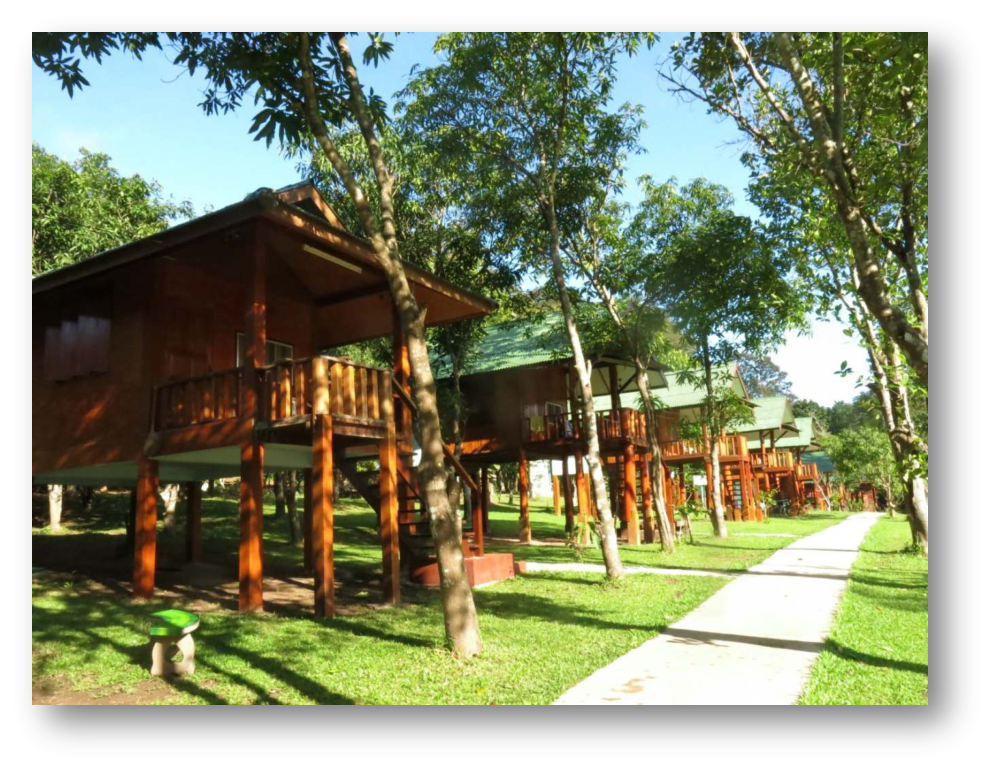
phenomena are provided to the lay communities by Thai-English speaking monks.
这些内容由通晓泰语与英语的僧侣提供给在家信众团体。
We provide fully accommodation such a single kuties, dormitories, two vegetarian meals per day with tea, coffee, juice or milk in place of dinner. Staying at Wat Tam Wua is free of charge to all public who seek practices of spirituality, however, the sacred grounds must not be viewed as hotels or resorts. Participants are asked to be discipline in their practice, to follow the daily schedule, to keep their area tidy and clean.
我们提供完善的住宿安排,例如单人库提(kuti)、宿舍等;每日供应两餐素食,晚间以茶、咖啡、果汁或牛奶替代晚餐。凡欲修习心灵/灵性修持者,皆可免费入住 Wat Tam Wua;但寺院清净圣地不得被视为旅馆或度假村。参与者须在修行中严守纪律,遵循每日作息,并保持个人区域整洁清净。
. Row of single Kuti(es) for Ladies behind the mountain.
(图示)山后为女性住众设置的一排单人库提(kuti)。
Page 163
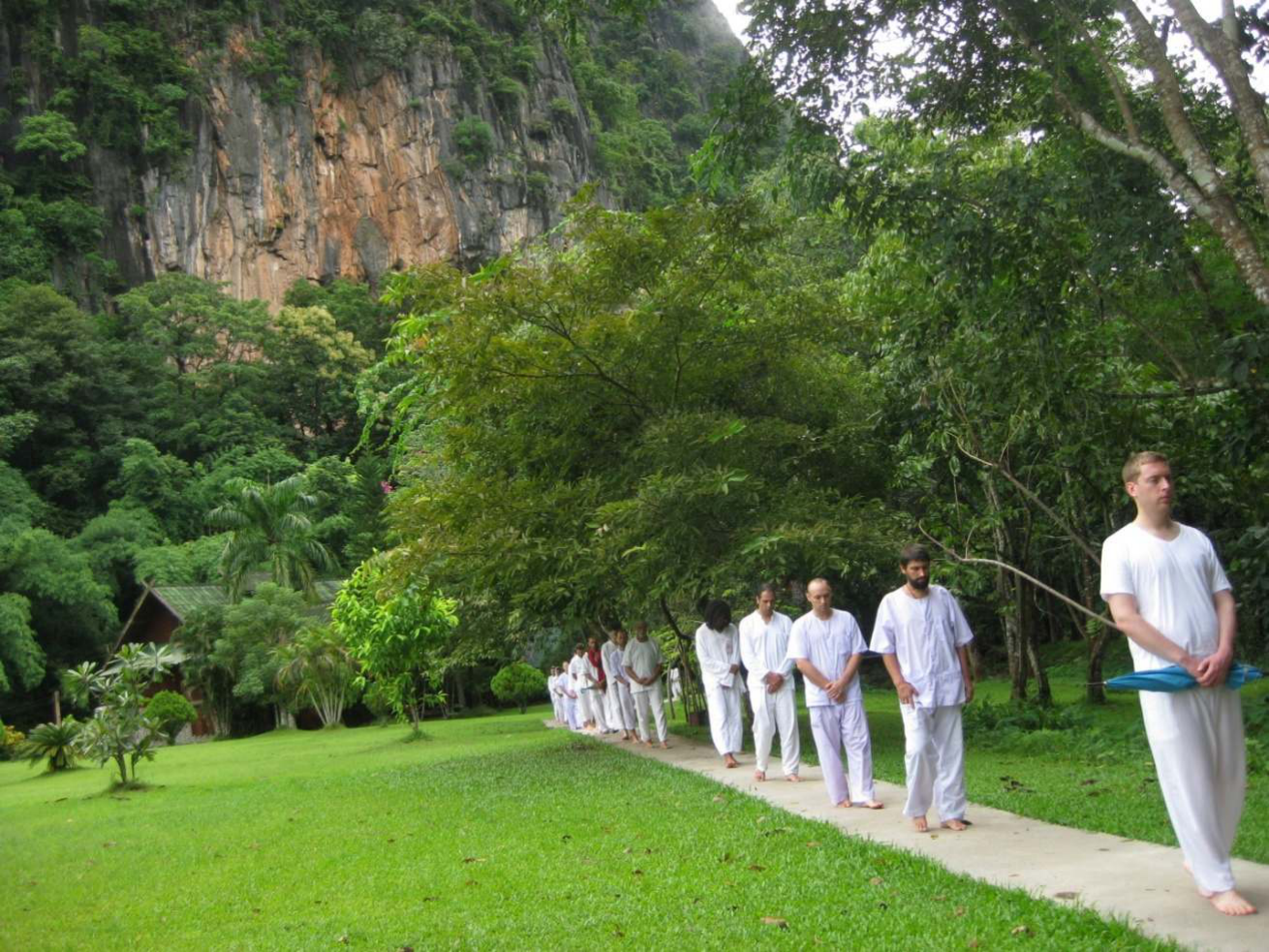
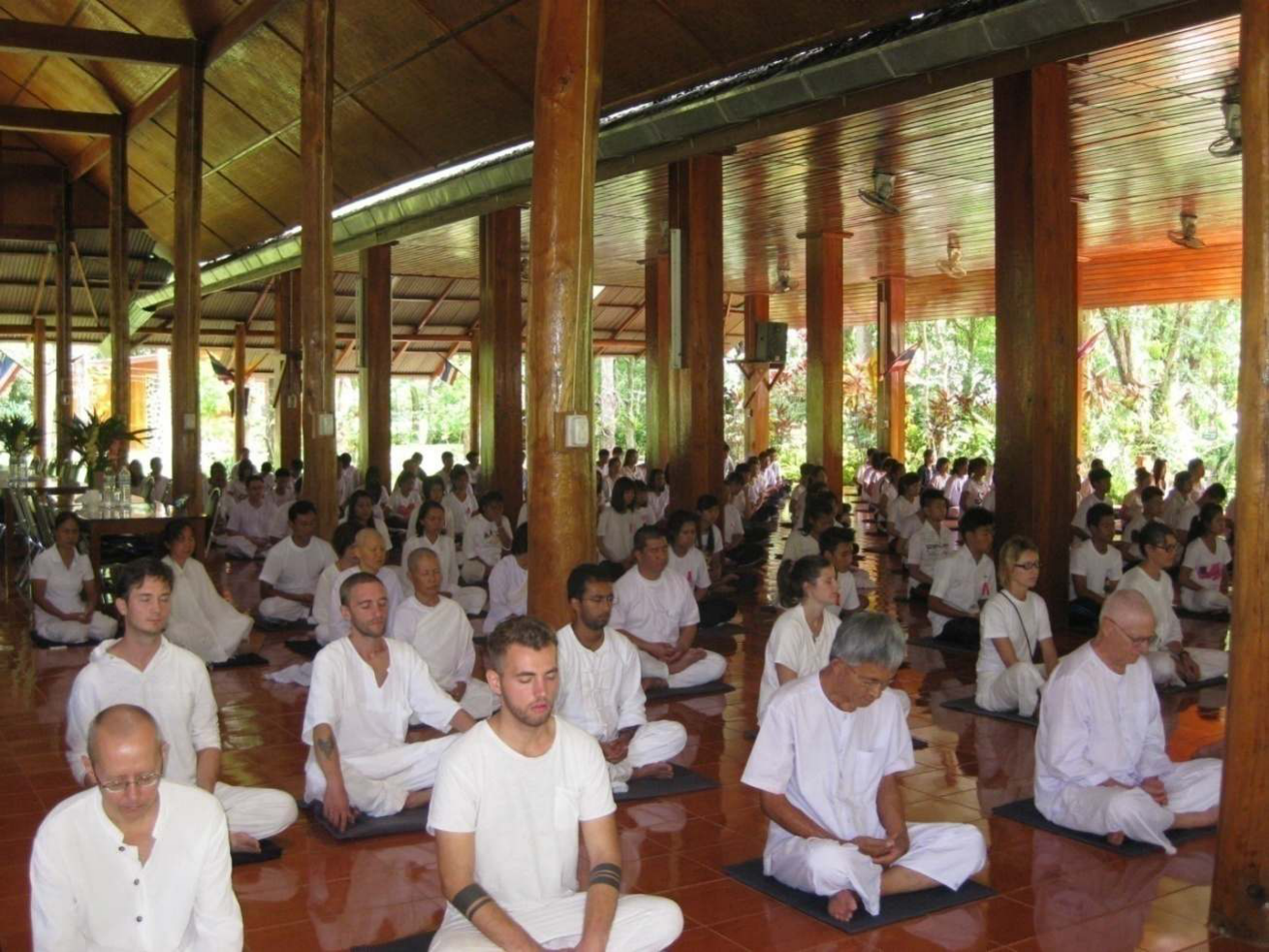
154
154
Page 164
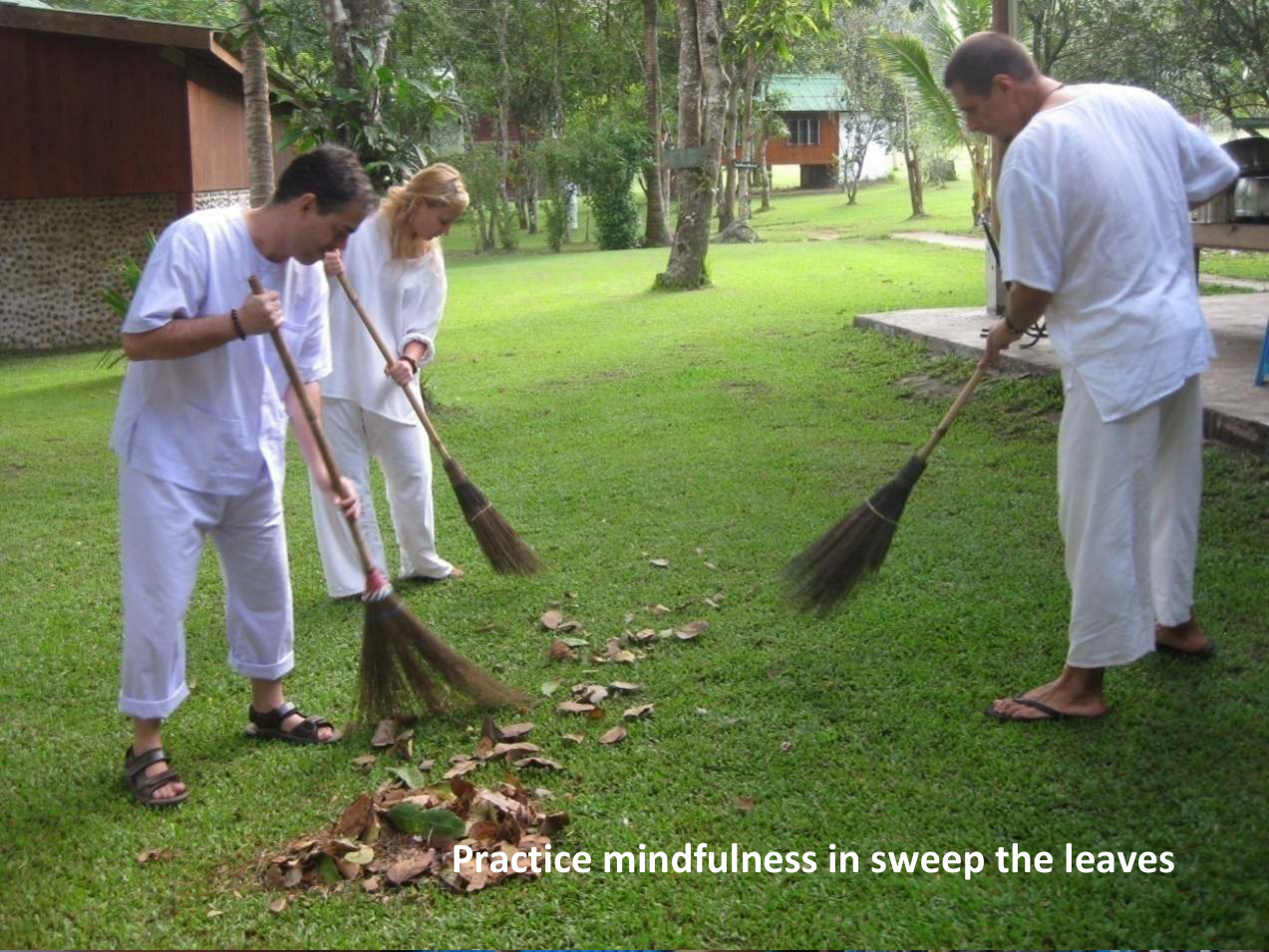
155
155
Practice mindfulness in sweep the leaves
在清扫落叶时练习正念
our library
我们的图书馆
Page 165
Contact us:
联系我们:
Wat Pa Tam Wua Forest Monastery Ban Mae Suya , Huay Pha, Mae Hong Son, 58000 Thailand Tel. +66(8) 1031 3326, +66(8) 7982 1168
帕塔姆瓦森林寺(Wat Pa Tam Wua Forest Monastery) Ban Mae Suya,Huay Pha,Mae Hong Son,58000 泰国 电话:+66(8) 1031 3326,+66(8) 7982 1168
Page 166
How to come here?
如何前来此处?
From Bangkok:
从曼谷出发:
By bus : " SOMBAT TOUR" Bangkok-Mae Hong Son Tel : 02-792-1444, 02-537-8333
乘巴士:“SOMBAT TOUR”曼谷—湄宏顺 电话:02-792-1444,02-537-8333
By Air Plane from Bangkok - Chiengmai : Nok air, Thai airways International , Karn Air,Thai lion Air
乘飞机从曼谷至清迈:皇雀航空、泰国国际航空 国际航空、坎航空、泰狮航空
By Air plane from chiengmai - Mae Hong Son : Karn Air,Nok Air
乘飞机从清迈至湄宏顺:Karn Air、Nok Air(皇雀航空)
From Mae Hong Son Bus station to Wat Tam Wua
从湄宏顺汽车站前往 Wat Tam Wua
: Prempracha Transport co., Ltd Tel 053-492999
:普林帕差运输有限公司 电话:053-492999
-------------------------------------------------------------
-------------------------------------------------------------
Page 167
158
158
REFERENCE WORKS IN THAI
泰文参考书目
1. หลักธรรมอยู่เป็นหัวใจของพระพุทธศาสนา. อ. วิทย์ อินทสระ
1.《หลักธรรมอยู่เป็นหัวใจของพระพุทธศาสนา》(法义乃佛教之核心):อ. วิทย์ อินทสระ 著
2. พระพุทธเจ้าทรงสอนอะไร. สมเด็จพระญาณสังวร สมเด็จพระสังฆราช สกล สังฆปรินายก
2.《พระพุทธเจ้าทรงสอนอะไร》(佛陀教导了什么):สมเด็จพระญาณสังวร(僧王,最高僧伽领袖)著
3. แก่นพุทธธรรม: สุวัฒน์ จันทร์อำนง
3.《แก่นพุทธธรรม》(佛法要义):สุวัฒน์ จันทร์อำนง 著
4. พจนานุกรมพุทธศาสตร์ ฉบับประมวลธรรม: พระพรหมคุณาภรณ์ (ป.อ.ปยุตโต)
4.《พจนานุกรมพุทธศาสตร์ ฉบับประมวลธรรม》(《佛教辞典·法义汇编本》):พระพรหมคุณาภรณ์(ป.อ.ปยุตโต,P.A. Payutto)著
5. ปฐมสมโพธิกถา: พระนิพนธ์ของสมเด็จพระมหาสมณเจ้า กรมพระปรมานุชิต ชิโนรส
5.《ปฐมสมโพธิกถา》(《本生正觉史》):สมเด็จพระมหาสมณเจ้า กรมพระปรมานุชิต ชิโนรส 御著
REFERENCE WORKS IN ENGLISH
英文参考书目
1. BUDDHISM PLAIN AND SIMPLE : The Practice of Being Aware, Right Now, Every Day : Steve Hagen
1.《朴素而简单的佛教:当下、日日的觉知修习》:史蒂夫·哈根著
2. ANAPANASATI BHAVANA: BUDDHASA BHIKKHU
2.《安般念修习》:佛使比丘著
3.VIMUTTIDHAMMA : From Chakra to Dhammachakra: Piyadasshi Bhikku
3.《解脱法:从“轮”到“法轮”》:毗耶达西比丘著
4.The Path to Enlightenment 1: Venerable Luangpor Pramote Pamojiio
4.《觉悟之道1》:龙婆帕莫特·帕莫吉尊者著
Page 168
159
159
5. NIBBANA : BUDDHADASA BHIKKHU
5. 涅槃:佛使比丘
6. TOWARDS TRUTH AND WISDOM: Ajahn Sumano Bhikkhu
6. 走向真实与智慧:阿姜苏马诺比丘
7.MINDFULNESS WITH BREATHING :A Manual for Serious Beginners : BUDDHADASA BHIKKHU
7. 随息正念:给认真初学者的手册: 佛使比丘
8.A Meditator's Guide : Venerable Luangpor Pramote Pamojo Teaches the Principles of Mindfulness and Meditation
8. 禅修者指南:隆波帕默尊者开示正念与禅修的原理
9. CONSIGNED BY LUANGPU : The teachings of Phra Rajvudhacariya ( Luang Pu Dulya Atulo )
9. 隆普遗教:帕拉·拉查乌达查利亚的教导 (隆普·杜利耶·阿杜罗)
------------------------------------
------------------------------------